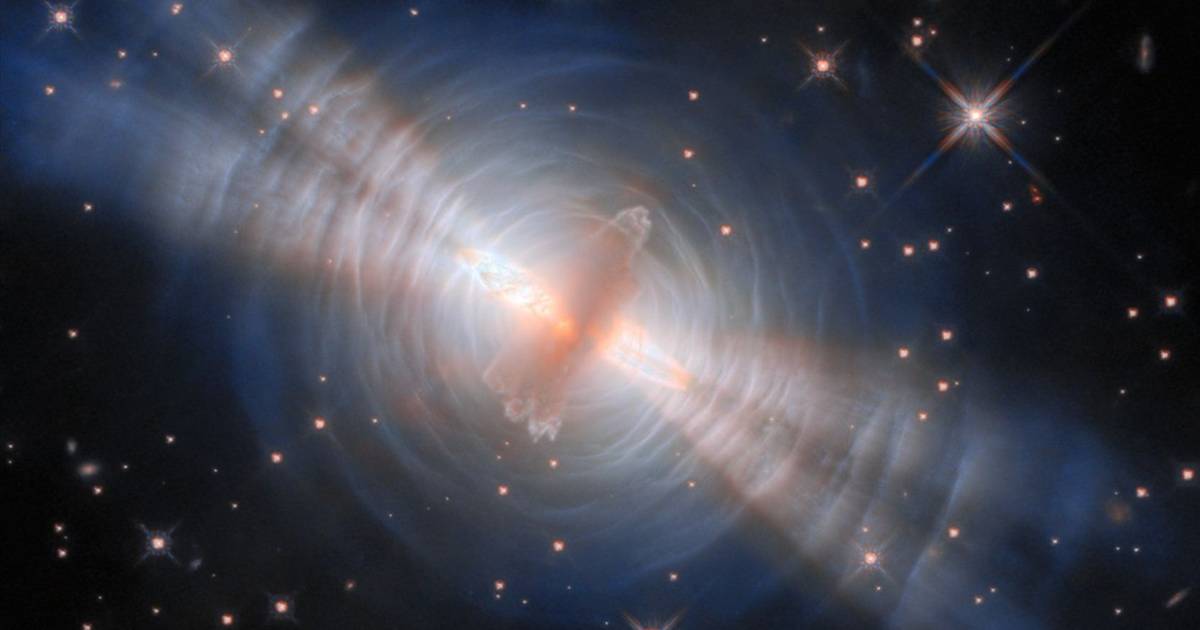
The Hubble Space Telescope has taken the sharpest and most detailed photo ever of the enigmatic Egg Nebula, revealing a dramatic dance of light and shadow around a dying star. Located approximately a thousand light-years from Earth in the constellation Cygnus, this celestial structure, officially known as CRL 2688, provides astronomers with a unique insight into the final stages of the life of stars similar to our Sun. In its center is a star hidden by a dense cloud of dust, like a “minuscule” inside an opaque “white egg”, and only Hubble’s sharpness can reveal the complex processes that shape this cosmic beauty.
Cosmic searchlights reveal the secrets of the past
The latest image, taken with Hubble’s Wide Field Camera 3 (WFC3), combines data from the visible and infrared spectrum to show incredible detail. Powerful beams of starlight emerge from the central, dense cloud of dust, breaking through holes in the mantle and acting like giant space reflectors. These light poles not only create a spectacular scene, butć and illuminate a series of concentric, thin arcs of gas and dust that surround the star. These rings, similar to the years on a tree, witnessed periodic ejections of material from the surface of the star that happened every few hundred years, thus offering an insight into its turbulent past. The infrared data, shown in orange shades, additionally reveal rapid outflows of hot molecular hydrogen emanating from the base of the light beams.
A rare insight into the short-lived phase of dying
The Egg Nebula is the first, closest and youngest pre-planetary nebula ever discovered, which makes it an extremely important object for the study of stellar evolution. This phase, which precedes the formation of a real planetary nebula, lasts very short in astronomical terms – only a few thousand years. This gives astronomers a rare, almost “forensic” opportunity to study ejection processes while the evidence is still fresh. Unlike more famous planetary nebulae such as the Helix or the Butterfly Nebula, the central star in the Egg Nebula is not yet hot enough to ionize the surrounding gas. This is why the whole structure does not shine with its own light, but it exclusively reflects the light of the hidden star, which is visible through the “polar openings” in the dusty disk.
The role of a hidden partner
The precise symmetrical patterns observed by Hubble are too ordered to be the result of a random supernova-like explosion. Scientists believe that the intricate shapes of the arcs and polar lobes point to a gravitational interaction with a hidden companion star. It is assumed that a binary star system is hidden inside the dense dusty disk, where the gravity of another, invisible body helps shape and direct the material ejected by the dying star.
Ingredients for creating new worlds
The material that stars like this eject into space is key to the cosmic cycle of life. The carbon-rich dust that forms this nebula will one day disperse and become the raw material, i.e. the “seed” for the formation of new star systems, planets, and even life. Our Sun system was formed in a similar way four and a half billion years ago. By continuously observing the Egg Nebula over a decade, comparing new images with older ones taken in the 1990s and 2000s, astronomers can follow the nebula’s evolution in real time. This enables them to perfect the model of how stars die and enrich the universe with the elements needed for the next generation of cosmic bodies.