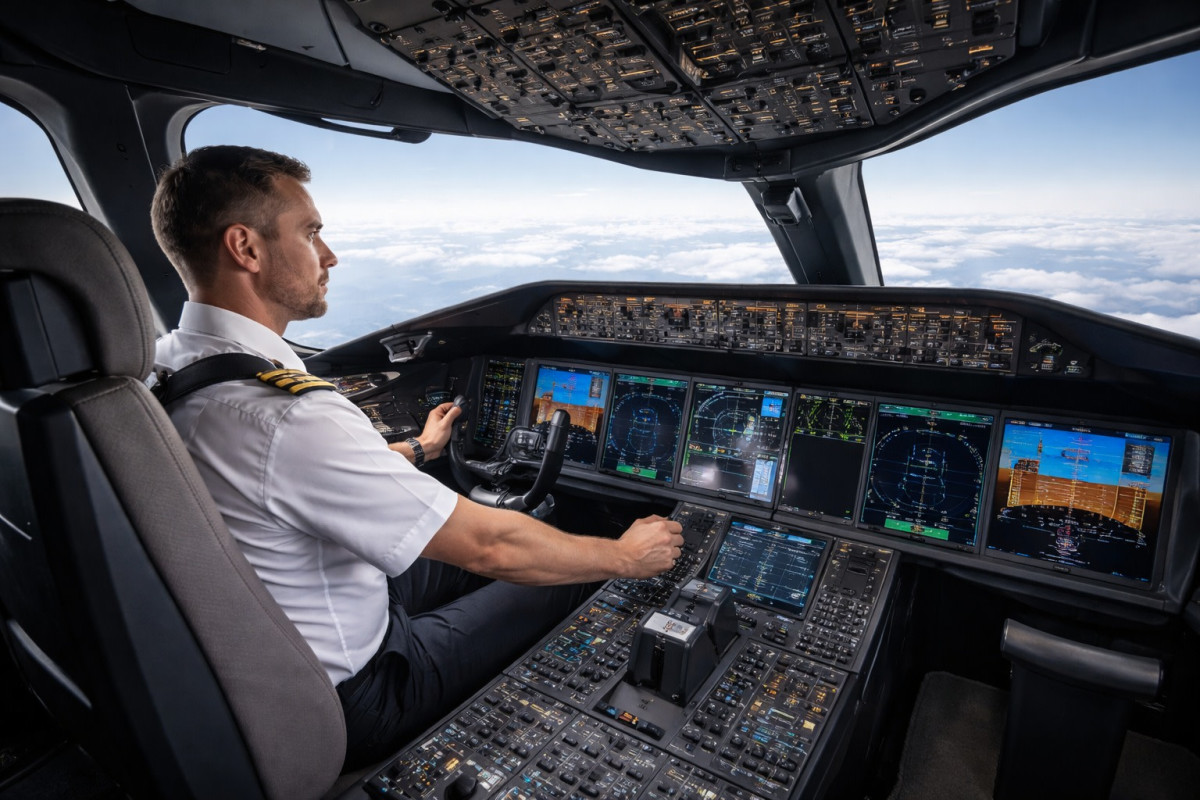
In the not-too-distant future, you may fly from Tel Aviv with only one pilot in the cockpit: a scenario that until recently sounded imaginary has become a practical proposal on the desks of regulators around the world in recent years. The idea is simple on the surface but far-reaching in its meaning, reducing the flight crew from two pilots to a single pilot during the cruise phase of long flights.
Those in favor of the move call it extended minimum crew operations, or eMCO for short. According to the model in question, the plane will take off and land with two pilots, but at cruising altitude, especially on intercontinental flights, one of them will go on an extended rest. The pilot left alone will continue to fly the plane, with advanced monitoring systems monitoring his alertness and physiological state.
Behind the scenes there is a clear economic motive: reports from international investment bodies estimate that potential savings of more than 15 billion dollars a year are inherent in the transition to a single pilot model in cruising. The savings result not only from reducing wages, but also from increasing the utilization of aircraft and reducing flight crew planning limitations. For companies facing a shortage of pilots and rising operating costs, this is a particularly tempting proposition.
The aircraft manufacturers are already investing in the development of the technological infrastructure. In recent years, Airbus introduced the Dragonfly project, which aims to enable the plane to identify emergency situations in which the pilot is not functioning, stabilize the flight and even make an automatic landing at a suitable airport. Boeing is investing in the development of advanced human-machine interfaces and systems that will help a single pilot deal with a higher task load.
The next step in the program, which will be tested in the EASA corridors, includes a model of a ground pilot. In case of an emergency, the pilot sitting in the control center will be able to remotely connect to the plane and assist in landing it. Here comes one of the most sensitive issues, cyber security. The possibility of hostile intrusion into remote control systems keeps security experts and countries facing security threats awake.
The pilots unions strongly oppose and run public campaigns under the slogan One is none. According to them, a commercial flight is a complex system in which two crew members perform constant cross-checking. In moments of crisis, they claim, it is precisely human dynamics, professional debate and mutual control that prevent disaster.
Industry sources mention cases in the past where one pilot experienced confusion, mental freeze or a sudden medical event, and the other pilot took over the flight. Although advanced automatic systems are able to maintain altitude and direction, managing complex faults, extreme weather or a security incident sometimes requires creative judgment and broad contextual understanding.
As of the beginning of 2026, some airlines are exploring the idea mainly on cargo flights, where there are no passengers. Cathay Pacific and Lufthansa are collaborating on operational trials to gain cumulative experience. However, many insurance companies are still reluctant and pile up difficulties on insuring passenger flights without immediate human backup in the cockpit.
In Israel, the Civil Aviation Authority follows developments carefully. Due to cyber threats, GPS jamming attempts and the unique security relationship, industry officials estimate that Israeli airports will be among the last to approve a single pilot model in cruise.
The deeper question goes beyond the issue of personnel. The industry believes that artificial intelligence does not get tired, does not suffer from heart attacks and is not distracted. The pilots mention that humans know how to identify subtle anomalies, change an intuitive decision and exercise complex judgment in unexpected conditions.
https://top-psychologist.com/sa/
https://top-psychologist.com/sa-uk/
https://top-psychologist.com/ph/
https://top-psychologist.com/ph-uk/
https://top-psychologist.com/id/
https://top-psychologist.com/id-uk/
https://top-psychologist.com/my/
https://top-psychologist.com/my-uk/
https://top-psychologist.com/ro/
https://top-psychologist.com/ro-uk/
https://top-psychologist.com/gr/
https://top-psychologist.com/gr-uk/
https://top-psychologist.com/lv/
https://top-psychologist.com/lv-uk/
https://top-psychologist.com/lt/
https://top-psychologist.com/lt-uk/
https://top-psychologist.com/rs/
https://top-psychologist.com/rs-uk/
https://top-psychologist.com/ar/
https://top-psychologist.com/ar-uk/
https://top-psychologist.com/me/
https://top-psychologist.com/me-uk/
https://top-psychologist.com/mx/
https://top-psychologist.com/mx-uk/
https://top-psychologist.com/eg/
https://top-psychologist.com/eg-uk/
https://top-psychologist.com/hr/
https://top-psychologist.com/hr-uk/