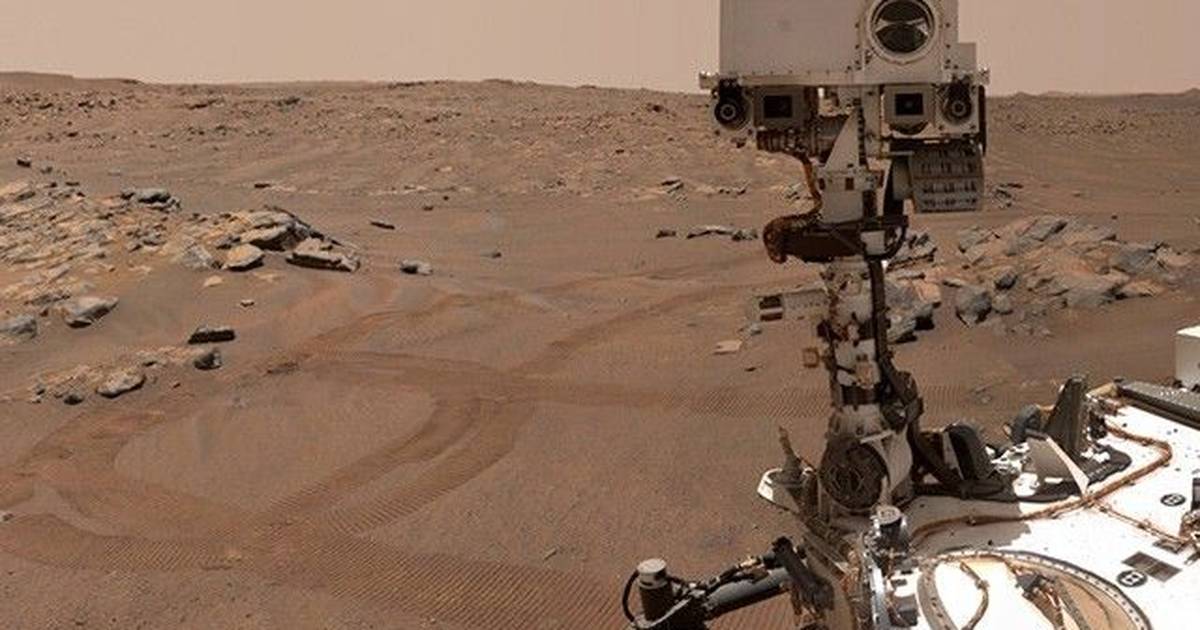
NASA has announced that Perseverance has received a new technology called ‘Mars Global Localization’ which enables it to independently find its exact position on the surface of Mars. This is a big deal because there are no GPS satellites on Mars, and the rovers rely on a combination of their own sensors and instructions from Earth to navigate, with a delay in communication. In practice, this means that until now, it was often necessary to wait for confirmation of the location before the rover continued, especially when moving on more demanding terrain.
So far, Perseverance has mainly used ‘visual odometry’, that is, following the details on the recordings and calculating how much it has moved, along with evaluating wheel slip. The problem is that small mistakes add up over time, so the rover can become less confident about where it is, which then limits how far it can dare to drive autonomously in a day. NASA explains in the announcement that the rover knew where it was “roughly” until now, but it čoften needed helpć people on Earth.
The new system works so that after stopping, the rover captures 360 degrees of the environment with its navigation cameras and then quickly compares these panoramic images with the orbital maps of the terrain it has stored. With this, he can recognize “where he is on the map” and continue according to plan without waiting for people to confirm his position afterwards. NASA states that Perseverance successfully used this method for the first time on February 2, 2026, and the goal is to make this kind of self-location part of regular missions.
NASA points out an interesting behind-the-scenes detail: the calculation for this type of image and map comparison requires more power than the rover’s main computer normally provides, so the whole story was helped by the hardware that Perseverance carried because of the Ingenuity helicopter that is no longer in use, that is, an additional computer module. So, the rover can now plan and conduct autonomous drives faster and more safely, which ultimately means more terrain covered and more scientific work at the same time.
https://www.youtube.com/redirect?q=https://www.raylyst.eu/
https://pinco-canada.net/fr-ca/pinco-hell-hot-100/
https://docs.juze-cr.de/s/kI9Zvw7Pq
https://vortexgame-argentina.com/bonificaciones/
https://gi2030.eus/profiles/farmaciaenmalaga/following
https://posteezy.com/prazise-wie-man-den-richtigen-solar-werkzeug-handler-europa-auswahlt
https://www.pinterest.com/pin/1133992381200173454
https://pinco-canada.net/fr-ca/programme-affiliation/
https://md.picasoft.net/s/GOgIx0f_W
https://notes.status.im/s/a4Ju3pdw9
https://broken-pads.zapf.in/s/3L-XQB6DY
https://test.najaed.com/user/onionflesh35
https://penalty.in.net/withdrawal/
https://classifieds.ocala-news.com/author/washbell8
https://pinco-ca.net/fr-ca/politique-sur-les-temoins/
https://hack.allmende.io/s/2UJk1tToy
https://es.pinterest.com/pin/1133992381200173092
https://md.chaospott.de/s/i4gtQTD1Zr
https://six6xbd.com/verification/
https://pad.leinelab.org/s/ORbfXHRV-s
https://md.ctdo.de/s/4J3Ryqgq-n
http://megapari-egypt.org/mma/
https://pad.flipdot.org/s/XRTWsgQT-
https://1xbet-costarika.com/bonos/
https://hedgedoc.ctf.mcgill.ca/s/vEt_7lFJ6