Jobs in the technology sector in 2026 are predicted to be differentiated when AI and robots appear in practice, competing directly with humans.
Theo Rest of Worldthe tech job market is being built “on contradictions,” with many businesses laying off employees on the grounds that AI will do more with fewer resources. However, most of these companies have not found a way to effectively deploy AI on a large scale.
Experts assess that low-level human resources will gradually be eliminated, but important positions will still be difficult to recruit. As automation increases, the reality is more complex: hybrid working remains a major obstacle, job titles branch, and workers are required to produce more output.
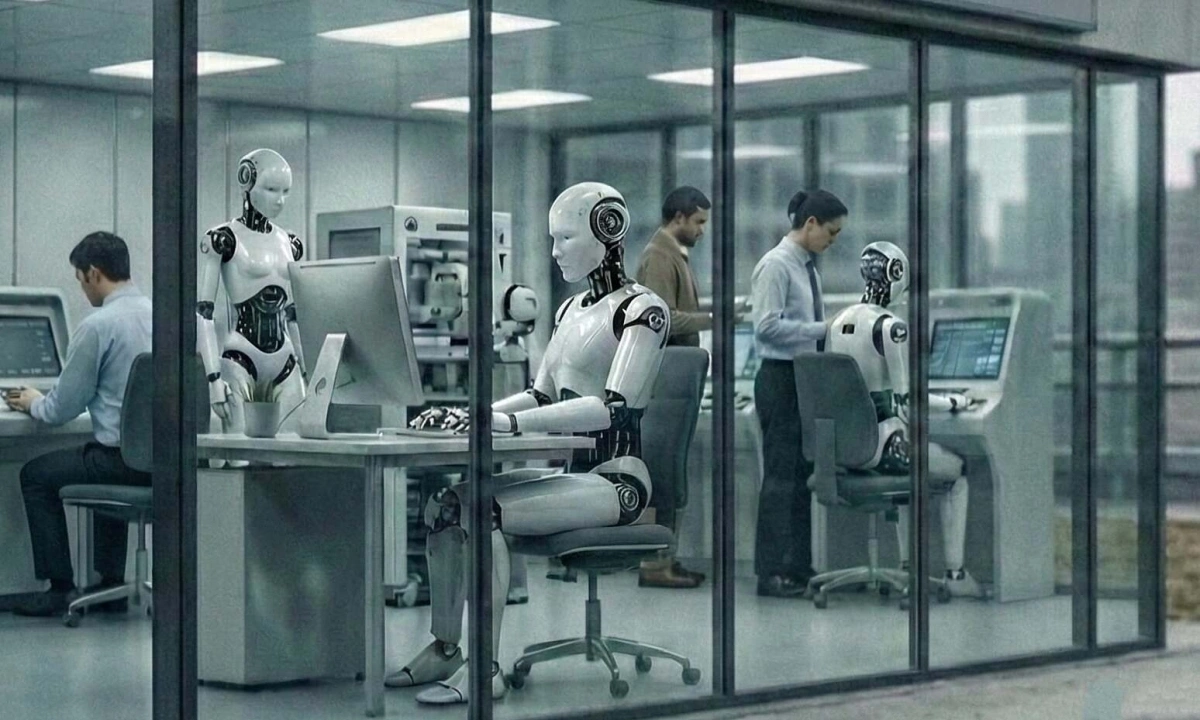
Illustration of a working environment mixed between humans and AI. Image: ChatGPT
AI agents “fight” humans
According to Deloitte’s emerging technology trends end-2025 study, 30% of organizations surveyed are exploring AI agents for work, 38% have begun early-stage testing, and 14% are ready to deploy.
According to Gartner’s prediction, by 2028, 15% of daily work decisions will be made automatically by AI agents, up from 0% in 2024. Meanwhile, 33% of enterprise software applications will integrate AI agents, up from less than 1% in 2025.
While most workers feel comfortable with traditional robots, which operate according to rules and are easy to predict, artificial intelligence systems can learn and adapt on their own. This brings new uncertainties, especially the fear of losing jobs when AI is integrated into humanoid robots – a field that has grown strongly since last year and is predicted to explode in 2026.
However, Deloitte’s research also shows that only 11% of businesses actively use these systems in production environments, 42% are developing a strategic roadmap for agents, and 35% have absolutely no specific strategy.
The cause comes from three basic infrastructure obstacles. In particular, integrating new technology into the old system is still difficult, because it is not designed for interaction with agents, thereby creating a processing bottleneck. Traditional data architectures that build on extract-transform processes also hinder agent deployment. Finally, the governance and control framework is limited, as businesses face limitations in establishing appropriate monitoring mechanisms for automated operating systems.
Deloitte predicts that this year, most technology jobs will evolve toward collaboration, creating environments where agents take on repetitive or dangerous tasks, while humans focus on creative problem solving and complex decision-making.
Research firm Korn Ferry also estimates that 2026 will be the year low-level human resources are eliminated to be replaced by AI agents. Although it helps save budget and increase efficiency in the short term, this can be a source of human resources crisis in the future.
“It would be a mistake to stop recruiting young, new people. They are the fastest to absorb new technology,” Korn Ferry analyst David Ellis said on the blog. “If you no longer own this generation and your competitors do the opposite, in the next 3-5 years, your competitors will be faster, more flexible and ready to seize new opportunities.”
Technology businesses have more “headaches” with regulations
After the pandemic, the remote working model became popular. Korn Ferry’s 2025 workforce survey shows that nearly three-quarters of employees want to choose hybrid or remote work. Many people emphasized “not giving in” and were ready to quit their jobs if required to be present full-time in the office.
Meanwhile, 52% of employers said the in-office policy hinders the recruitment process, while 72% find it easier to recruit employees to work remotely. The results were given after surveying 230 experts and consultants, 1,600 leaders from different fields and countries.
“If the company’s values are strong enough, say the business is large or pays well, you can impose requirements in the workplace,” Ellis explains. “But most organizations in 2026 will need to adjust their policies to match the expectations of the talent they want to attract, or worse, accept filling vacancies with whoever is willing to work instead of choosing good people.”
New titles appear thanks to AI
According to technology recruitment platform Built In, the highlight when businesses look for personnel this year is the appearance of new titles, accompanied by more sophisticated skill requirements. Generic positions like “software engineer” and “data scientist” will appear less frequently. In the AI and data segment, there are new titles such as “Prompt Engineer” specializing in designing and refining input factors to optimize output for LLM; AI solution architects help design the overall architecture to integrate AI into existing business systems; or AI Coach helps train AI systems and provides detailed instructions on how to apply them to businesses.
In AI governance, ethics and security, there will be a number of new roles such as Chief AI Ethics Officer to help ensure artificial intelligence is developed and deployed responsibly and transparently; AI compliance management helps monitor compliance with global regulations and standards when using AI and data security; or DevSecOps Engineer whose role is to integrate security protocols directly into the AI development lifecycle from the ground up.
In addition, there will be specialized positions, for example Quantum Computing Scientist in researching and applying quantum computing models to solve problems beyond the capabilities of classical computing; Edge computing engineers focus on processing data at the “edge” of the network to reduce latency, especially for IoT devices; or Metaverse developers create immersive virtual environments and experiences using 3D and spatial computing.
“The technology field is changing drastically as AI dominates everything,” Built In commented. “Specialists will be given priority in recruitment. People with general knowledge will have to adjust direction when new job titles appear. If 2025 is the year of restructuring, 2026 will be the year of resonance.”
Bao Lam synthetic
- Salaries of IT industry personnel continue to increase
- AI threatens 200,000 European banking jobs
- How AI affects the wave of technology layoffs
- ‘Eye-strained’ looking for general engineer for strategic technology
- Thirst for AI Vietnamese human resources
https://www.slideshare.net/juliarodyk13?tab=about
https://hashnode.com/@marylady
https://www.pampling.com/comunidad/blog-de-usuarios/48367-La-viejecita
https://www.thuum.org/viewthread.php?page=1&thread=33114newpost=true#107586
https://ecency.com/undefined/@lobbont/re-crypto-gamer-2026113t14192051z
https://www.portalnet.cl/usuarios/8k8-casino.1148265/#profile-post-1421477
https://es.yummypets.com/mag/2018/06/22/117654/conoce-6-signos-indican-gato-se-aburre
https://bonussenza.blogspot.com/2026/02/bonus-senza-deposito-guida-completa-ai.html
https://senzadocumenti.wordpress.com/2026/02/19/bonus-senza-deposito-2026-la-guida-definitiva-per-vincere-subito-nei-migliori-casino-italiani/
https://slotbonussenza.flazio.site/
https://bonussenza.teampages.com/teams/2025782-Bonus-Senza-company-team-website/pages/195111
https://slotbonussenza.weebly.com/
https://bonussenza.mystrikingly.com/
https://sites.google.com/view/bonussenza/home
https://bonussenza.hotglue.me/
https://slotsenza.teamapp.com/clubs/941203/articles/9578367-bonus-senza-deposito-la-guida-completa-ai-migliori-casino-italiani-del-2026?_detail=v1&_expires_at=1775001599
https://nostalgic-griffin-a93.notion.site/Bonus-Senza-Deposito-2026-La-Guida-Definitiva-per-Giocare-Gratis-nei-Migliori-Casin-Italiani-30cafcb6717080578b9ef9eedecb6bcf?source=copy_link
https://cookiecasinos.de/
https://cookiecasinoonline.de/
https://cookie-casino-online.de/