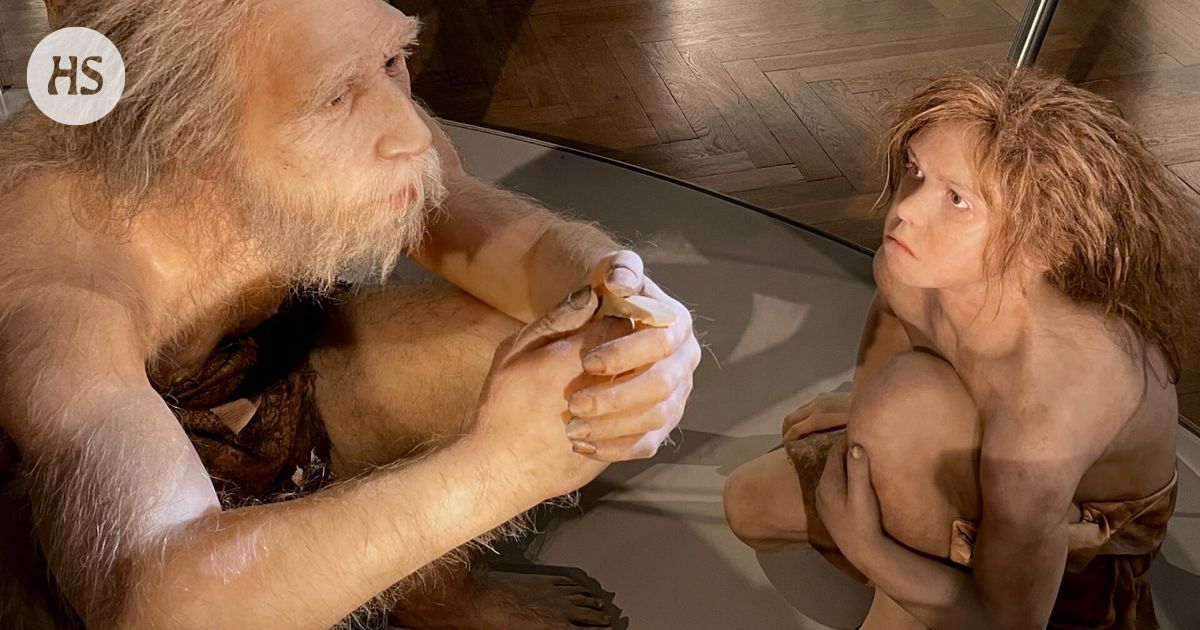
The human species|The continuation of the family was successful when a Neanderthal man and a modern human woman were involved.
According to a study by the University of Pennsylvania in the United States, Neanderthals and early modern humans had offspring with each other, most often in such a way that the child’s mother was a modern human and the father was a Neanderthal.
It explains why the genes of Neanderthals are so unevenly distributed in modern humans.
The researchers compared the genes of Neanderthals and the genes of sub-Saharan African populations and found a clear excess of the genes of modern humans in the X chromosomes of Neanderthals.
When Neanderthals and early modern humans had offspring with each other, the roles were mostly divided as follows: the child’s mother was a modern human and the father was a Neanderthal.
that appeared in Science magazine research according to this, this explains why the Neanderthal inheritance is so unevenly distributed in modern humans.
Modern humans still carry a bit of the Neanderthal heritage, but there are large areas of our DNA where there are particularly few sequences inherited from related species. Scientists call these gaps Neanderthal deserts.
“Neanderthal deserts” occur on several chromosomes, but they are most striking on the X chromosome.
American Researchers at the University of Pennsylvania weighed two explanations for the deserts.
Either the X chromosomes of the Neanderthals hindered the survival of modern humans in some way and natural selection eliminated them.
Or the early interbreeding mainly took place between Neanderthal men and modern human women, in which case clearly less DNA from the X chromosome of Neanderthals ended up in the human gene pool.
At conception, the child always receives an X chromosome from the mother. A girl child gets an X chromosome from the father, but a boy gets a Y chromosome.
Research team weighed competing theories by looking at how much modern human DNA ended up in Neanderthals during an earlier phase of human-Neanderthal mixing.
They compared the DNA of the Neanderthals of that time and the DNA of sub-Saharan African populations, with no Neanderthal DNA mixed in.
The analysis revealed a clear relative excess of modern human inheritance on the Neanderthal X chromosomes.
This suggests that the continuation of the family succeeded mainly between Neanderthal men and modern human women.
The same has already been concluded by studying the mitochondrial DNA of cells, which is inherited only from the mother.
Neanderthals and modern humans encountered in the Middle East and Europe as modern humans spread north from Africa.
Neanderthals were the first in Europe. They disappeared no later than 30,000 years ago.