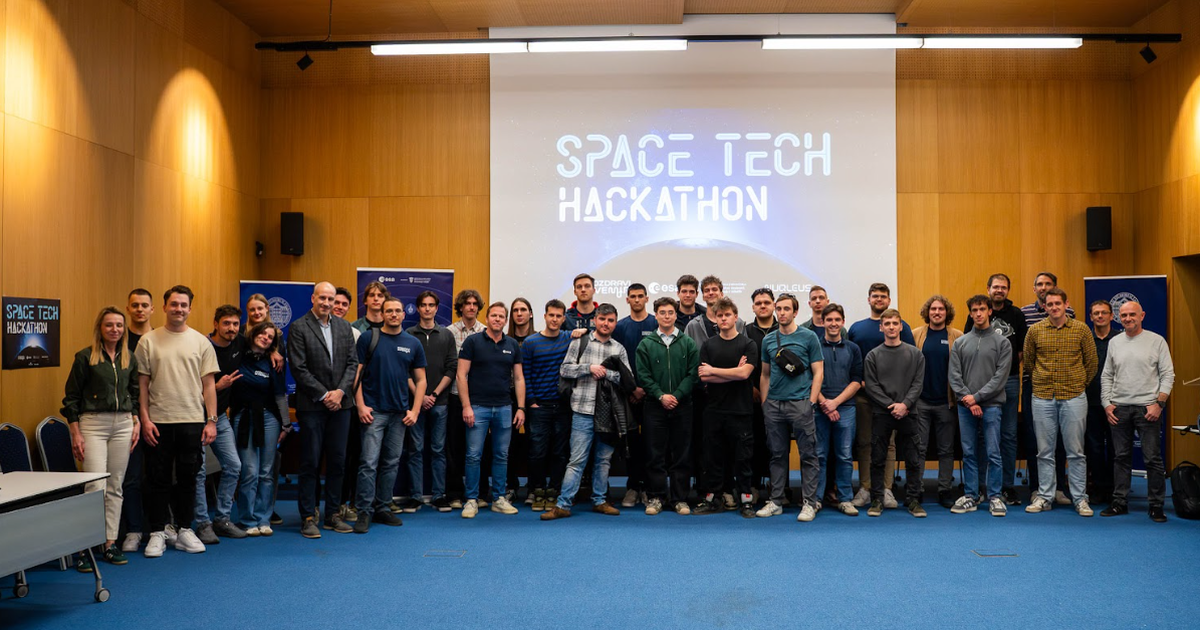
The first Space Tech Hackathon was held on the 6th and 7th of October and was organized as part of the “Salute to the Universe” project, with the support of the European Space Agency (ESA), the Ministry of Science, Education and Youth and Nuqleus.
Mentoring support to the participants was provided by experts in the field of space technologies, artificial intelligence and data analysis: Mario Brčić (FER), who was also the leader of the hackathon, Karol Brzostowski (ESA), Bruno Ćaleta (OIKON), Dragan Divjak (List Labs), Senko Rašić (Good code) and Matija Srbić (Nuqleus).
The pursuit of wild boars brought victory
The project “Where’s My Hog” won first place, a new prize of 2000 euros and professional support from ESA in developing the idea and submitting the project to their competitions. Riverč is about a solution that uses satellite data, artificial intelligence and drone footage to track wild boar migrations and assess damage to agricultural land.
Second place and a cash prize of 1,000 euros went to the “Urban Lungs” project, which, by analyzing satellite data, helps cities identify overheated and scorched urban areas without greenery and proposes measures for their restoration.
Third place and a prize of 500 euros was won by the project “Polis – City Planning Tool”, which uses artificial intelligence to simulate and predict the expansion of cities in order to help urban planners and city administrations in planning the development of infrastructure and space.
From space debris to smart city planning
The work took place through an intensive program that included the development of ideas, prototyping with the help of AI tools and the preparation of presentations that the teams presented at the end to the professional audience. A number of innovative projects have been developed that show how space technologies and satellite data can be applied in various areas – from urban planning and energy to tracking space debris, detecting the movement of wild animals, analyzing marine ecosystems and solving urban heat islands.
Support for the event was provided by the University of Zagreb, Srce – University Computing Center of the University of Zagreb, the advanced AI platform Lovable and GameBoost Energy, providing additional energy during the 24-hour competition.