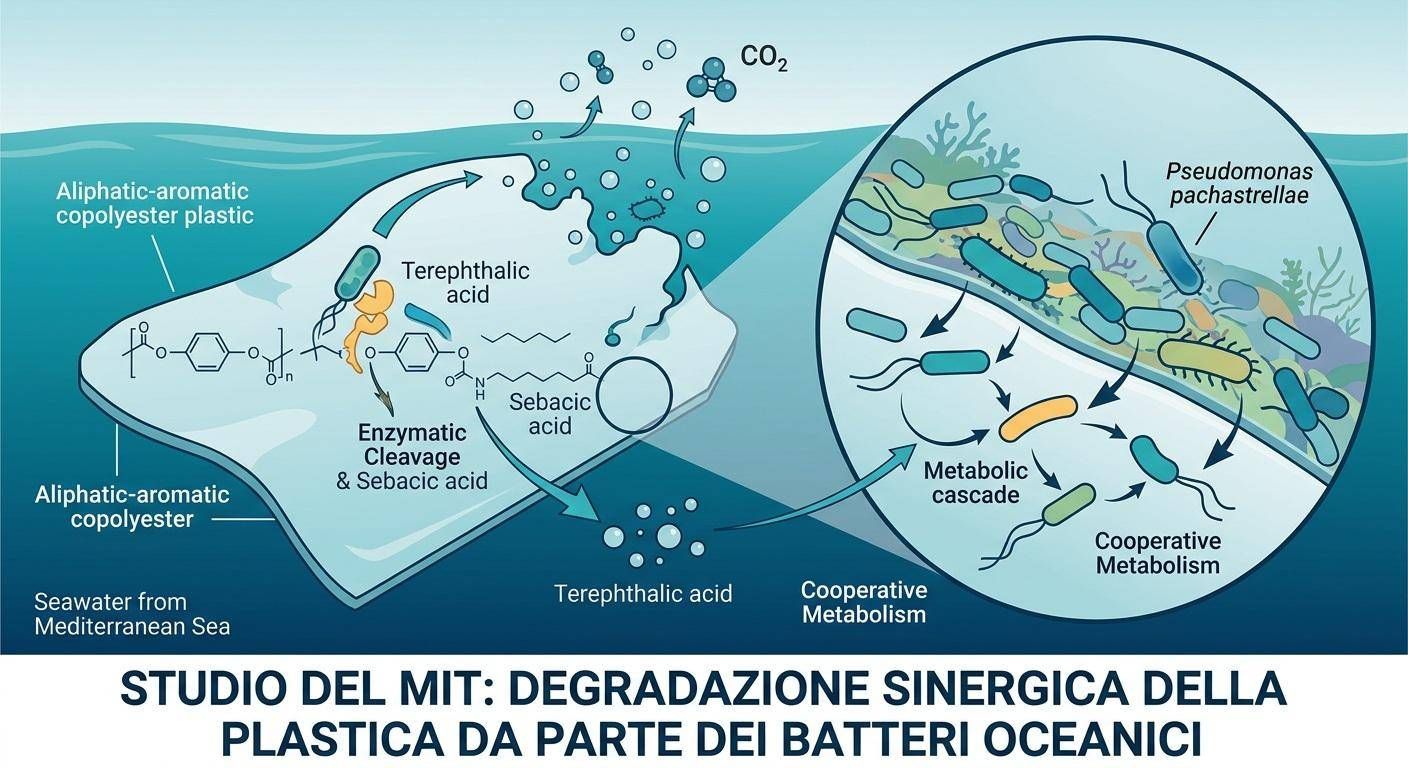
A study conducted by MIT researchers and published in the journal Environmental Science and Technology identified the biological mechanisms through which specific populations of marine bacteria collaborate to degrade biodegradable plastics. The research highlights how the decomposition process is not the work of a single organism, but the result of a complex synergy between different microbial species that operate in complementary phases.
The investigation examined an aliphatic aromatic copolyester, a material commonly used in food packaging and agriculture. Through samples taken at different depths in the Mediterranean Sea, the team isolated thirty bacterial species capable of proliferating on the surface of the polymer. The analysis revealed that only a particular bacterium, Pseudomonas pachastrellae, has the ability to split plastic into its three fundamental chemical components: terephthalic acid, sebacic acid and butanediol. However, the study shows that this microorganism is not capable of independently consuming all the by-products generated.
“It is very rare for a single bacterium to complete the entire degradation process because it requires a significant metabolic load to support all the necessary enzymatic functions“, explained Marc Foster, lead author of the study. Researchers have in fact demonstrated that it complements it mineralization of plastic occurs only when other bacterial species intervene to consume the individual chemical compounds resulting from the initial breakdown. By reducing the community to a select group of five species with complementary metabolic capabilities, the team achieved the same level of degradation observed in the original larger community.
The results highlight how the degradation rate of biodegradable materials is not an absolute value, but strictly depends on the microbial community present in the destination environment and on the specific chemistry of the polymer. “
There is much ambiguity about how long these materials actually persist in the environment
“said Foster, adding that “the biodegradation of plastic strongly depends on the microbial community in which the plastic ends up“. Understanding these dynamics is considered a fundamental step for the development of new microbial recycling systems capable of converting waste into useful resources and for more accurately predicting the life cycle of materials dispersed in the oceans.