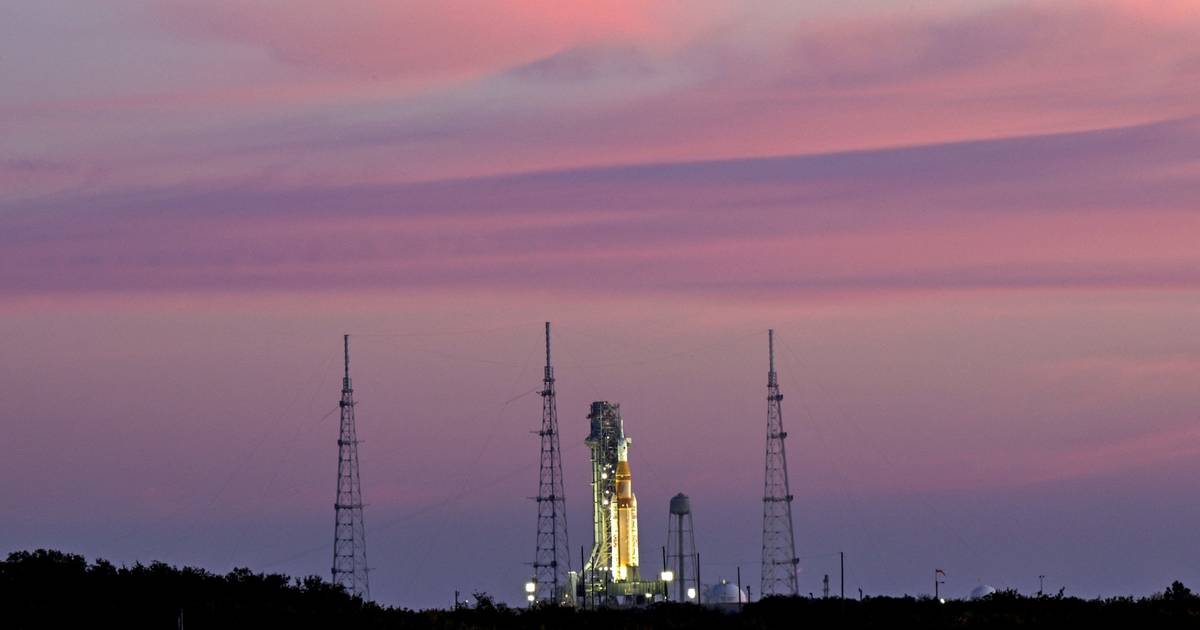
Next month, more On April 1, 2026, NASA will launch its Artemis II mission, officials announced last week, and take four astronauts into orbit around the Moon. At first glance, this may not sound too impressive, since Artemis is only repeating the circumlunar mission of Apollo 8 almost 60 years later.
When Apollo 8 took off, human beings had never seen the far side of the Moon with their own eyes, nor had they seen Earth from its satellite. But Artemis II, just like Apollo 8, is heralded as the forerunner of the human landing on the moon. And this time, the plan is to stay.
A rocket from the last century
The Apollo missions of the late 1960s and early 70s were extremely risky. Three astronauts died in the Apollo 1 capsule fire, and Apollo 13 barely made it back to Earth after an oxygen tank explosion. But the Cold War was in full swing, the space race had to be won, and President John Kennedy tried to turn America’s competition with the USSR into a glamorous point of national pride. Artemis aims to be all of these, but most of all it revives the “very risky” side of Apollo, using 50-year-old technology.
NASA was not allowed to design the Artemis spacecraft from scratch. Congress ordered it to use off-the-shelf technology developed for the Space Shuttle, including main engines and fuel tanks. Critics called the Artemis, SLS or Space Launch System rocket the “Senate Launch System” because it deliberately saved existing jobs for existing suppliers in politically important federal states. This approach is also being questioned due to budgetary pressures, as the White House has proposed cutting NASA’s budget by 25 percent and phasing out SLS and Orion after the third mission in favor of cheaper commercial alternatives.
Problems that are not solved
The Artemis II mission is delayed because it faced a series of serious technical problems, including difficulties with the life support system and a persistent hydrogen leak that recalled similar problems with the launch of the unmanned Artemis I mission in 2022. Č one would think that this has been resolved in the past three years, but it has not.
In late February, another blow came when a malfunction cut off the flow of helium to the rocket’s upper stage during testing. Helium is used to pressurize fuel tanks, and the problem forced NASA to return the nearly 100-meter-tall rocket to the Vehicle Assembly Building (VAB) for repairs, canceling its planned spring launch date. New NASA Administrator Jared Isaacman acknowledged the “glitch” but emphasized that early detection allowed for repairs without compromising safety.
Expert warnings and shocking risk assessments
Multiple delays lead to wider reserves towards mission security. Some former NASA engineers and astronauts have expressed concern, particularly about the capsule’s heat shield, which cracked dangerously during the Artemis I mission’s reentry into Earth’s atmosphere. Two veteran NASA scientists told ABC News that the unsolved problem could threaten the lives of astronauts. NASA decided to use the existing shield, but with a “less stressful” return path to secure the crew.
NASA’s own assessments acknowledge the elevated risks, and the Aviation Safety Advisory Board has called for a review of the Artemis architecture for future missions. NASA’s Office of the Inspector General estimated the overall risk of crew loss in the Artemis program at 1 in 30. As reported by Scientific American, mission manager John Honeycutt admitted that the probability of flight success was “slightly better than flipping a coin,” far from the desired 1 in 50 standard for mature programs. Some estimates go so far as to put the probability of mission failure at 1 in 2.
Considering that the mission faces such high risks, but also the lack of ability to rescue the crew in the later stages of the program, the pressure is growing. NASA has persisted with Artemis mainly to try to show that the old space program can still deliver as flashier commercial entities like SpaceX rush ahead. Cynics suggest that NASA will fly the mission several times, declare it a triumph, and then hire one of these companies to perform the moon landings instead. But previous NASA accidents resulted at least in part from political or programmatic launch pressures. We shouldn’t let Artemis II become another one of those.