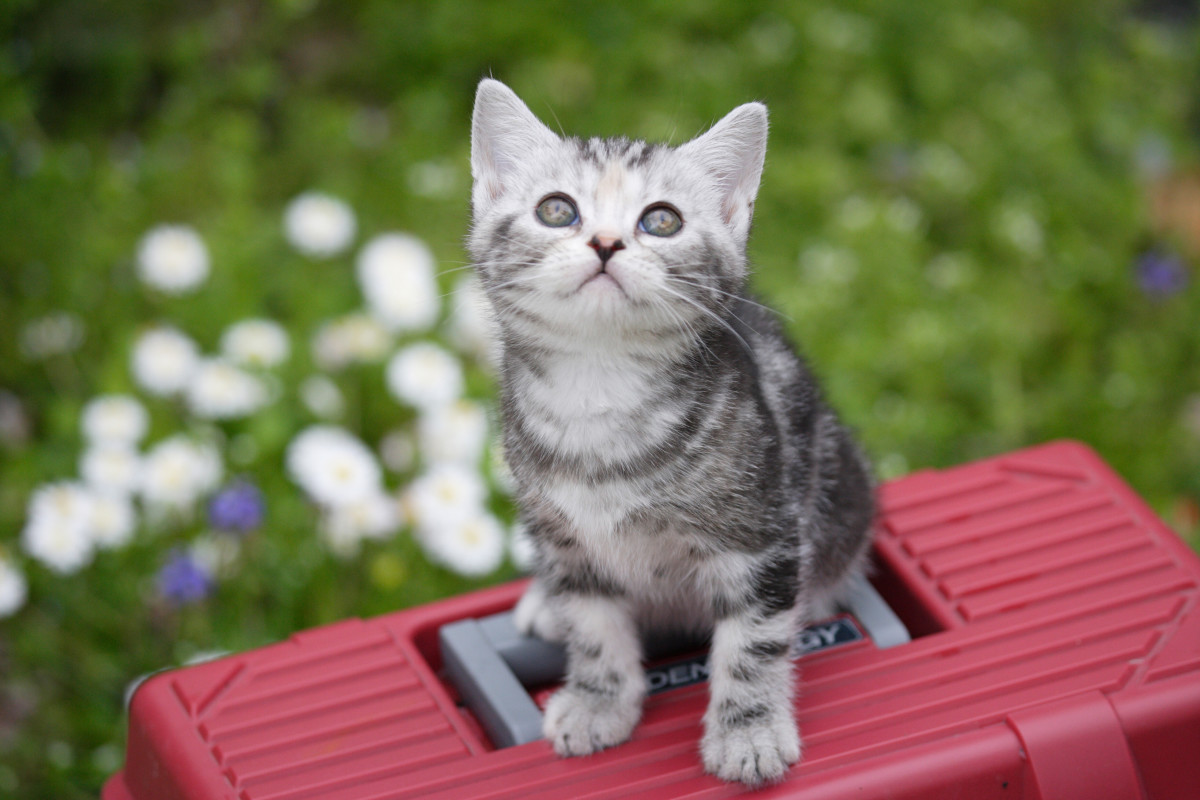
Cats are endowed with the “air-righting reflex”, a complex maneuver that allows them to turn their bodies during a fall to right themselves and land on their feet, thus avoiding serious injuries. This ability, which sometimes seems to defy the laws of physics because an object floating in the air should not be able to rotate around itself without external support, has troubled and intrigued scientists for many decades. Researchers from Yamaguchi University in Japan sought to deeply understand the mechanics behind this amazing ability and focused on analyzing the structure and flexibility of the feline spine.
In order to investigate this, the researchers performed a rigorous series of experiments, the first of which included a direct examination of the spines of five cats that died of natural causes or in veterinary clinics, in accordance with ethical guidelines. The scientists separated the thoracic part of the spine, which includes the ribs and the upper and middle back, and the lumbar part, which is the lower back. They applied measured and controlled twisting forces to each part with the help of dedicated devices, in order to measure the flexibility, strength and durability of the various links during rotational movement around the axis.
In the second phase of the study, the researchers used high-speed cameras to film two healthy, vital cats being gently released from a certain height and falling onto a soft, padded mattress. The cameras recorded every movement and change in the angle of the body at a very high rate. Special markers were placed on the cats’ bodies, mainly in the shoulder and hip area, which allowed the computer system to accurately track the movement of the various body parts during the fall. The careful analysis of the footage, conducted frame by frame, provided a rare glimpse into the dynamics of body movement in the air in real time.
The research findings revealed that the cat’s spine does not have uniform flexibility along its entire length. Instead, there are significant differences between the different regions that play separate roles when twisting in the air. The thoracic part of the spine was found to be the most flexible, having what the researchers called an extensive “neutral zone”. In this area, the spine can rotate almost completely freely, to an impressive angle of almost 50 degrees, with minimal energy investment.
On the other hand, the lumbar part of the spine was found to be much harder and it actually functions as a stabilizer. The biomechanical analysis showed that this stiffness does not allow a significant rotation in the back of the body, which raises initial puzzlement as to how the whole body manages to turn almost 180 degrees in such a short time.
When they combine the findings of the mechanical tests with the analysis of the high-speed motion pictures, the researchers formulated a model that explains the complex operation. It turned out that the rotation of the cat in the air is carried out serially, the cat first rotates its head and upper body, including the front legs, towards the ground, taking advantage of the enormous flexibility of the thoracic spine and the fact that this part is relatively lighter. The back of the body, including the hind legs and tail, rotates in the second phase.
The key to this lies in the rigid lumbar portion which serves as a sort of “solid anchor” for the rapidly rotating front portion, since the rear portion of the body provides high resistance to rotation, the front torso can “lean” on it to some extent as it completes its twist, thus preventing the entire body from spinning uncontrollably or flipping back. When the front part completes the rotation and is in a relatively horizontal position, the back part rotates after it, utilizing the torque created in the previous phase of the movement.
In their article, the researchers wrote that the results of the study indicate that the rotation of the body during straightening in the air is carried out serially, with the front body rotating first and only after that does the back body rotate. We also noted that the flexible thoracic spine part and the stiffer lumbar part in the twist angle are specially adapted to allow this behavior.
According to them, these findings not only provide an in-depth scientific explanation for an age-old biological mystery, but may have wider practical implications. An accurate understanding of the mode of movement may help, for example, in the development of more accurate mathematical models for animal movement in general, which will contribute to research in animal biomechanics and physiology. Also, this knowledge may help veterinarians better understand spinal injuries in cats and more accurately diagnose these injuries.
Moreover, the researchers note that the unique mechanism they discovered may contribute to technological developments in the field of robotics, in particular in the development of robots capable of more advanced navigation and maneuvering in the air or in complex areas. The possibility of producing robots that combine flexibility and variable stiffness in their spine, similar to the biological structure of cats, may lead to breakthroughs in the design of mobile, faster and more agile robots, which are able to deal with complex movement challenges in a better way.
https://hackmd.hub.yt/s/LVbU-ECUp
https://pastelink.net/ujq93ova
https://telegra.ph/Sur-les-traces-de-Bastogne–une-histoire-entre-m%C3%A9moire-et-r%C3%A9alit%C3%A9-03-18
https://ivebo.co.uk/read-blog/282201
https://network.musicdiffusion.com/read-blog/84881
https://gettr.com/post/p3ykobo9b7f
https://bresdel.com/blogs/1478117/Les-casinos-en-ligne-en-Belgique-un-march%C3%A9-en-pleine
https://www.molecularcloud.org/p/les-casinos-en-ligne-l-gaux-en-belgique-ce-qu-il-faut-savoir-en-2026
https://www.leenkup.com/read-blog/115569
https://connect.usama.dev/blogs/72101/Les-casinos-en-ligne-en-Belgique-entre-innovation-et-encadrement
https://www.twitch.tv/hudsonderrik/about
https://network.crcna.org/user/214725
https://www.facer.io/user/1r4GDZVWRR
https://findaspring.org/members/noeldunkan/
https://www.dibiz.com/gowaf62301
https://cal.com/max-lewis-mx0ok9
https://www.nintendo-master.com/profil/gowaf62301
https://mez.ink/korijohnson
https://www.diigo.com/profile/jekkky
https://micro.blog/yecal
https://www.passes.com/samuuel090
https://vrcmods.com/user/luchanikov
https://app.wedonthavetime.org/profile/gonewox911
https://devfolio.co/@EthanWard/readme-md
https://spoutible.com/KianHernandez