Google only needed to spend 650 million USD in 2014 and make Mark Zuckerberg “lose painfully” when acquiring DeepMind, a company ambitious to develop AGI super intelligence.
One day in June 2013, actress Talulah Riley rented a castle in Tarrytown, New York, to celebrate her husband, Elon Musk’s birthday. Riley was married and divorced twice with this billionaire, in 2010-2012 and 2013-2016.
“It was a pseudo-ancient American castle,” Demis Hassabis, winner of the 2024 Nobel Prize in Chemistry and co-founder of AI startup DeepMind, recounts in the upcoming book The Infinity Machine: Demis Hassabis, DeepMind and the Quest for Superintelligence (Infinite Machine: Demis Hassabis, DeepMind and the Quest for Superintelligence) written by journalist Sebastian Mallaby.
Musk was one of the first investors in DeepMind – a startup founded in 2010 and quickly attracted attention as it pursued the ambitious goal of artificial general intelligence (AGI). Years before OpenAI or Anthropic was born, Hassabis envisioned the “Manhattan project for superintelligence”, recruiting brilliant minds in the field and inventing a virtual assistant that could play various video games.
Larry Page, co-founder of Google, was also present at the party and offered to go for a walk with Hassabis. He spoke in a whisper due to the effects of a rare vocal cord disease, suggesting that the effort to build DeepMind “might be meaningless” without backing.
“Why don’t you take advantage of what I’ve created?”, Page said. At that time, Google acquired a number of artificial intelligence startups and continued to hunt for potential names in the field.
“He basically said I could build a company like Google, but that would take up most of my career,” Hassabis recalls. “But if the real mission is to achieve AGI, why don’t I use all the resources he has accumulated. I think the argument is quite convincing.”
Hassabis said he was “fed up” with having to rush around and try to raise funds for DeepMind – the company he called his “most important event”. “I would go to Google, buy a bunch of machines and then focus on solving the artificial intelligence problem,” he said.
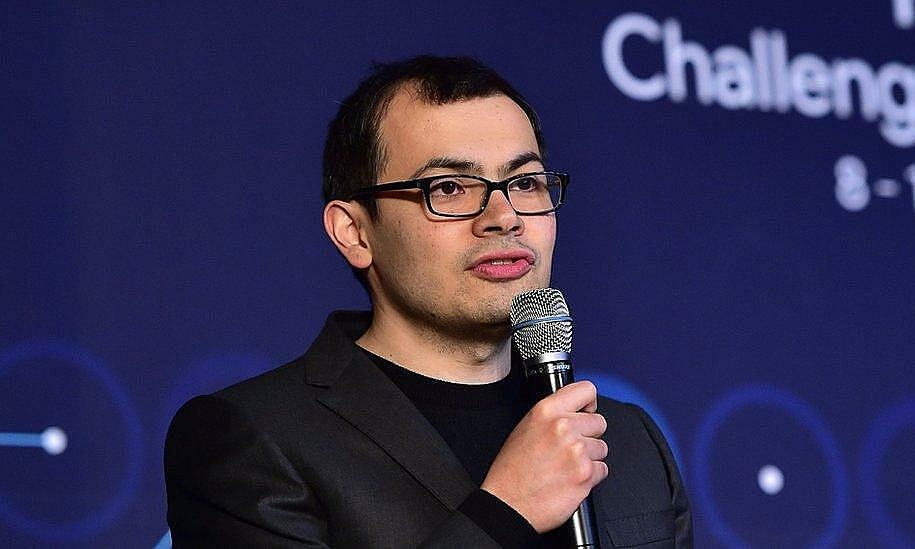
Hassabis presented at the AlphaGo promotional event in Seoul, South Korea in March 2016. Image: Reuters
In the fall of 2013, Hassabis and his co-founders flew to Google’s headquarters in Mountain View, California. To keep the secret, the two sides rented an office opposite. Google sent internal AI experts to evaluate DeepMind’s capabilities.
The DeepMind team demonstrates advances with Atari “agent” software. However, throughout the meeting, the price was not mentioned. “We thought, as soon as we mentioned money, they would think we were trying to take the money and run away with it,” said DeepMind co-founder Mustafa Suleyman.
Not mentioning the value of the deal, but Suleyman and Hassabis want to know the research budget that Google can provide as well as ensure safety when operating. If DeepMind is owned by Google, the two argued, the company should be protected by an independent oversight board of scientists, philosophers and other luminaries. They will have the final say on how AI is deployed into society.
“The basic idea is, we have to plan for success,” Suleyman explains. “In that scenario, we cannot let Google founders use AGI for their own purposes.”
To add more pressure, Suleyman mentioned a series of names that had invested, such as Peter Thiel, Solina Chau, Elon Musk – all billionaires at that time. Another company is also courting DeepMind: Facebook (Meta).
Facebook CEO Mark Zuckerberg at that time was said to have been very worried when a series of technology giants began creating their own artificial intelligence capabilities. Suleyman also met with Amin Zoufonoun, Facebook’s head of corporate development.
Through discussions, Zoufonoun proposed a solution that would help DeepMind’s founders be richer than if Google acquired them. If Facebook were to acquire it, it would price it lower than the company’s stock purchase price, but still pay a huge bonus to the founder and top associates.
However, money is not the main goal. Zoufonoun dismissed Suleyman’s talk about AI governance. Therefore, Suleyman and Hassabis think Facebook is indifferent to AI safety – something DeepMind focuses on.
Zoufonoun also informed Zuckerberg, emphasizing that DeepMind has a strong and exceptionally good team of AI experts. If you don’t buy it, it will all belong to Google.
When he learned that Hassabis had lunch with Page, Zuckerberg also invited him to his house for dinner. The two discussed the potential of AI and Zuckerberg appeared very excited. But then, Hassabis mentioned other popular technologies such as virtual reality, augmented reality, and 3D printing and found that the Facebook CEO was equally excited.
“It was a test, telling me what I needed to know,” Hassabis recalls. “Facebook offers a higher salary, but I want to find someone who really understands why artificial intelligence is important above all else.”
Then Hassabis turned back to Page: “Let’s go further.”
Rejected, Zuckerberg’s competitive instincts arose fiercely. He is said to have “frantically” recruited individual researchers. One of them is Yann LeCun, a pioneer of deep learning technology at New York University and also one of the founders of modern AI.
“What does it take for you to join Facebook?”, Zuckerberg asked LeCun.
Zuckerberg’s goal is quite clear: If he cannot buy DeepMind and have the company’s good staff, Facebook CEO wants a famous professor to gather AI experts for him. With almost limitless financial resources, this professor can recruit top scientists.
LeCun made a condition with Zuckerberg that he would not leave New York or give up his professor position. The next day, the head of Facebook accepted and the two signed a contract. In December 2013, Zuckerberg and LeCun announced the establishment of an AI laboratory in Manhattan.
Immediately afterward, LeCun called Koray Kavukcuoglu, a former student and key expert at DeepMind, offering him a generous salary if he came to Facebook. “That was the moment I thought DeepMind would fail if it was lured away from talent,” Suleyman said.
Hassabis quickly counterattacked. He told Kavukcuoglu that DeepMind was about to be acquired by Google, and urged Page to complete the deal.
DeepMind has no revenue. The company’s biggest “fortune” is its 30-40 excellent researchers and technology experts, not engineers. Don Harrison, Google’s head of negotiation, valued each person at about $10 million, but the two co-founders objected, wanting twice as much.
Hassabis also issued a series of conditions, such as remaining in London, limiting the use of DeepMind’s technology for evil purposes, banning use for military purposes, and establishing an ethics and safety review council to reduce Google’s power.
“The deal is not simply about price. It is about a structure that reduces control over an asset that we have invested a lot of money in,” he said.
At the end of January 2014, Google bought DeepMind for $650 million – a deal considered a “bargain” based on today’s standards.
After being owned by Google, DeepMind is still one of the largest artificial intelligence laboratories, famous for many breakthroughs in the field of AI, from developing the AlphaGo system to defeat the world’s top Go player, to the AlphaFold model that helps predict protein structure with high accuracy, opening up great potential in biomedicine. Over the past decade, the search for AGI super intelligence has also been assessed to be getting closer and closer.
https://tv5.zp.ua/shahovij-skandal-stolittja-vijnu-magnusa-ta-nimanna-ekranizuie-netflix/
https://dp.vgorode.ua/ukr/news/obschestvo/a1287780-sudnij-den-manchester-siti-ban-v-apl-shtrafi-ta-vidkhid-hvardioli
https://zp.vgorode.ua/ukr/news/obschestvo/a1287778-spekuljatsiji-navkolo-ostannoho-tantsju-messi-svitove-turne-chi-zaruchnik-apple
https://od.vgorode.ua/ukr/news/obschestvo/a1287781-mbappe-proti-pszh-sudovi-tjazhbi-z-parizhem-trivajut
https://e-news.su/536641-zrada-chi-neobhidnist-chomu-illja-kovtun-obminjav-prapor-ukrajini-na-horvatskij-pasport.html
https://www.freelancejob.ru/press/914/
https://tumba.kz/sport/15-sport/68987-kapitanynavigrozitdodvyhlettjyrmuvfinljandii.html
https://newshub.ge/en/news/society/how-virtual-reality-is-changing-the-game-for-modern-athletes
https://www.kremlinrus.ru/article/186/177899/
https://fc-arsenal.com/kak-sportivnye-platformy-primenyayut-ii-pri-analize-matchey
https://www.t.ks.ua/olimpiyske-naymanstvo-skandal-navkolo-14-mln-dlya-eylin-gu-nabiraie-obertiv-0#google_vignette
https://www.ukrinformer.com.ua/novaja-tehno-jera-formuly-1-horonit-avtosport/
https://porady.com.ua/kak-dostych-uspeha-v-zhyzny-dystsyplyna-vazhnee-vrozhdennoho-henyya/
https://nagpursatta.com/latest/the-power-of-delayed-gratification-in-achieving-major-life-goals/
https://apk-store.org/article/recovery-in-sports-how-it-becomes-the-most-important-part-of-training
https://regtv.kz/2026/03/27/ent-sportivnaya-analitika-v-czifrovuyu-epohu-kak-menyayutsya-privychki-bolelshhikov-v-czentralnoj-azii.html
https://www.banker.kz/news/analiticheskoe-myshlenie-i-risk-menedzhment-kak-si/
https://timeshealthmag.com/the-cognitive-science-of-sports-engagement-how-strategic-analysis-boosts-mental-wellness/
https://undrtone.com/KotilaakariIida
http://opensource.platon.org/forum/projects/viewtopic.php?p=12855929
https://doselect.com/@cc0e05b6d3343da5444a7817c
https://webyourself.eu/kotilaakarimarkusvepsalainen
https://l2top.co/forum/members/laakarikotiinemilialaine.162141/
https://www.grepmed.com/KotilaakariJariNiskanen
https://haveagood.holiday/users/486388