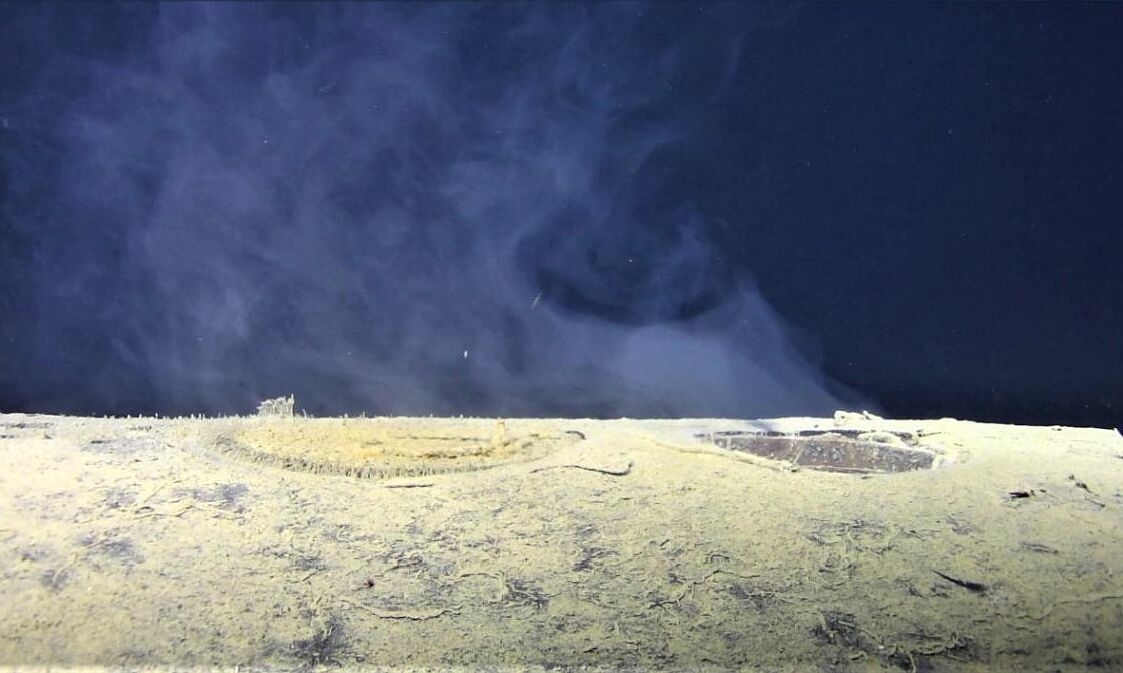
New research shows that the K-278 Komsomolets ship that sank 37 years ago is emitting radioactive material into the deep waters of the Norwegian seabed.
In 1989, the Soviet K-278 Komsomolets sank to a depth of 1,680 m after a fire, killing most of the crew. The ship carried a nuclear reactor to provide power and two nuclear torpedoes, raising concerns about environmental pollution.
Marine radiation ecologist Justin Gwynn from the Norwegian Radiation and Nuclear Safety Authority and colleagues analyzed data from a detailed survey of the wreck using the remotely operated vehicle AEgir6000 2019. Research results published in the journal PNAS on March 23, showed that the submarine was leaking radiation in waves.
Sonar image (hydroacoustic positioning technology) of the K-278 Komsomolets submarine on the bottom of the Norwegian sea, above is the AEgir6000 remote control vehicle. Image: Institute of Maritime Research/AEgir6000
The reactor is deteriorating, releasing visible plumes of radioactive material into the water. The reactor has been leaking for more than 30 years, the team said, but there is little evidence of radionuclide accumulation in the environment around the ship because the released radionuclides are quickly diluted in seawater.
The research team discovered that the leaking process was not continuous but occurred in irregular waves from a number of specific locations along the ship’s hull. Samples collected from the radioactive material plume showed that around the ship, strontium and cesium concentrations were 400,000 and 800,000 times higher than the average level in the Norwegian Sea. High concentrations of uranium and plutonium also indicate that the nuclear fuel inside the reactor is corroding.
However, a few meters away from the submarine, the level of radioactive pollution dropped sharply, meaning the radioactive isotopes quickly dispersed. Samples of sponges, corals, and anemones living on the wreck had slightly high cesium concentrations, but no other obvious signs of deformation or damage. The surrounding sediment also contained very few signs of contamination.
New research also shows that the torpedo compartment seals, made in 1994, are still intact. The team of scientists has also seen no signs of weapons-grade plutonium leaking into the environment.
Radioactive material leaking from the K-278 Komsomolets ship. Video: YouTube/Havforskningen
Sinking deep into the seabed and severely damaged, the K-278 Komsomolets will increasingly lose its structural strength over time. Therefore, the future of the ship is still worrying. The team believes that further investigations are needed to determine the mechanism behind the observed leaks, the corrosion process inside the reactor and its consequences, as well as the fate of the remaining nuclear material in the reactor.
According to Gwynn and his colleagues, K-278 Komsomolets offers a unique opportunity to understand the risks from other reactors sunk or abandoned in the Arctic, accidents involving nuclear-powered ships and other nuclear technology at sea. Therefore, they judged it extremely important to continue monitoring the ship’s condition.
https://sndct.app/guide-how-to-earn-tokens-in-sandbox-projects/
https://sndct.app/elsa-ai-guide-from-registration-to-airdrop/
https://sndct.app/syndicate-update-fewer-clicks-more-airdrops/
https://sndct.app/early-bird-campaign-your-first-step-into-the-syndicate-ecosystem/
https://sndct.app/syndicate-dev-update-airdrop-experience-improvements/
https://sndct.app/syndicate-teper-i-na-android-airdropi-dostupni-vsim/
https://www.socialmention.com/blog/pages/chicken-road-game-guide-at-stake-casino.html
https://www.mctb.org/wp-content/pgs/best-plinko-casino-sites-in-2026.html
https://lazosdeamormariano.net/modules/pages/?improve-your-limbo-game-strategy.html
https://tiemchupanh.com/pgs/limbo-game-risk-vs-reward-at-stake-casino.html
https://hashmiphotos.com/articles/free-plinko-demo.html
https://www.prestigevision.com/articles/?why-play-dice-game-at-stake-casino.html
https://walkindermatology.com/pages/play-plinko-demo-online.html
https://www.maxwaugh.com/articles/mines-game-tips-for-stake-casino.html
https://uvderm.com/pages/stake-plinko-strategy.html
https://soloscuola.com/pages/dice-game-rules-at-stake-casino.html