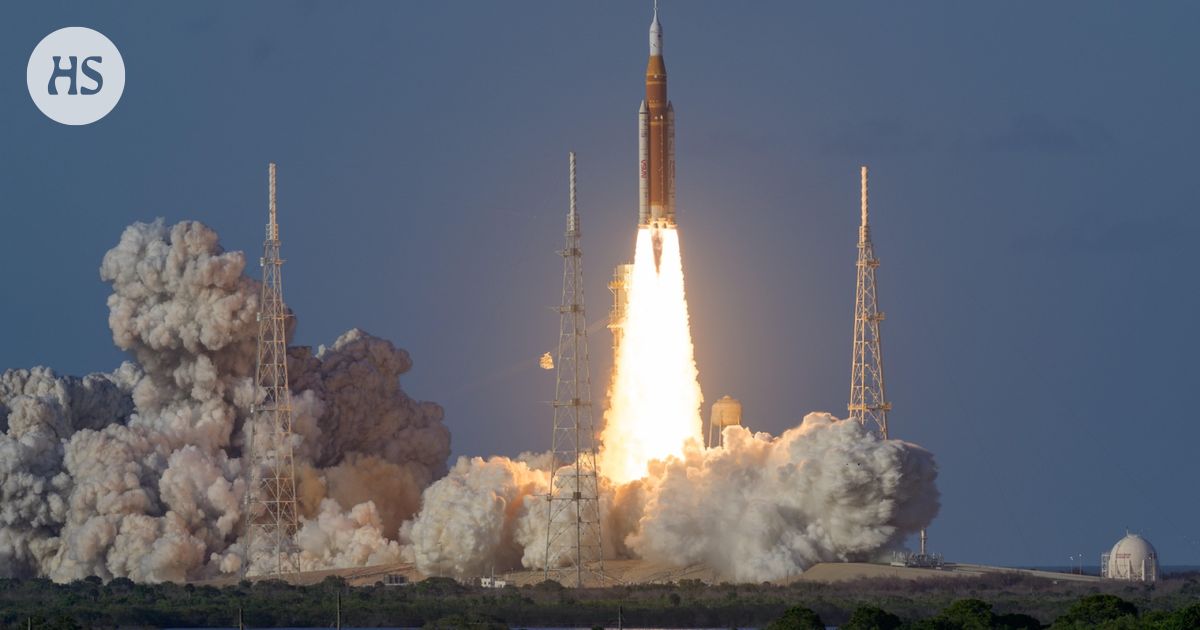
Moon trip|The spacecraft Orion has four astronauts on board. The only reported malfunction so far has been in the ship’s toilet, but the problem was fixed.
The moon rocket Artemis II rose into space from Florida on Thursday morning Finnish time.
At the nose of the rocket is the spacecraft Orion, with four astronauts on board. Soon, Orion will head towards the Moon and circle it.
Man is now returning to the Moon for the first time in more than 53 years. The last time the Apollo 17 astronauts were near the Moon and on its surface was in December 1972.
During the flight, the astronauts test Orion’s control and technology. This is how they gather experience for the next flights of the Artemis program.
Moon FLIGHT Artemis II rose into space on Thursday morning Finnish time. It took almost a hundred meters to orbit the Earth launch vehicle SLS.
Artemis II took off from the Kennedy Space Center in Florida at 1:35 a.m. Finnish time. The SLS launch vehicle reached low Earth orbit after about eight minutes of flight.
There was a moon rocket in the beak spaceship Orionwith four astronauts on board. Now Orion is already orbiting the Earth on its own. The other phases of the moon rocket have been disconnected. They have fallen into the sea.
Only the reported problem so far has been in the ship’s toilet. The fan in Orion’s toilet was blocked. It takes care of, among other things, the unpleasant odors of the urine tank in Orion’s toilet.
On Earth, those familiar with Orion’s technology grasped the problem. With the help of instructions, an astronaut Christina Koch got the bug fixed.
“Houston, Integrity, good inspection,” Koch thanked air traffic control as he tried the restroom after the repair, says the website Space com.
“Integrity” refers to Orion’s nickname. The word is used in communication between air traffic control and the spacecraft. NASA spokesmen emphasized that the toilet could be used for big things all the time.
Orion’s with the help of man trying to get back close to the Moon after a gap of more than 53 years.
Man walked around the moon last in December 1972. There were three astronauts on the Apollo 17 mission. Two of them also landed on the surface of the Moon.
Now more people are flying near the Moon at once. The commander of the Orion quad is Reid Wiseman and the pilot Victor Glover. The other two astronauts are Christina Koch and Jeremy Hansen.
Koch will be the first woman to go near the Moon. Glover, on the other hand, is the first black astronaut on a trip to the moon.
Hansen is a CSA astronaut from the Canadian Space Agency, the others are NASA pilots from the US space agency. Hansen is the first person from outside the United States to fly around the moon.
Four astronauts rose into space in the evening on Wednesday. The direction is soon towards the moon. Christina Koch in the middle.
Officeaketin leading the departure Charlie Blackwell-Thompson described the flight as historic, even though we are not quite going to the surface of the Moon yet.
“Good luck and blessings, Artemis II. Now let’s go,” he said.
Orion’s journey towards the Moon can begin on Friday Finnish time. It takes about three days. The length of the trip is almost 400,000 kilometers.
The Artemis II lunar rocket lifted off from Kennedy Space Center’s launch pad 39B. For example, Apollo space flights and dozens of space shuttles have taken off from the same place.
Orion will still circle the globe on an oval track on Thursday. Its farthest point is about 60,000 kilometers from Earth.
For comparison, the ISS space station orbits the Earth at an altitude of only about 400 kilometers.
Astronauts and air traffic control will soon have to decide on the next step. Will Orion continue towards its destination, the Moon? Or will it return to Earth?
Thursday In Finland, it seemed that the journey would continue. If Orion continues towards the Moon, the Orion Service Module rocket will push it into its right orbit.
Then Orion has to go around the Moon. It is the only means of returning to Earth after leaving Earth’s orbit.
The gravitational forces of the Earth and the Moon take care of the journey. Orion’s maintenance module can, however, repair the track during a trip lasting about a week.
Astronauts on Thursday, at first, it was quite a rush to check that everything is working in Orion. Orion’s equipment had to be started.
Immediately after departure, the astronauts took off their Orange spacesuits. The solar panels of Orion’s maintenance module opened.
The astronauts first checked that the filter that removes carbon dioxide from the ship was working. Electricity was running Orion’s maintenance module from batteries to Orion devices.
The astronauts even tried manual control of Orion for a while.
at the beginning of the mentioned Orion toilet is like a luxury compared to the Apollo toilets 1968–1972. The astronauts took care of all their needs in bags that were sealed airtight.
Orion’s toilet resembles the toilets we have used in airplanes or trains. In them, the toilet sucks the waste into its udder.
There was time to reserve bags for the urine, which were intended for collecting poop.
In Orion, the poo is collected in bags, which are only taken to waste management after the trip. Urine, on the other hand, is immediately directed out into space.
Koch told air traffic control that the urine container was already full. It had to be emptied into space.
Orion’s toilet is a more compact version of the international space station’s toilets. It is known as the “general hygiene room”.
In the toilet, each astronaut has his own funnel that sucks the urine into the tank.
If and when the journey continues at Easter, the astronauts will test Orion’s technology for more than a week. One of the main purposes of the flight is to gather experiences from Orion.
Before Artemis II, Orion had only test flown twice, without humans and manual control.
The experience of Orion is important, as it is the astronauts’ quarters on all Artemis flights. Artemis III will be resurrected in orbit around the Earth in 2027. Artemis IV can take people to the Moon during 2028.
The Artemis program will continue into the 2030s if the US space agency NASA receives federal funding for it.
https://sites.google.com/view/immobilienmakler-dachau0
https://storage.googleapis.com/dachau/Immobilienmakler.html
https://keithbach.blob.core.windows.net/wirverkaufenjedesobjekt/IndividuelleBeratung.html
https://sites.google.com/view/kosmetikstudio-dachau1
https://storage.googleapis.com/kosmetikdachau/Kosmetikstudio.html
https://keithbach.blob.core.windows.net/kosmetikstudio/KosmetikDachau.html