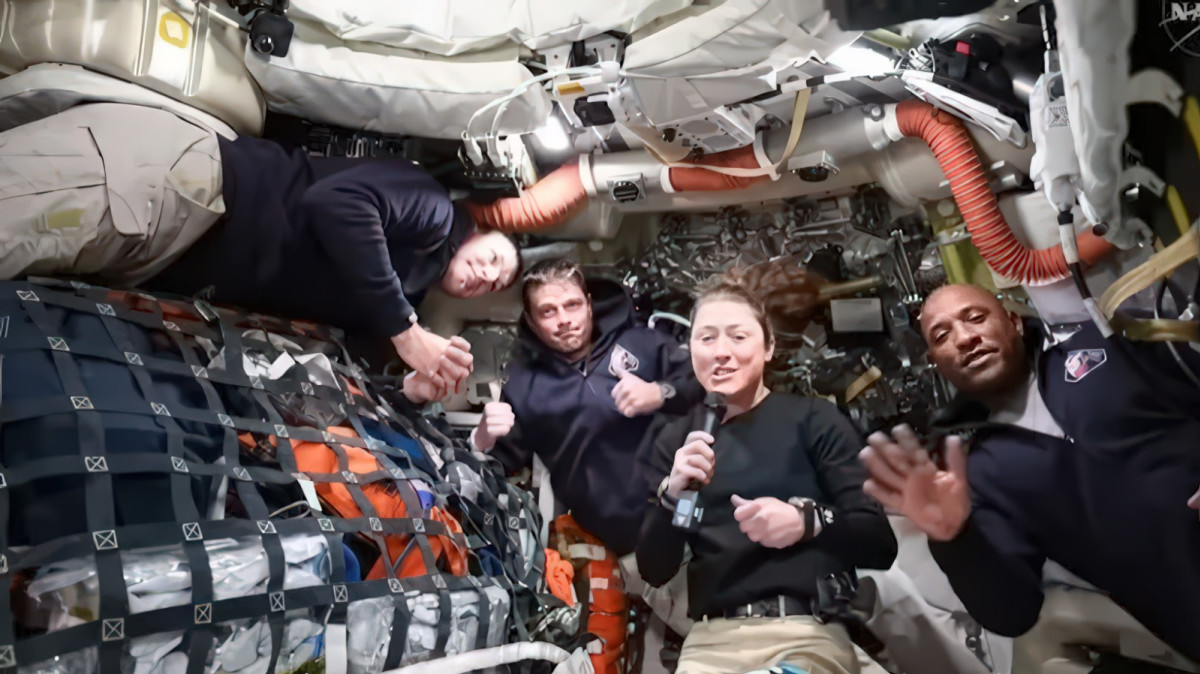
One of the most jarring experiences for the crew in the early days is the “Space Adaptation Syndrome” (SAS). Without gravity, the fluids in the body “migrate” from the legs towards the head and chest. The result: a swollen face, nasal congestion and a constant feeling of nausea accompanied by dizziness. The human brain loses its spatial navigation; “Up” and “down” are concepts that cancel out.
To cope with the weightlessness, the astronauts adopt the neutral body posture. Because the muscles do not have to hold the body against gravity, the joints naturally bend slightly. They look like they are “standing” in the air, but in fact they are in a state of complete limpness. To work in front of the Orion’s touch screens, they use “foot restraints”: loops on the floor that hold them in place and prevent them from floating away from the task in the middle of typing data.
The professional tasks: not only “passengers”
Although the spacecraft is mostly autonomous, the crew is not resting for a moment. In the early days, the most critical mission was the “proximity maneuver.” Pilot Victor Glover detached the “Orion” from the upper rocket stage (ICPS) and then manually flew it back to it. This is a pure flight mission designed to test if, in the event of a computer malfunction, humans could dock the spacecraft at a future space station around the moon.
In addition, the team performs comprehensive tests for the life support systems (ECLSS). They measure CO2 levels in every corner of the spacecraft and make sure that the air filtration system is able to overcome the odors and heat emitted by four human bodies in a closed space. Another task is an experiment in optical communication (laser) – an attempt to transmit data to Earth at a speed many times higher than the known radio speed, which will enable 4K video transmissions from Mars in the future.
Daily routine: from “wipe shower” to vacuum services
The “loo” (the toilet): The UWMS system is a small box with a suction tube (for urine) and a tiny seat (for solid waste). Everything works on a vacuum. This is the moment when privacy is most severely compromised: a thin curtain is all that separates the astronaut from the other crew members who are half a meter away from him.
Nutrition: The food comes in aluminum bags. They inject hot water into bags of dried concoctions, massage them and wait. There are no plates and no regular cutlery; everything is eaten straight from the bag to prevent crumbs from getting into their friends’ eyes or computer fans.
The “dead time” and the psychology of the task
In the few hours they have left as free time, the astronauts deal with documentation. Christina Cook, for example, is expected to spend time photographing the moonscape and the receding blue ball. Their pre-downloaded music and podcasts are their only connection to human culture.
But the biggest challenge is sleep. They sleep in sleeping bags tied to the walls on the sides of the spacecraft. In order not to “suffocate” from the carbon dioxide they themselves emit in their breath (which tends to accumulate as a “bubble” around the head in weightlessness), ventilators must operate at high power near their heads all night. It’s constant white noise that requires quality earplugs.
The way home: the “jump” on the atmosphere
The most complex and dangerous part begins on the seventh day. The return to Earth is not a direct “fall”, but a brilliant physical maneuver called Skip Re-entry.
During penetration, the temperature outside the spacecraft will reach 2,760 degrees Celsius, hotter than the surface of the Sun. The spacecraft’s heat shield will wear and tear on purpose to keep the heat away from the crew. After that, at an altitude of about 7 kilometers, the huge braking parachutes will open that will slow the spaceship down from a speed of thousands of kilometers per hour to a soft landing speed in the waters of the Pacific Ocean, near the coast of California.
There, as they rock inside the capsule on the ocean waves, US Navy rescue forces will be waiting for them. For the astronauts, the first encounter with fresh air, real gravity and flowing water will be the end of the most fascinating journey of the 21st century.
https://1win-mines-game.in.net/en-in/real-or-fake/
https://1win-mines-game.in.net/en-in/registration/
https://1win-mines-game.in.net/en-in/responsible-gaming/
https://1win-mines-game.in.net/en-in/strategies-and-tips/
https://1win-mines-game.in.net/en-in/support/
https://1win-mines-game.in.net/en-in/terms-and-conditions/
https://1win-mines-game.in.net/en-in/withdrawal/
https://vortex-game.in.net/en-in/
https://vortex-game.in.net/en-in/9winz/
https://vortex-game.in.net/en-in/about-us/
https://vortex-game.in.net/en-in/batery/
https://vortex-game.in.net/en-in/batery/batery-app/
https://vortex-game.in.net/en-in/best-vortex-apps/
https://vortex-game.in.net/en-in/bonuses/
https://vortex-game.in.net/en-in/cookies-policy/
https://vortex-game.in.net/en-in/demo/
https://vortex-game.in.net/en-in/deposit/
https://vortex-game.in.net/en-in/download/
https://vortex-game.in.net/en-in/how-to-play/
https://vortex-game.in.net/en-in/odds96/
https://vortex-game.in.net/en-in/odds96/odds96-app/
https://vortex-game.in.net/en-in/predictor/
https://vortex-game.in.net/en-in/privacy-policy/
https://vortex-game.in.net/en-in/promo-code/
https://vortex-game.in.net/en-in/provider/