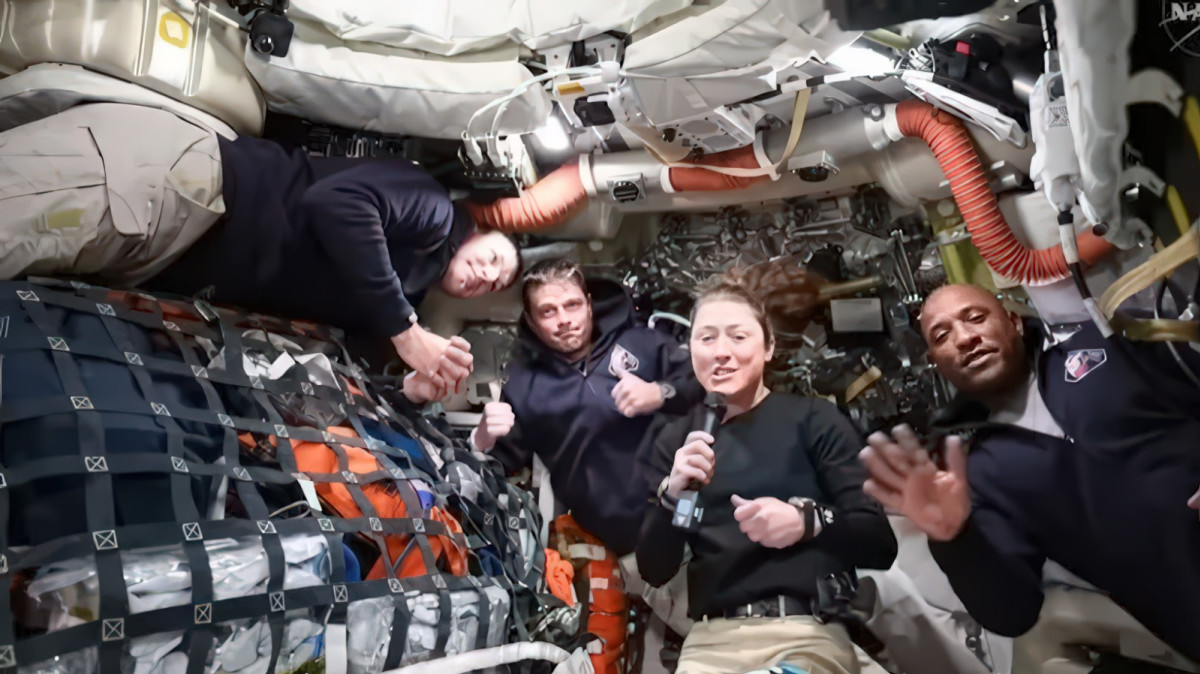
This is the moment when the moon becomes the dominant factor pulling the spacecraft, and marks the beginning of the most dramatic phase of the Artemis 2 mission: passing over the far side of the moon and breaking the distance record from home.
The transition to the “dark side” and wireless silence
One of the most exciting moments in the mission will begin today at 21:34 (Israel time). The spacecraft will begin the “Lunar Flyby”, which will plunge the crew into the darkness of the far side of the moon. During the six-hour flight, the astronauts will experience a complete communication blackout every time the Moon’s enormous mass blocks communication with NASA’s deep space network on Earth.
While they are cut off from the world, some 6,400 kilometers above the dark surface, the crew will not rest. They were trained for months to identify and describe geological phenomena in real time. Using professional cameras, they will record through the Orion windows the rare sight of sunlight filtering in around the edges of the moon – a kind of solar eclipse from the astronauts’ point of view.
The most exciting spectacle is expected to occur when the spacecraft emerges from the other side: “Earth sunrise”, in which the Earth – which will appear only the size of a basketball – will rise above the lunar horizon.
Live science from the cockpit
The current mission is the final touchstone of the multibillion-dollar Artemis program. NASA’s goal is to return humans to the surface of the moon as early as 2028, thus ahead of the corresponding Chinese plan.
Establishing a permanent lunar base is not just a matter of national prestige; This is a training ground and an essential technological testing ground for the next destination: Mars.
The physiological challenge at the peak moment
From a health perspective, being so far from Earth poses unique challenges. The crew is exposed to radiation levels that do not exist in low Earth orbit (as in the International Space Station). Although it is a record day, the astronauts are obliged to continue their physical training routine and monitor the levels of oxygen and carbon dioxide inside the capsule.
Every minute of the flight, the Orion’s systems are tested to the limit to make sure they can keep a crew alive for weeks in deep space.
In about four days, after they complete the orbit around the moon and use its gravity to “throw” back home, the final and dangerous phase of the ocean landing will begin. Until then, the four Artemis 2 astronauts can take pride in their new title: the humans who have gone the furthest away from home ever – on their way to pave the way for the next generation of space explorers.
https://flipbooklets.com/pdfflipbooklets/freecrunchyrollpremiumaccount
https://myspace.com/freecrunchyrollaccount
https://www.start.gg/user/954b1dc6
https://hackaday.io/freecrunchyrollaccount
https://eventprime.co/o/freecrunchyrollpremiumaccount
https://www.bandlab.com/post/d45ab4ad-82b1-4bd3-a039-0a5332e432fe
https://freepeacockpremiumaccount.weebly.com
https://aetherhub.com/Tourney/ViewLeague/22441
https://devpost.com/peacockpremiumaccount
https://tawk.to/freepeacockpremiumaccount
https://issuu.com/freepeacockpremiumaccount
https://www.facebook.com/events/1975000983429761
https://flipbooklets.com/pdfflipbooklets/freepeacockpremiumaccount
https://myspace.com/freepeacockpremiumaccount
https://www.start.gg/user/2a618669
https://hackaday.io/freepeacockpremiumaccount
https://eventprime.co/o/freepeacockpremiumaccount
https://www.bandlab.com/post/7a989cf2-a3d5-454e-8aa2-70b983d4a67c
https://www.tumblr.com/peacockpremiumaccounts
https://freebumbleboost.weebly.com
https://aetherhub.com/Tourney/ViewLeague/23182
https://devpost.com/freebumbleboost
https://tawk.to/freebumbleboost
https://issuu.com/freebumbleboost
https://www.facebook.com/events/2145764109611169