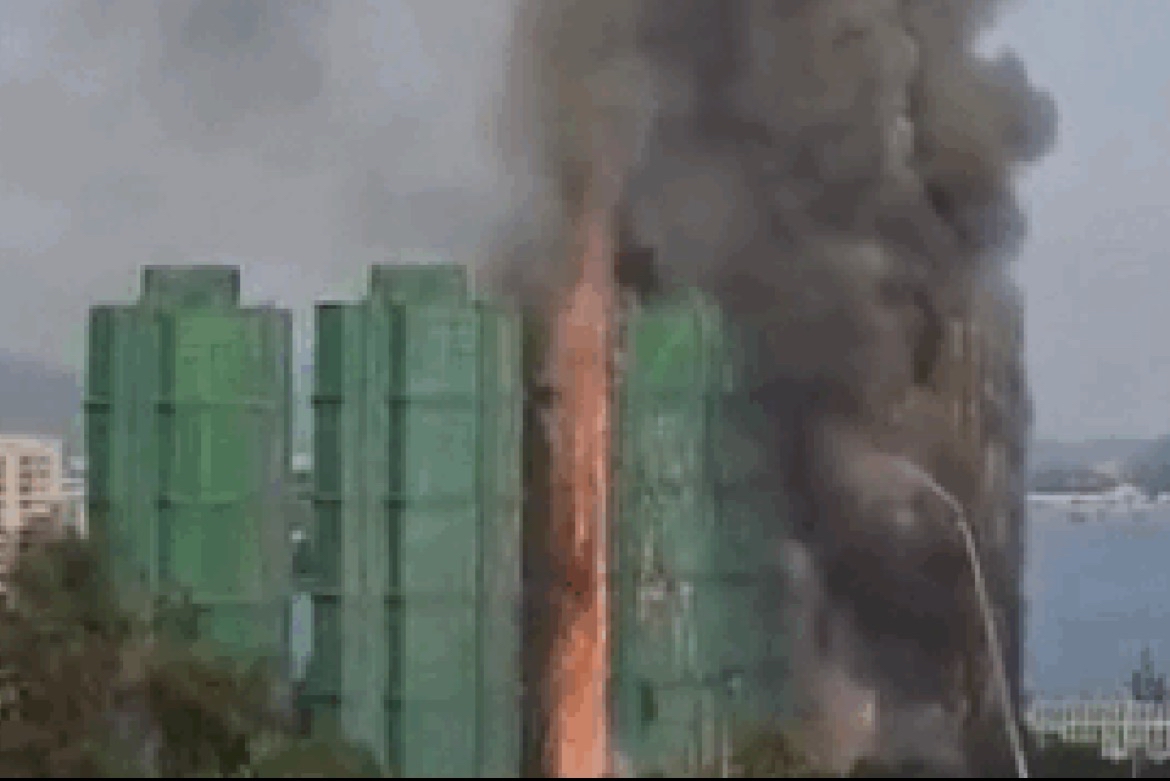
More than 40 people died and dozens were injured in a huge fire at a housing estate in Hong Kong’s northern Tai Po district, where flames spread through bamboo scaffolding installed on one of the blocks.
The police, cited by local media, indicated that, in addition to the victims, there are people trapped inside the three buildings affected by the fire, while authorities raised the alert level to 4 on a scale of 1 to 5 due to its rapid spread.
A dense column of smoke and the collapse of parts of the scaffolding can be seen in images shared on social media and in local news outlets, while several nearby streets were closed to traffic.
The fire, which started in the multi-story outdoor scaffolding, was initially classified as alarm level 1 but quickly escalated to level 4 at 3:34 p.m. local time.
The fire has drawn many people to the area, where some residents cover their faces to avoid inhaling the thick smoke as they look at the damage to their homes.
The director of the Fire Department, Andy Yeung Yan-kin, was on his way to the Prince of Wales Hospital to follow up on the case of an injured firefighter there, according to sources consulted by the South China Morning Post.
It was later confirmed that this firefighter was one of the 36 deceased, along with three residents, in a provisional count.
The Hong Kong Observatory has maintained a red alert for fire risk since Monday, warning of an extremely high risk of forest or urban fires, based on factors such as humidity, wind speed and dryness of vegetation.
The Wang Fuk Court complex, where the accident occurred, is undergoing a renovation process costing 330 million Hong Kong dollars (42 million dollars, 36.6 million euros), a proposal that generated discontent among many residents last year.
The complex has 1,984 residences, housing approximately 4,000 residents.
The fire also affected the surrounding area: Tai Po Baptist Public School, a nearby elementary school that advised parents to avoid the area due to the fire.
A recent precedent
This incident is part of a series of scaffolding-related fires in Hong Kong that have exposed vulnerabilities in construction and urban renewal structures.
Last October, a fire on the external scaffolding of the Chinachem Tower forced the evacuation of dozens of people and left four hospitalized.
Department of Buildings officials then confirmed the structural integrity of the building, although they identified loose materials on the facade that required immediate removal.
The tower’s renovation work, which included small repairs to the external walls and air conditioning supports, used standard protective coverings, nets and tarpaulins, but the fire was restricted to the facade, without affecting the interior.
On that occasion, experts pointed to welding sparks at construction sites or discarded cigarette butts as possible sources of the accident.
These incidents reinforce recurring concerns about the safety of bamboo scaffolding — common in Hong Kong due to its light weight and low cost — often associated with renovation work, flammable materials or external sources of ignition, in a context of high urban density and drought-prone climate.