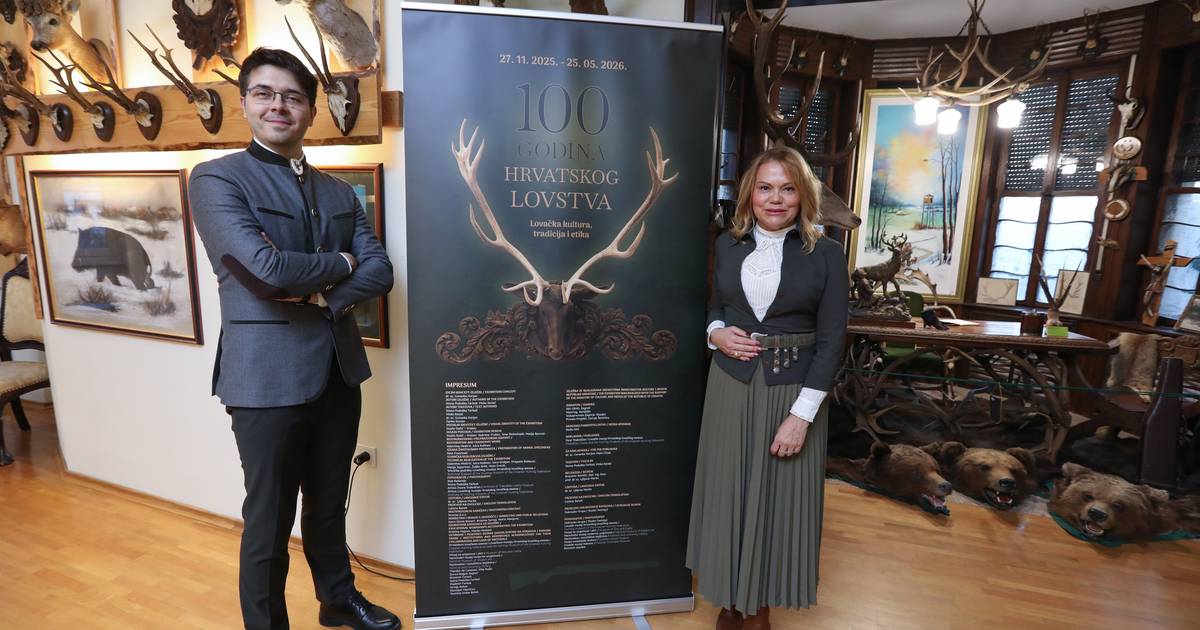
The exhibition ‘100 years of Croatian hunting – hunting culture, tradition and ethics’ opens in the Hunting Museum in Zagreb, which provides an overview of the multi-layered tradition of hunting in Croatia and confirms the key role of the Croatian Hunting Association in its preservation. The exhibition was organized on the occasion of the 100th anniversary of the Croatian Hunting Association, but also on the occasion of the 70th anniversary of the Hunting Museum, and before the opening, we spoke with Vesna Farkaš, the curator and co-author of the exhibition, who revealed to us what visitors can expect from this exhibition and what it is like. Over the years, the Hunting Museum has contributed to the preservation of hunting culture in Croatia.
– The idea for this exhibition came from the director of the Trakošćan castle Goranka Horjan and I during one of our meetings. Namely, the Trakošan castle has a very nice hunting hall and that was somehow the first impulse for us to achieve cooperation, given that they also have a beautiful history of hunting with the Drašković family, and we are the only specialized hunting museum in this part of Europe. The curators of the exhibition are our colleague Vinko Kova. from Trakošan and I, from the Hunting Museum. This is the year in which the Croatian Hunting Association celebrates its 100th anniversary, and at the same time this year, on November 25, the Hunting Museum celebrated its 70th anniversary, and I can say that for a private museum that is actually a very nice number. The Hunting Museum belongs to the Croatian Hunting Association and Heritage, collects, preserves, systematizes and exhibits the valuable heritage of Croatian hunters – Vesna Farkaš told us.
The basic idea of the exhibition was to show how the tradition of hunting is actually reflected in many chapters of human life and how over the years it has become a part of everyday life in the form of various decorations or works of art.
– Colleague Vinko and I actually wanted to show that hunting is more than hunting, that hunting is not only the basic leisure activity of going to the forest and nature when hunting wild animals, that hunting is actually reflected in many life chapters or spheres, so hunting is also described in art, music, fine arts, and sculpture. Hunting used to be an important means of communication for the nobility through tapestries, hunting scenes were depicted on the most beautiful pieces of porcelain service, ajnik… Also, hunting resources, such as skins or antlers of some animals, were used in clothing, but also in furnishing interiors, spaces, and equally as decorative materials for women, for clothes in the space. We wanted to show all of that with our exhibition, and I think we succeeded in that to a large extent. Of course, there was also inter-museum cooperation, with some exhibits the Museum of Arts and Crafts met us, with some private donors and so on – Mrs. Farkaš told us.
This exhibition in the Hunting Museum is a sort of continuation of the exhibition that was held earlier this year in the Trakošan Castle area, where, as Mrs. Farkaš told us, it attracted an extremely large number of visitors:
– The first part of the exhibition was set up in the authentic area of Trakošan Castle, which is our most beautiful castle, and it was seen there by over 61,000 visitors, which is an extremely beautiful and positive promotion of Croatian hunting. And on the occasion of the 70th anniversary of the Hunting Museum, today we are opening an exhibition in the Hunting Museum, that is, where these exhibits are mostly at home. The Hunting Museum is a small museum that covers approximately 800 square meters and it has a very beautiful and rich collection that shows hunting from all angles and spheres.
The Hunting Museum in Zagreb is located in an authentic location, in Villa Wohlmuth at Nazorova 63, and the idea of its establishment dates back to 1896, when the Austrian architect Hermann Bolle presented a wooden pavilion at the millennium exhibition in Budapest, which represented hunting and forestry, two areas that are still closely connected today.
– The first idea of founding the Hunting Museum dates back to 1896, when for the millennium exhibition in Budapest, Hermann Bolle created a beautiful wooden pavilion that represented hunting and forestry, and they still go hand in hand today because the wild is, of course, hiding and living in the forests. The intention was to move the pavilion to today’s Botanical Garden after that exhibition, but unfortunately that did not happen. He was very happy for us because that way we would have a special and authentic place of the Hunting Museum. As for our museum, after some searching for space, it was located in Villa Wohlmuth, where we are still today, at Nazorova 63. It is an authentic and original space, the way that villa was built, which is one of the ten most beautiful villas from the transition from Art Nouveau to the Art Nouveau period – Mrs. Farkaš told us.
What is particularly interesting is the fact that today the Hunting Museum enjoys great popularity among the young audience and, along with hunters, novice hunters, citizens and tourists, it is regularly visited by primary and secondary school students who also want to see a part of preserved Croatia. hunting culture, for which numerous interactive contents have been prepared at this exhibition.
– Today we are actually extremely popular with the younger audience and I think that is where we should build our future because today’s children have very little opportunity to experience and see wild animals, wild animals. of our regions, and in our natural history collection, which stretches across the entire floor of the museum, we have an extremely rich collection of wildlife in the type of open dioramas, scenographically arranged in an ambient setting. Children can immediately enter habitats and wildlife, they can see them up close, so nothing is in closed display cases, and with this exhibition we have taken another step forward, towards a modern museum interpretation, so we have several interactive contents with the help of in which the youngest audience, but also the audience in general, can get to know hunting culture and ethics more – Mrs. Farkaš told us at the end of our conversation.
The grand opening of the exhibition will be held on Thursday at 18:30, and the exhibition will remain open until May 25, 2026.