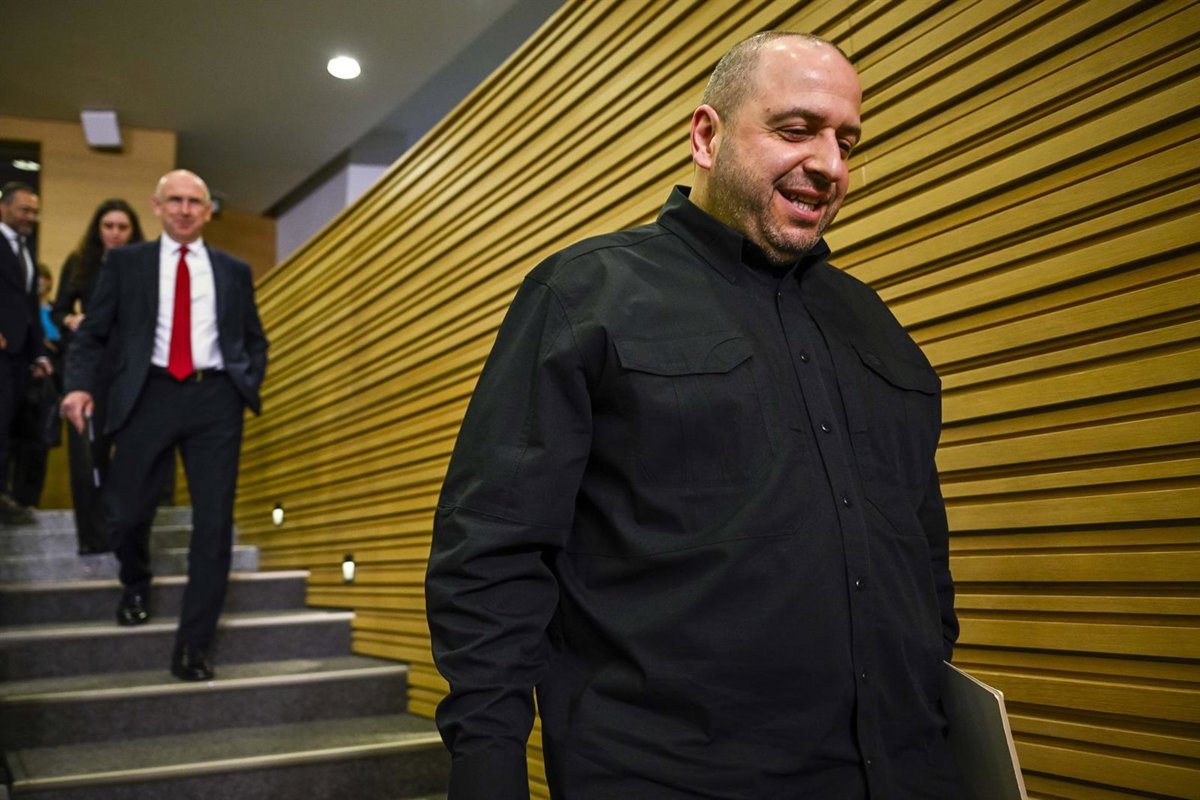
The president of Ukraine, Volodymyr Zelensky, announced this Saturday his new peace delegation marked by the absence of his already resigned advisor Andri Yermak, who left office this Friday in the midst of a corruption scandal, which will debut this weekend with a visit to the United States to discuss the current situation of the negotiations.
Yermak, until now head of the negotiation team, has given his place to Rustem Umerov, the secretary of the National Security and Defense Council and former ‘number two’ of the team. Umerov will have as his main assistant Yermak’s until now deputy, Alexander Bevz.
The bulk of the delegation will be made up of the head of the General Intelligence Directorate of the Ministry of Defense, Kirill Budanov, the deputy military head of the Ministry of Defense, Vadim Skibitsky, the head of the General Staff of the Armed Forces of Ukraine, Andriy Hnatov and the head of the Foreign Intelligence Service, Oleg Ivashchenko.
This delegation is now traveling to the United States, to meet on Sunday in Florida with the US special envoy, Steve Witkoff, and Trump’s son-in-law, Jared Kushner, and discuss the evolution of events, as confirmed by the president of Ukraine.
“This Saturday, Rustem presented a report with a clear mission: to quickly and rigorously define the steps necessary to end the war. Ukraine continues to work with the United States in the most constructive way possible, and we hope that the results of the meetings in Geneva will be realized in the United States. I look forward to the report from our delegation after its work this Sunday,” the Ukrainian president said.
Witkoff will lead a US delegation to talks in Russia next week.
Last week, the United States issued an ultimatum to kyiv to accept the terms of a deal that appeared to favor Russia by Thanksgiving. The document ended up in a more diluted version by compartmentalizing the thorniest issues after intense diplomatic activity in Geneva and under pressure from kyiv’s European allies.
The Europeans have been excluded from the details of many aspects of the talks and only participate in bilateral talks where their input is absolutely necessary at this stage, such as defining security guarantees with the United States.
While Washington has touted progress in talks with Ukraine, they still face the same obstacles as previous rounds: What satisfies Ukraine is likely to be a deciding factor for Russia, and vice versa.
Russian President Vladimir Putin reiterated on Thursday his demand that the Ukrainian army withdraw from areas of the Donetsk region that Moscow has not been able to take by force, an idea that kyiv has repeatedly rejected.