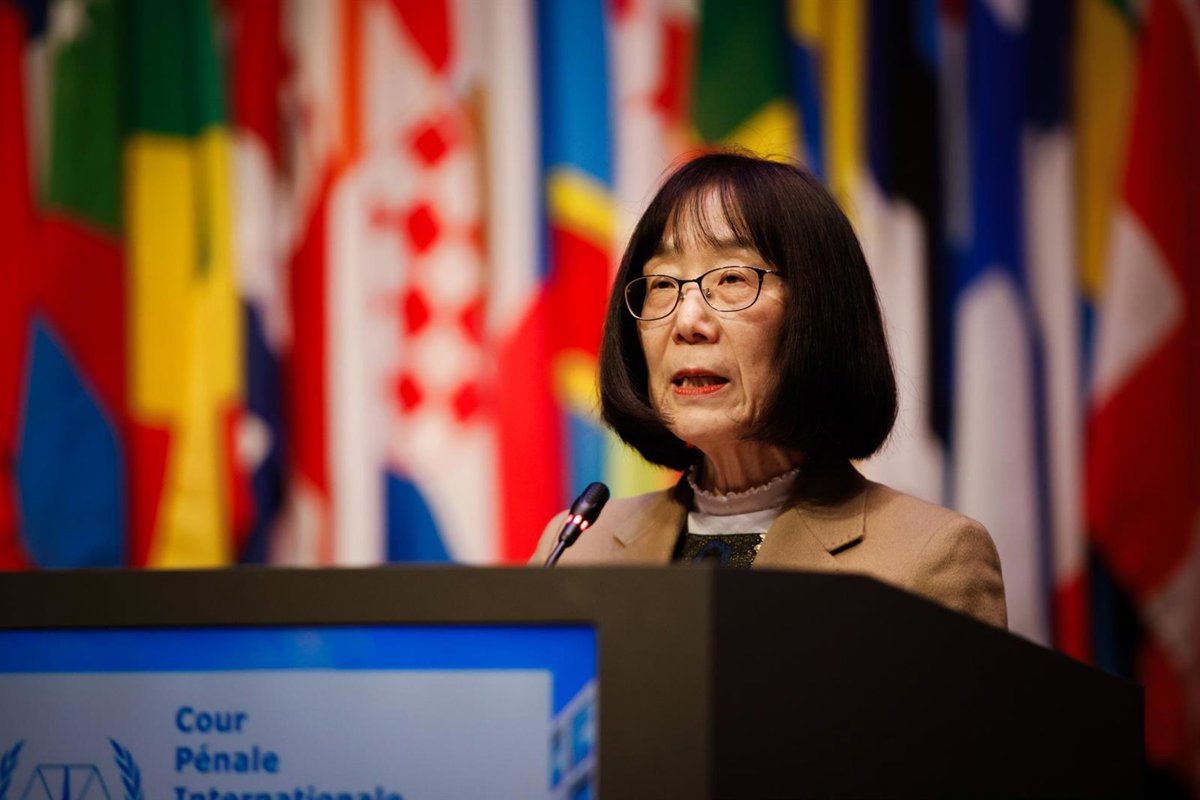
The president of the International Criminal Court (ICC), Judge Tomoko Akane, denounced this Monday the “coercive measures” and “threats” issued in recent months by the United States and Russia, which do not accept the jurisdiction of this court, based in the Dutch city of The Hague.
“Last year I remembered (…) the dangers that loom over this noble institution, International Law, international justice and, ultimately, humanity. I promised (…) that we would never surrender to coercive measures, threats, sabotage or violence. Both the prediction and the proposal came true,” he declared.
“Let me be explicit: we will never accept any type of pressure on the interpretation of the statutory framework or on the resolution of cases,” she concluded, stating that the Rome Statute offers legal avenues without States “undermining the independence and impartiality of the court” and encouraging them to “resort to consultations if they detect problems in requests for cooperation.”
Akane regretted that “the United States has sanctioned nine officials, including six judges, along with terrorists and drug traffickers”, stressing that “their personal and family lives are disrupted and their ability to carry out financial transactions is interrupted, also in the States Parties, including Europe.”
He also recalled that a third of the ICC judges and the entire Presidency are subject to arrest warrants issued by the Russian authorities: “As far as we know, these officials have been accused and arrested ‘in absentia’, and hearings are being held in their absence.” “This will have an obvious impact on their personal safety,” he said.
“These coercive measures have the obvious objective of undermining the existence and reputation of the court, the integrity of its judicial procedures and the security and tranquility of its officials,” he said during the opening of the session of the Assembly of States Parties to the Rome Statute of the ICC in The Hague.
However, the judge has defended that the TPI’s response has been “absolutely unequivocal”, alleging that its “independence and impartiality” are its “pillars” and “have not been affected.” “Our loyalty is limited exclusively to the Rome Statute and International Law,” he concluded.
Thus, he has indicated that they have adopted “various measures to mitigate the impact” of the sanctions and strengthen their “resilience”, but he did not want to detail the measures adopted, claiming that “the majority” are “confidential to guarantee their effectiveness.”
On the other hand, he took the opportunity to thank the States that have collaborated with the institution to “find solutions”, and has asserted that he will continue his “efforts to increase the number of States parties and thank the commitment of civil society partners to raise awareness and promote universal ratification.”
Hours earlier, the NGO Human Rights Watch (HRW) had urged the member countries of the ICC to “remain firm” in their defense of the court, as well as to enforce judicial resolutions against those who do not arrest or hand over the people wanted by this entity, while it had pointed out to some those who have “attacked” it, such as Washington or Moscow.
The court has been subject to sanctions by the United States since it issued an arrest warrant against Israeli Prime Minister Benjamin Netanyahu and his former Defense Minister Yoav Gallant for war crimes in the context of the offensive in the Gaza Strip, which has left more than 70,000 dead in two years. As for Russia, there is an arrest warrant against Russian President Vladimir Putin for alleged crimes in Ukraine.
ZERO TOLERANCE POLICY
On the other hand, the president of the TPI has declared that the court “is committed to improving its work culture, and the management applies a policy of zero tolerance against harassment, including sexual harassment, as well as against discrimination and abuse of authority.”
“The Presidency and the plenary session of judges, as well as the court as a whole, take this matter with absolute seriousness. In cases where we had authority, in accordance with the legal framework, we have held those responsible, including an official elected this year, to protect the affected personnel, promptly, impartially and in compliance with due process,” he said.
However, he mentioned that the CFI is also working to “improve its internal systems and processes, as well as the ethics charter,” while publishing the “fundamental values for the entire court.”