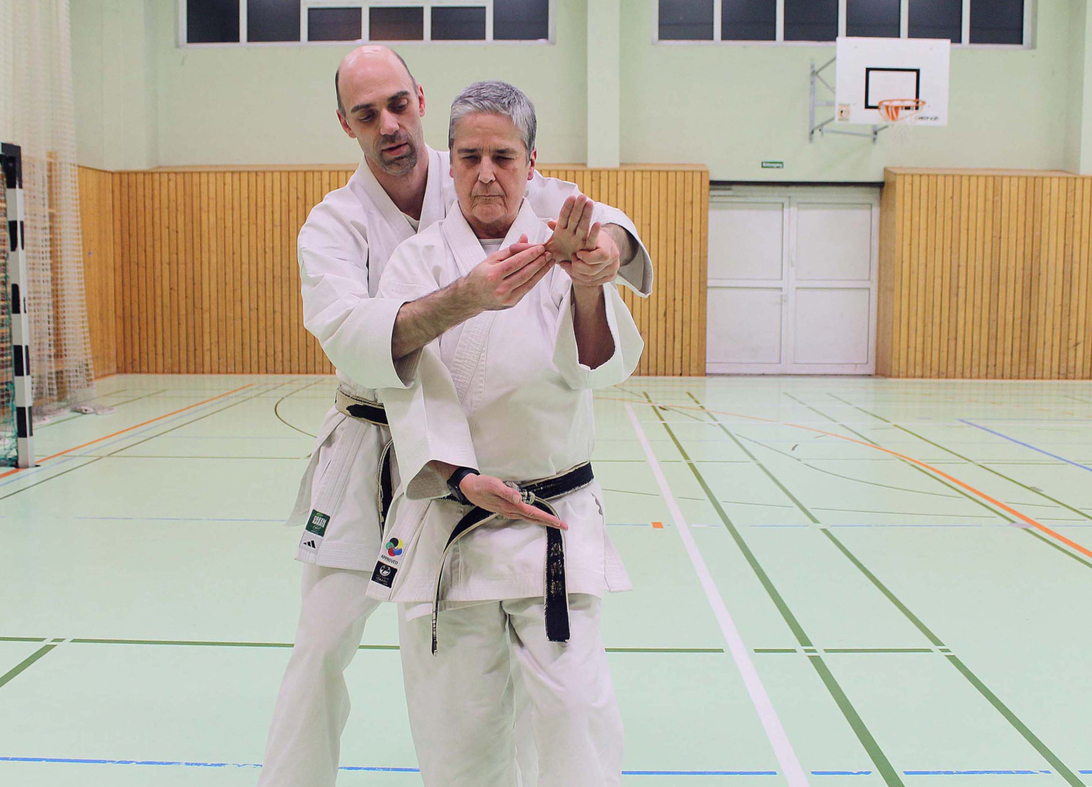
Berliner Helga Balkie has deleted the phrase “I can’t do that” from her vocabulary. She doesn’t let him, but that’s exactly what makes the blind athlete so strong. She became world champion in blind karate three times and European champion once.
She can’t say exactly whether she’s always been so hard on herself. In any case, she is convinced that this saved her from the wheelchair. The 67-year-old was diagnosed with multiple sclerosis when she was young. At that time she had already started practicing karate.
Berlin martial artist went blind 30 years ago
“Actually because I had to assert myself against my four brothers,” she says and laughs. From today’s perspective, this was probably the most important basis for her mobility in old age, even if it was limited by the progression of the disease. She was unable to prevent blindness as a result of MS almost 30 years ago.
At that time she was working in the public service with the police, but was then retired. Her son Tobias was ten years old. He noticed how bad his mother was. Suddenly she was just at home, thinking a lot and not knowing what to do next. “In this situation, my son asked me to come back to training,” remembers the Hellersdorf resident.
That took a lot of effort from her. Also because she didn’t know how the others who previously knew the karate athlete as a sighted person would react. But it worked because Helga really wanted it. Although the fit woman with short, gray hair doesn’t like to talk about that time. Because she sensed that some of the group no longer had much confidence in her.
Fortunately, this chapter is a thing of the past. She changed clubs together with Tobias and has been part of the Hellersdorfer Athletics Club Berlin since 2011. And that was another new challenge: for Helga, because as a blind person she now had to learn new attack and defense techniques, so-called katas. For trainer Heiko Kuppi, because Helga was the first blind karateka he trained.
She counts the steps from the edge of the mat
He stands close behind or in front of her, explains a lot, touches her arms and indicates the direction. If he snaps his fingers, Helga knows that’s exactly where she has to run. The coach always came with me to the competitions. He led the karate fighter into the starting position on the mat.
During such tournaments, Helga relied particularly on her “pictorial memory” and worked through the rehearsed punching, pushing and kicking techniques one after the other. “For better orientation, I counted the steps from the edge of the mat to the middle,” she says. Jumps were only suggested because the risk of injury is too great.
She still finds it most difficult to walk straight and turn her body. But anyone who watches her training in the sports hall at Maxi-Wander-Straße 51 hardly notices it: she moves in a highly concentrated, powerful and fast manner as a team following the coach’s instructions.
No more competitions
Helga has not taken part in competitions for seven years. The doctors suggested this to her for health reasons. But she is once again taking on a new task in which she is passing on her knowledge and experiences. Together with a sighted trainer, she looks after children and adults with disabilities. “It’s a lot of fun for me and it means a lot to me because it’s an appreciation,” says the athlete.
Communication is now working quite well, even though her charges first had to learn how to communicate with her. “I don’t see how to just shake your head or nod,” says Helga. She can usually tell whether her legs or arms are being moved correctly just by the rustling of her karate clothing.
In October, Helga Balkie was presented with a certificate of honor by the State Secretary for Sport Franziska Becker at the “10 Years of Inclusion through Sport” ceremony. As a thank you for your many years of commitment to the sport of para karate. In quiet moments, the 3rd Dan fighter thinks about her future. And I hope she can continue doing this sport for a long time.