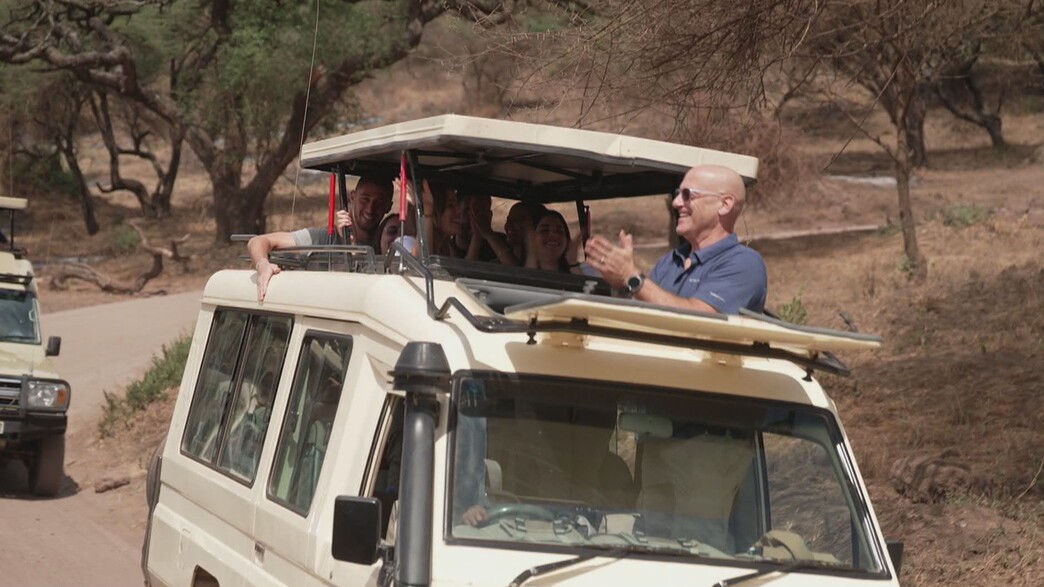
About 40 injured men and women set out on a journey aimed at allowing them to speak, digest, and start life anew • For the first time, almost half of the group were warriors who were physically and mentally injured, who bravely raised questions about femininity and self-image • The moments of riots in Tanzania following the elections shook some of those who are still learning to breathe again • And before they returned – they buried part of the pain in African soil
On Sunday, the day of recognition for the wounded of Israel’s systems and the victims of hostilities will be observed. Many of them are accompanied by the IDF Disabled People’s Organization. A group of wounded men and women, most of them from the last war, went on a special safari trip in Tanzania last month. Against the backdrop of the landscapes of Africa, they managed to open up and talk about the difficulty. Until at one point – riots that broke out in the country following the presidential elections caused the trip to be shortened, and brought some of them back to the trauma.
“I wasn’t born this way”
Karina dreamed of becoming a warrior, she joined the Karakal and became an outstanding commander. In November 2023, four months before the liberation, when she was only 21 years old, she was injured in the overturning of a Hummer at the Egyptian border during an operational activity. “The vehicle spun around, then braked hard and that’s what caused the rollover. A second after that I realize he was talking about my leg. I woke up in intensive care after a day and a half or two days breathing. The first thing that came to my mind – which leg is this? The one with the tattoo?”
“I wasn’t born like this,” she says, showing a picture of herself in uniform. “Yes, I had a beautiful leg.” She laughs as she presents the prosthesis: “Really tactical, removable. On a flight, for example, I take it off and put all my things in there,” she says with a smile.
The beginning of a long road
“Liberation Trip”, the project established about a decade ago by the Association of Friends of the IDF Disabled Organization, is intended to be much more than a single trip abroad. Its purpose is to provide the participants with help at the beginning of a long road, to allow them to process the experiences, and to regain faith in their ability to move forward and recover from the injury.
Adi Strauss, chairman of the Association of Friends of the IDF Disabled Organization, explains: “They came in as strangers to each other, they didn’t believe it, they thought we were someone who came to give them a fun trip. But gradually they are exposed to the depths, to conversations. We really build them the foundations of a better life.”
The company that started the rehabilitation
The trip also posed difficult physical challenges to the participants. When the walking route became steeper and required effort, Yossi and Alon leaned on each other. “A difficult walk”, said the two reservists who were injured in the “Iron Swords” war. “Everyone and their injury – my shoulder and back. What hurts you? Leg and shoulder”, talking while the “inseparable duo since the days of rehabilitation” supported each other on the way up.
Alon, a hightkist and a major in the Arauv paratroopers, was seriously injured by an explosive device in Khan Yunis. A month before the war, he married Yali. Yossi, a project manager and father of four, did 224 reserve days before a device exploded on his power in the northern Gaza Strip. He was hospitalized for almost a year and a half, while at home with his wife and children – the youngest of whom was born a month and a half before he went to fight.
“It meets you in the little things,” says Alon, “going to the supermarket, picking up bags. You’re a mess in the head. It’s not only physical, it’s also cognitive and mental.” Yossi adds: “If you ask me today what I do in life – in rehabilitation. With the children it’s the hardest. You can only hug with one hand. There are games we avoid playing. I’m dying to go back to playing soccer, being a goalie, playing basketball, picking up the child.”
The injured carer
Yoram Ben Yehuda, a clinical psychologist from the “Liberation Trip” organization, describes to the participants during a safari trip: “The most important invention of the prey – to be a herd. A herd watches over each other. We are also a herd.” Yoram has accompanied such journeys for many years, as the person responsible for the therapeutic side and as a trauma and bereavement specialist.
On October 7, Yoram lost his son Itamar, a Golani fighter, who fell in the battle at the Pega outpost. “There is a title called the wounded therapist – this is my way of taking care of myself,” he shares, “he had an identical twin, Gilad, both the youngest of five brothers. On October 7th I split into two, one remains on that date and one moves forward in the chronology of time.”
When asked if it is difficult to see participants of Itamar’s age, he answers: “There are parts. I have a twinge of jealousy in my heart for moments, because I would easily change. But I am ashamed of it, shake the feeling from my head and move on.”
The discourse circles – anger, pain and fear
During the trip, in-depth conversations are held led by the mentors – wounded and veterans who accompany the group. “How much does anger drive you?” Yoram asks Karina. “I don’t think about how much of the day I spent in anger and how much in joy,” she replies. In this circle, the participants say, there is no need to explain – everyone understands.
Noa Zeevi, a rescue and rescue fighter who was injured on October 7 at the Zikim base, who was shot in the head while running towards the terrorists. I was pronounced dead,” she shared with the group, “I’ve always been a nervous person, and since the injury I’ve gone up a few levels. Both because of the brain injury and because of the post-trauma. It’s hard for me to contain everything.”
Pain of warriors
In this year’s campaign, a phenomenon that had not been seen before stood out: almost half of the group were injured. Each of them brings with it an additional and complex layer of coping. Inbal Moyal, who was injured in a stampede attack in August 2024, says: “I was injured in the pelvis, my whole back is full of severe burns. To say that it doesn’t bother me as a woman? It bothers me a lot.”
Noa adds: “I think my femininity was damaged. My face changed. It ruined everything.” She bursts into tears and walks away, but her friends invite her to cry together. Karina, on the other hand, says that it was her partner who was afraid that she would need time to herself and leave him.
The riots in Tanzania – and the return to trauma
On the fourth day of the trip, elections were held in Tanzania and riots broke out throughout the country. The expedition’s convoy of jeeps managed to slip away, but the last two jeeps got into a mess and a rear window was smashed. “They started knocking on our windows. It was really stressful,” describes Dana Elhadef, who was injured by a rocket falling at her base in July 2024, “it brought me right back to the injury.”
The last ritual – to leave something behind
Just before the delegation returns to Israel, everyone gathers for a final and important meeting. “One by one they will come, present the object, and put it in the sack.” It is a charged moment in which each participant places on African soil something of the weight he has been carrying since his injury.
Alon approached first. In one hand he holds a unit flag with a picture of a soldier who fell in the war. “I put some things of my soldiers, and of my fallen friends,” he says in a steady voice. Yossi came after him, holding a family photo from the 5th of October. “Here, on this journey, I realized that going back to the same family we were – it won’t happen anymore,” he says quietly, “We have to learn to live the new life with the injury. And I’m leaving it behind.”
After them came Shai Dadon, a reserve fighter who was wounded in Gaza. He holds the puck he was wearing on the day of the injury: “I chose to bury the puck, and with it the questions: Why exactly did I stay alive? Why did I go through all this?”. A., a fighter in an elite unit who was wounded in the war in Lebanon, carries one fragment out of many that were removed from his body. “I chose to bring a shard. To put all this injury behind me.”
Then comes Noah’s turn. “I would like to leave here my self-judgment and my lack of acceptance with how the injury affected me. I did not appreciate enough the gift called life, and freedom of movement with my body. You only live once – and somehow I live twice.”
This is the moment when each of them deposits something behind, leaving Africa with a part of the pain – hoping to return with it a little easier.