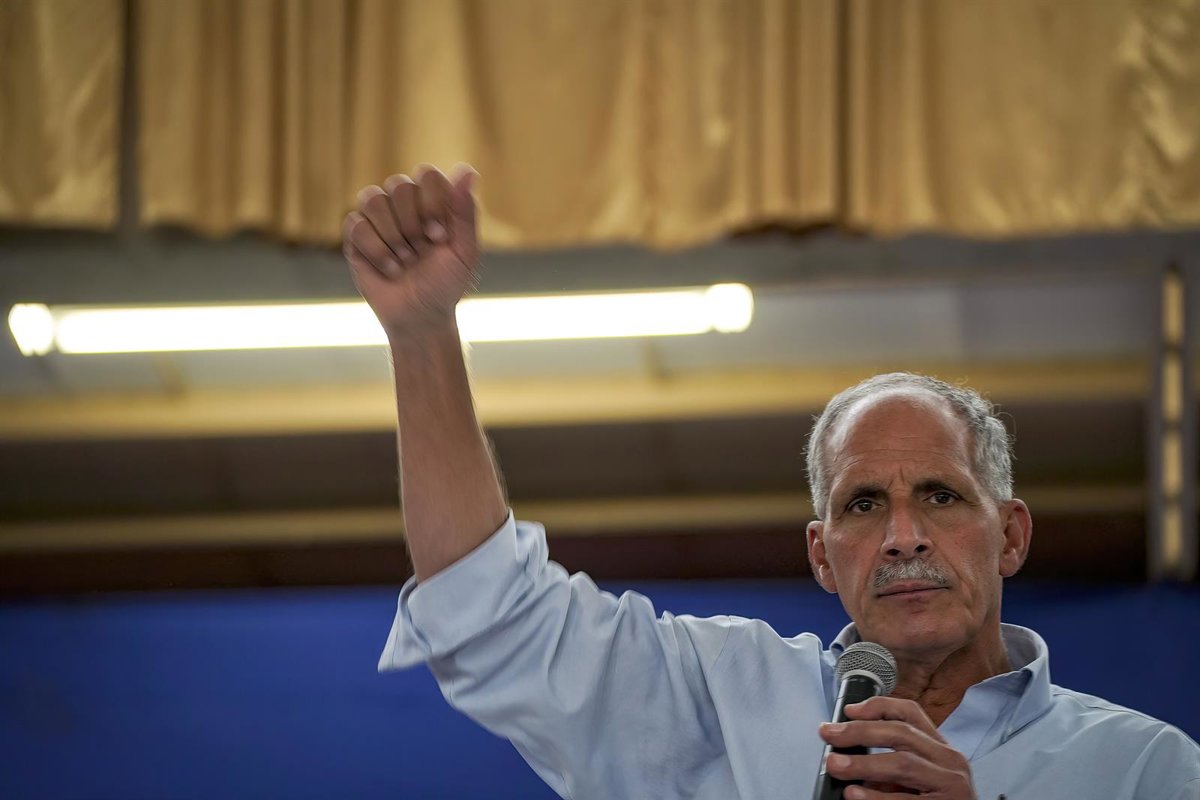
The National Electoral Center (CNE) of Honduras declared this Wednesday Nasry Asfura, candidate of the National Party, winner of the presidential elections held on November 30 in the Central American country in a climate of tension due to allegations of fraud by other candidates for the Honduran Presidency.
“By the majority will of the Honduran people, expressed in a sovereign manner at the polls, the plenary session of CNE councilors, declares the citizen: Nasry Juan Asfura Zablah elected as constitutional president of the Republic of Honduras, for a period of four years, which begins on January 27, 2026 and ends on January 27, 2030,” reads a statement issued by the CNE.
The candidate backed by the US president, Donald Trump, has collected 1,479,748 “valid” votes, according to the electoral body’s note after a count of 97.86 percent.
The CNE has specified that there are “18,820 minutes correctly disclosed and 333 at the moment with inconsistencies, which means that 1.73 percent of the total of 19,167 (minutes) are inconsistencies.” “That is, there is a total of 98.18 percent of minutes disclosed and consistent, with a difference between the first candidate and the second candidate of 0.74 percent.”
Despite this, he has indicated that “challenge or review procedures should neither prevent the proclamation of results (…), nor become an excuse to reopen or repeat the process whose presidential elective level has a proven mathematical impossibility of reversing the result.”
Thus, the results “returned by the system” give victory to Asfura, with 40.27 percent of the votes, ahead of Nasralla, who obtains 39.53 percent and the LIBRE candidate, Rixi Moncada, who obtains 19.19 percent.
The document, which also includes the names of the 20 elected deputies of the Parliament of the Central American country, has been signed by the secretary and three advisors of the electoral body, including its president, Ana Paola Hall, who has assured on her account on the social network
Hall also wanted to clarify that the “certification contained in the declaration of general elections at the presidential level was on the verge of being a political hostage; but, we have firmly defended and continue to defend that the declaration does not belong to the will of any counselor, nor of any political party, it only responds to the truth of the results that reflect the will of the Honduran people.”
However, the document does not have the signature of Marlon Ochoa, CNE advisor for the ruling party LIBRE, who has accused Hall and Cossette López – representative in the CNE for the National Party – of “imposing from an embassy the final declaration of the presidential election without having completed the vote count and without even having resolved the complaints and demands for a recount.”
“Of course I understand the United States and the elite allies of organized crime, they want a president who responds to their interests. It does not matter that it arises from an electoral coup d’état,” he stated on his X account, a day after reporting these events to the country’s Prosecutor’s Office.
After the publication of the text, Asfura thanked in his X account “the great work done by the counselors and the entire team that carried out the elections” and assured that he is “prepared to govern.”
For his part, Nasralla has stated before the Honduran television network HCH that the presidential statement “is illegal.” “I don’t know how they are going to give it and I don’t know, who is giving it? I don’t accept (it) and I published a couple of examples on the (social) networks of the ways in which the minutes were violated,” he noted before adding that “there was an algorithm where the highest figure was always given to the National Party.”
It should be remembered that Asfura’s declaration as president-elect of Honduras comes 24 days after the elections were held and after several interruptions in the counting.
In this context, the Organization of American States (OAS) has released a statement in which it states that it “takes note of the declaration of results” of the CNE while it “closely follows the events in Honduras.”
The Secretary General of the OAS, Albert Ramdin, stated in the same note that “he is aware of the difficulties experienced during the electoral process, recognizes the work carried out by Honduran institutions and regrets that the total count of the votes cast by citizens has not yet been completed.”
However, he has shown himself open to collaborating with the Honduran authorities to “support a peaceful transfer of power and in accordance with the law, in the best interest of the Honduran people” and has indicated that the OAS Electoral Observation Mission continues to be deployed in the Central American country, “carrying out its work in a professional and independent manner (…) and will issue a report in the coming days with its findings and recommendations.”
The Mission, which has also issued a statement after the dissemination of the CNE results, has stressed that the text has been adopted by “a collegiate body constitutionally mandated to do so”, has assured that “it has not identified determining fraudulent elements” during the electoral process and has considered that “the declared results reflect the will expressed by the citizens in the ballot boxes counted.”
Despite this, he has warned that the official results arrive “in a post-electoral context of extreme polarization and complexity, which has prevented the electoral authorities from working with the tranquility and autonomy that is typical of a democracy, even affecting their personal integrity and that of their families.”
“Delays were observed in the management of the retracted material and limitations in the implementation of technological solutions for the processing of the results. Although these deficiencies affected the timeliness and clarity of the official information, the Mission verified that they did not compromise the integrity of the election,” he maintained, while regretting that “the circulation of misinformation in this context generated uncertainty in the population, a situation that was aggravated by the absence of timely institutional communications by the CNE.”
Thus, he has indicated that “he is aware that there are actors who have expressed disagreements with the electoral process and its outcome”, which is why he has asked to “end” the remaining count and “channel the existing challenges through the corresponding legal channel.”
https://www.brownbook.net/business/54579795/gpnmncom
https://bestadsontv.com/profile/520792/Reid-Padgett
https://www.divephotoguide.com/user/pmcsvdhots
https://skitterphoto.com/photographers/1984252/elian
https://www.wishlistr.com/profile/midnightio/
https://protocol.ooo/en/users/MaverickCampbell69
https://www.callupcontact.com/b/businessprofile/steroidskaufen/9905426
https://gitflic.ru/user/bfvyzugyag
https://www.siteinspire.com/profile/25745-joaquin
https://profile.ameba.jp/wyumzzdtgy
https://www.bunity.com/-f735aa8a-9125-4cc3-b981-b428c6de013b?r=
https://schoolido.lu/user/rctyorcsrc/
https://forum.amzgame.com/thread/detail?id=239341
https://hedgedoc.envs.net/s/FYtCJ_qAO
https://cannabis.net/user/201263
https://yabookscentral.com/members/rctyorcsrc/profile/
https://telegra.ph/httpssteroidskaufencomde-12-15-2
https://www.gta5-mods.com/users/TheodoreMitchell39
https://wallhaven.cc/user/vxyzepkgdd
https://tamilculture.com/user/gtlujhbsbkd-gtlujhbsbk
https://www.bandlab.com/user9008800971997789
https://cannabis.net/user/202128
https://bulkwp.com/support-forums/users/ymplfscqts/
https://allods.my.games/forum/index.php?page=User&userID=217124
https://www.obesityhelp.com/members/wyumzzdtgy/about_me/