The Trump administration claimed ICE agents enjoyed “absolute immunity” after the Minnesota shooting, despite strict rules on the use of force.
The shooting and death of female driver Renee Nicole Good, 37 years old, in Minneapolis, Minnesota, by special agent Jonathan Ross of the US Immigration and Customs Enforcement (ICE) on January 7 shocked American public opinion, sparking a series of protests in many cities against immigration raids.
However, President Donald Trump’s administration officials have repeatedly spoken out to defend Agent Ross’s deadly shooting, even though instructions from ICE stipulate that this is only a last resort.
“That agent is protected by absolute immunity,” Vice President J.D. Vance said last week about the ICE agent who shot and killed Good. “He was just doing his duty.”
However, ICE’s internal documents stipulate that during immigration raids, agents need to minimize their use while trying to remove suspects from the vehicle, and issue orders in a “professional”, “firm” and “polite” tone.
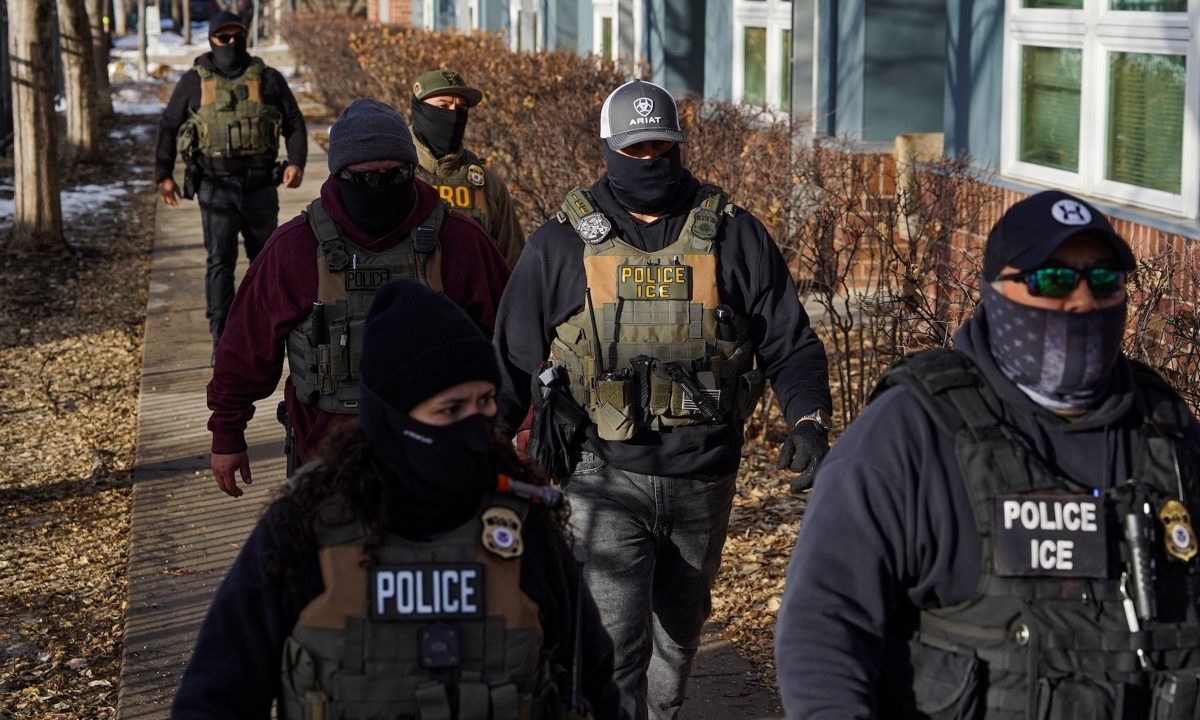
ICE agents participate in an immigration raid in Minneapolis, Minnesota, on January 13. Image: Reuters
“The first step in arresting someone sitting in a vehicle is not to reach in and pull them out, unless absolutely necessary,” an internal ICE document on stop instructions reads. “Deadly force may only be used when agents believe lives are in danger.”
The fact that Trump administration officials were quick to honor Ross as a “hero” and describe Good as a “domestic terrorist” has raised doubts about whether the federal agents carrying out President Trump’s deportation campaign are properly trained to deal with street encounters.
The response of President Trump and his officials to the incident also shows that they are supporting the use of deadly force in self-defense, which is considered only a last resort according to standard guidelines.
Instead of encouraging agents to defuse tense confrontations, President Trump and a series of administration officials seem to have tacitly approved of tougher, more forceful tactics.
Weeks before the shooting, an ICE leader told officers to act aggressively if threatened. Immediately after the incident, President Trump and many government officials announced that Good intentionally drove into the agent, although video analysis of the encounter showed that the female driver appeared to have swerved to avoid this person.
On January 13, the US Department of Homeland Security reiterated the position of “absolute immunity” for agents by posting a video on social networks, in which White House Deputy Chief of Staff Stephen Miller declared: “You have immunity to perform your duties and no one, whether city officials, state officials, illegal immigrants, left-wing agitators or domestic rioters, can prevent you from fulfilling your legal duties and responsibilities.”
Tensions in Minneapolis escalated dramatically after Good’s death. On the night of January 14, federal agents in the city shot and wounded a man who was allegedly attacking him, according to information from authorities. The incident led to hours of clashes between protesters and law enforcement.
White House spokeswoman Abigail Jackson confirmed that ICE agents were using appropriate tactics.
“The entire Trump administration stands behind the heroic ICE officers who are performing their duties with the highest professionalism and integrity while making America’s communities safer,” she said. “Self-defense against an individual using a car as a deadly weapon is not ‘brute force tactics’. ICE officers have the right to self-defense.”
Department of Homeland Security spokeswoman Tricia McLaughlin emphasized that all ICE agents are trained to use the minimum level of force when dealing with dangerous situations, prioritizing the safety of the public and themselves, and they also undergo formal training on de-escalation measures.
However, Donell Harvin, former director of the Washington Department of Homeland Security and Intelligence, said that ICE agents did not properly implement the professional safety rules of law enforcement. He also pointed out that some information shows that some ICE recruits are only trained for 47 days, instead of 5 months as before.
The Minneapolis shooting also showed the risks of Mr. Trump’s decision to send ICE to carry out large-scale raids in a series of cities, pushing them into confrontations with angry crowds.
According to a 2021 report from the Government Accountability Office, most ICE agents are not trained for crowd control. This is partly due to ICE’s history of focusing on targeted, low-profile arrests that rarely put officers in conflict with the public.
In fact, federal officers do not have absolute immunity from prosecution, even though the US constitution makes it difficult for states to prosecute them for actions taken while on duty. They could still face federal charges, but this is considered unlikely in the Minneapolis incident.
Deputy Attorney General Todd Blanche emphasized “there is no basis for a criminal civil rights investigation” into this shooting. Instead, administration officials said ICE will conduct an internal investigation.
The US Department of Justice meanwhile decided to investigate Good’s partner and groups protesting immigration management forces, instead of considering whether Agent Ross’s shooting was legal or not. At least six federal prosecutors in Minneapolis simultaneously resigned in protest.
President Trump also made no move to ask ICE to step back, raising the risk of more conflicts between agents and protesters.
“Do not be afraid, wonderful Minnesotans, the day of judgment and atonement is coming!”, he wrote on social networks on January 13.
The encounter led to ICE agents shooting and killing people in Minneapolis, Minnesota. Video: X/AlphaNews
Scott Shuchart, a senior ICE official under former President Joe Biden’s administration, commented that through the messages given, Trump administration officials seemed to want to send agents “forget the procedures in the training documents” and “forget what the lawyers told them.”
According to internal homeland security documents, including training materials, use of force instructions, legal guidelines drafted by ICE attorneys, and gun policies, tactics to avoid confrontation or provoke confrontation are always emphasized.
“Officers on duty should use de-escalation tactics through communication or other techniques during the encounter to stabilize, delay or de-escalate a potentially violent situation,” the document notes.
The documents also state the “use of force level” that officers should follow. They begin with the officer arriving at the scene with a “professional, courteous attitude”. Next is giving verbal commands. Officers can then deploy “soft techniques” such as applying “pressure points” or using “chemical agents”, followed by “hard techniques”, such as strikes with the hands, feet, head or whole body or using non-lethal weapons, such as batons. The final step is the use of deadly force, including shooting.
The document states that officers have the right to increase the level of force used at their discretion and can use lethal measures if faced with “imminent danger of serious bodily injury or death to the officer or bystanders.”
In the case of female driver Good, whether Agent Ross is in danger or not is becoming a controversial topic.
Video shows federal agents quickly approaching the SUV that Good had stopped on the street. An agent cursed as he asked Good to get out of the car before almost immediately trying to open the driver’s door by reaching through the open window.
As Good appeared frightened and drove forward, Agent Ross, who was standing at the front of the car and recording video with his cell phone, opened fire and killed her.
Ross is an experienced ICE officer who worked as a shooting instructor at St. Paul, Minnesota, and also received extensive training as a task force member. Special forces are often trained in crowd control. In court documents, Ross said he fought in Iraq.
But Ross and the ICE agents involved in Good’s shooting may have failed to comply with some points in the training program, according to documents and interviews. Three former senior ICE officials said their officers were often advised not to stand in front or behind stopped vehicles to avoid being hit by them.
Renee Nicole Good, the woman shot and killed by ICE agents in Minneapolis on January 7. Image: Economic Times
Customs and Border Protection, a unit within the Department of Homeland Security that has similar duties to ICE, requires agents to “avoid standing directly in front or behind a subject’s vehicle.”
The Department of Homeland Security’s office of inspector general said it is conducting a review of ICE’s hiring and training processes. Additionally, the office has begun a review of how ICE investigates “allegations of excessive force” and disciplines officers.
“I feel so embarrassed,” said a former ICE agent with more than 25 years of experience TIME about the Minneapolis shooting. “Most of my colleagues feel the same way. It’s an insult, because those of us who used to work in a standard way are having to see how they operate now.”