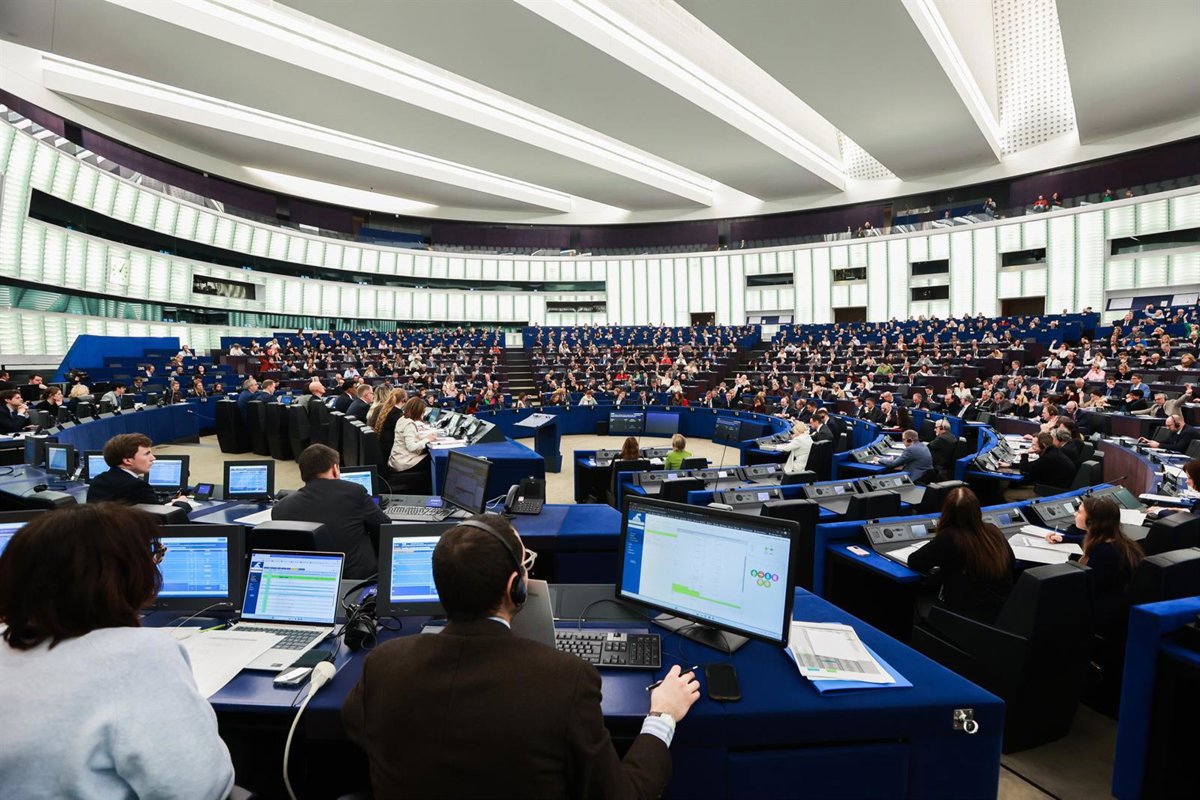
The European Parliament has asked the institutions of the European Union to respond with “firmness, collectivity and decision” to “any form of coercion” against member states, after the United States has threatened eight European countries in retaliation for its military deployment in Greenland in the face of Donald Trump’s threat to take control of the island.
In a non-binding resolution approved by a large majority this Wednesday in the plenary session of the European Parliament in Strasbourg (France), MEPs have denounced the use of “unilateral trade threats” and “economic intimidation” against Denmark and five other EU member states “as a form of coercion.”
On Saturday, Trump announced that starting next February 1, he will impose additional 10% tariffs on the United Kingdom and Norway, as well as six other EU countries (Denmark, Sweden, France, Germany, the Netherlands and Finland) for their participation in ‘Operation Arctic Resistance’ and until an agreement is reached for the purchase of Greenland.
These are exercises promoted by Denmark, to whose kingdom the Arctic island belongs, and which have had the support of the other seven countries mentioned by the president of the United States, who declared this deployment, directly, as a “threat” to global security.
CONCERN ABOUT US “FOREIGN INTERFERENCE”
Following what they consider to be “threats” from the United States, the MEPs have lamented in the resolution “the more transactional approach of the US Government in foreign policy”, marked by “a lower commitment to multilateralism and European security”.
Faced with this situation, they demand that the European Union as a whole learn from its “vulnerabilities”, to “avoid being exposed to coercion in the future”, with greater spending on defense, the coordination of defense capabilities, as well as greater strategic autonomy.
The European Parliament also raises “serious concerns” about “foreign interference in Greenland”, including hybrid actions and explicit threats by the United States “to the sovereignty of Greenland”, posing a risk to the strategic interests of the EU, NATO and even the rules-based order.
The text calls for a “unified response” from the Twenty-Seven and supports the joint statement made by several EU Member States on January 6, 2026, stating that the future of Greenland can only be decided by Denmark and Greenland.
Likewise, it expresses alarm at the US National Security Strategy of December 2025 which, according to MEPs, “formalizes an unfounded policy of viewing the EU, including its fundamental values, principles of democratic governance and several of its fundamental security objectives, as opposed to US interests.”
Recognizing the vital role of NATO and the United States as a key ally of Europe, Parliament also highlights the increasing unpredictability and isolationism of US foreign policy, including the risk of troop withdrawal from Europe.
THE INFLUENCE OF THE EU DOES NOT REFLECT ITS ECONOMIC POWER
The text approved in the European Parliament confirms that from Ukraine to the Caucasus, passing through the Middle East and extending to the Arctic, the European Union faces “an arc of instability” around it, which is why they urge the community institutions to “not allow themselves the luxury” of turning in on themselves.
The EU, the resolution defends, “must remain open and engaged”, emphasizing its “global visibility and political influence”, which “are often not equal to its economic, financial and diplomatic impact”.
Faced with this reality, one of the resolution’s speakers, German PP MEP David McAllister, has stated that the EU must strengthen its “global alliances” and improve its capacity to “deter threats” and ensure that enlargement, the neighborhood policy and cooperation with like-minded democracies “contribute to its long-term security.”
“At the same time, the EU must increase its visibility, improve its external representation and ensure that its instruments, from sanctions to strategic communication, are used effectively and consistently,” he added.
Another of the report’s rapporteurs, the Dutch socialist Thijs Reuten (S&D, Netherlands), indicated after the vote that “the current circumstances leave no room for doubt” that “Europe needs a solid, autonomous and operational defense capacity.”
“We must go beyond short-term national interests and not only complete a single defense market, but also give true meaning to the EU’s mutual assistance clause,” he declared, demanding that “Europe can take care of itself.”