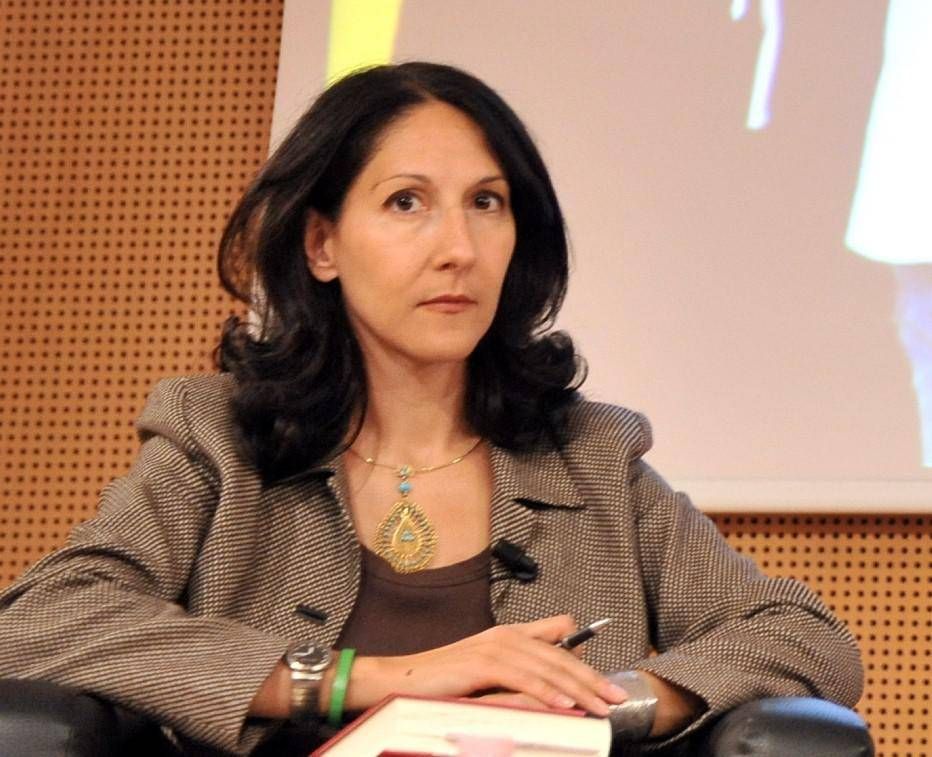
When Farian Sabahi arrives at the Guarini Institute of John Cabot University, the news of the day is already a signal: Iranian exercises in the Strait of Hormuz, in the midst of a new cycle of pressure and counter-pressure between Tehran, Washington and Israel. In his lesson, introduced by the professor Federigo Argentieri and coordinated by Martina Atanasova of the university’s International Relations Society, Sabahi does not present Iran as an indecipherable enigma, but as a coherent system, where history, ideology, economy and the architecture of military power come together. And where, above all, diplomacy and deterrence are not alternatives: they are two tools of the same strategy.
The indirect negotiations in Geneva brought the nuclear dossier and the issue of sanctions back to the centre. Meanwhile, at sea, Iran is flexing its muscles: exercises, messages, temporary closures of sections of the Strait for security reasons. For Sabahi, associate professor of contemporary history at the University of Insubria, expert on Iran and author of “We women of Tehran”, “History of Iran 1890-2020”, and “At the court of the Shah”, simultaneity is not a contradiction: it is the method. The Iran that emerges from the lesson is an actor that thinks on three tracks: war, diplomacy, internal change. But the third way, at the moment, appears suffocated: in recent months there have been successive arrests, repression and isolation of reformist currents.
Does diplomacy still matter?
The format of the talks remains indirect, mediated by Oman. The agenda revolves around well-known elements: limits on the nuclear program, inspections, management of uranium supplies, easing of sanctions. The Iranian position insists on a precise exchange: greater access to international inspectors in exchange for concrete economic benefits. Among Tehran’s demands is not only relief from sanctions, but also the return of assets frozen following the 1979-81 hostage crisis.
The issue of the credibility of the agreements emerges as a key factor. The precedent of 2018, in Sabahi’s reading, is not a negotiating detail, but a political watershed: the unilateral decision of the Trump administration, in its first term, to exit the JCPOA and impose new sanctions, including secondary ones. Measures which have effectively prevented the Europeans from maintaining the commitments made in the nuclear agreement.
Sanctions and the economy: systemic effects
Sabahi underlines that sanctions do not represent just a geopolitical tool, but a decisive internal variable. High inflation, devaluation of the rial and loss of purchasing power directly affect social stability. “If you want to help the Iranians inside Iran, the only way is to lift the economic sanctions. You can’t have a revolution with an empty wallet.” The economic compression, he observes, also produces distorting effects: expansion of parallel markets, uncertainty in prices, defensive behavior on the part of traders and consumers.
Sabahi gives very concrete examples: shops that close, goods that are held back because “they will cost more tomorrow”, not only for consumers, but for the shopkeepers themselves, and therefore wholesale. It’s not just discontent. It is a mechanism that, paradoxically, can make society less capable of sustaining prolonged mobilizations.
Hormuz: you don’t need to close the Strait to make it a weapon
The Strait of Hormuz is the strategic “lever” par excellence. Not because Iran shuts it down every time, but because the very possibility that it can does so affects markets, insurance, logistics chains, and political decisions. Approximately one fifth of global oil consumption (in terms of “petroleum liquids”) and approximately one fifth of global LNG trade passes through Hormuz. It’s enough to make it a global point of vulnerability.
The fear map: Why Gulf neighbors have the most to lose
One of the most interesting passages of Sabahi’s lesson does not concern Tehran, but Doha and Abu Dhabi. Sabahi describes the reaction of the Gulf countries to the hypothesis of Iranian retaliation, and he does so with an “infrastructural” logic. “The fear,” he explains, is not just that military bases or assets will be hit. The real fear is a blow to critical infrastructure, particularly power plants. In the Gulf, electricity means water.
Without electricity, desalination plants fail, in an area where drinking water largely depends on them. Even elevators, essential in skyscrapers, and air conditioners, an essential element for urban liveability, would not work. In this sense, Iranian deterrence does not necessarily have to aim at “classical” military targets, and there is no need to do so with sophisticated ballistic missiles. It can threaten critical civil infrastructure: electricity and water, i.e. social stability.
Qatar, the Emirates and Oman have a direct interest in cooling the escalation. If the conflict spreads, if the United States bombs, the Gulf countries become plausible targets, even if only as “platforms” where American troops are present. This is why they push for indirect channels, mediations, discrete formats.
Pasdaran and dual state: the structure that governs the Islamic republic
The most “structural” part of the lesson concerns military architecture: Iran, Sabahi reminds us, has a double system. On one side the regular army, on the other the Pasdaran, created to preserve the system, control internal order and project influence externally. This duality is not an institutional detail: it is an anti-coup mechanism and, at the same time, the basis of contemporary power. Sabahi insists: the Pasdaran are strong militarily, but also economically and politically. In a country under sanctions, the control of borders and flows fuels smuggling and revenues. And whoever controls the borders also controls the riches.
This point is directly linked to the topic of sanctions. In a “compressed” economy, parallel markets and informal networks expand. Sabahi describes how theoretically unavailable goods end up in the country anyway, and how this fuels power and political capital for the structures that manage those channels. This is also why any hypothesis of a “simple transition” appears illusory: there is not only a leadership to replace, but an ecosystem of power with profound material interests.
Women, rights and pragmatism of the regime: the “non-imposed” veil to survive
The lesson then goes into the theme that Sabahi has known and talked about for years: Iranian women, the legal asymmetry and the cultural strength of a society that, despite everything, produces human capital. Women today represent approximately two-thirds of freshmen and two-thirds of graduates. Only 8% of the Iranian university population, men and women together, choose humanities faculties, while scientific and technical disciplines prevail.
Sabahi cites global symbols: Shirin Ebadi, Nobel Peace Prize winner in 2003, now exiled in London; Narges Mohammadi, Nobel Peace Prize 2023, currently detained in Zanjan; Maryam Mirzakhani, Fields Medal for Mathematics. But immediately afterwards he highlights the fracture: in court, “my word is worth half”, the “blood price” is worth half, the inheritance is worth half. And freedom of movement remains conditional.
Then comes one of the most interesting passages about the present: after the “woman life freedom” movement, the regime chose a defensive pragmatism. The easing of the application of the rules on the veil was decided in 2025 by the Council of the National Interest, a body created by Ayatollah Khomeini a few months before his death to resolve disputes between the different centers of power.
The basic principle, Sabahi recalls, is explicit: deciding according to the national interest and the preservation of the Islamic Republic. The law on the obligation to cover the head remains, but the enforcement changes: “the code is still the same, but the order to the police is not to put it into practice”. A controlled easing to save Islamic rigor and political stability. However, it is not clear whether the same format will be repeated in negotiations with the United States. (by Giorgio Rutelli)
https://allods.my.games/forum/index.php?page=User&userID=227893
https://www.thuum.org/viewthread.php?thread=37207
https://edabit.com/user/yDSa2DpbxW367beDh
http://issuu.com/koatgungkuanhxanh
https://pubhtml5.com/homepage/knmqe/
https://imageevent.com/bentiecehowarth/easyfunwithoutlimits
https://hashnode.com/@noellestevens
https://linktr.ee/noellestevens9.6.7.3.1
https://nohat.cc/u/noellestevens
https://medium.com/@wi.m.itch0.4.9/fun-and-fast-paced-entertainment-on-the-road-4005bb2a65b2
http://sapos-stunning-site.webflow.io/
https://tinted-shrimp-t6k58v.mystrikingly.com/
http://gitea.com/baumgaerthompson/-/projects/9331
https://muckrack.com/baumgaer-thompson/bio
https://69664f205cfed.site123.me/
https://myanimelist.net/profile/baumgaerthompson
https://pbase.com/baumgaerthompson/image/176059906
http://allods.my.games/forum/index.php?page=User&userID=225644
https://paizo.com/people/carlostucker
https://devfolio.co/@carlostucker/readme-md
https://app3.mockplus.com/app/share-29b168ae2f0a5d138fc0edf9c800db10share-jXi1t3pfv/prd/H0igYPuqB4
https://www.keepandshare.com/discuss4/34453/fun-colorful-and-full-of-energy
https://www.divephotoguide.com/user/jeffreywallaceallace
https://portfolium.com/carlostucker93729
https://inkbunny.net/jeffreywallace