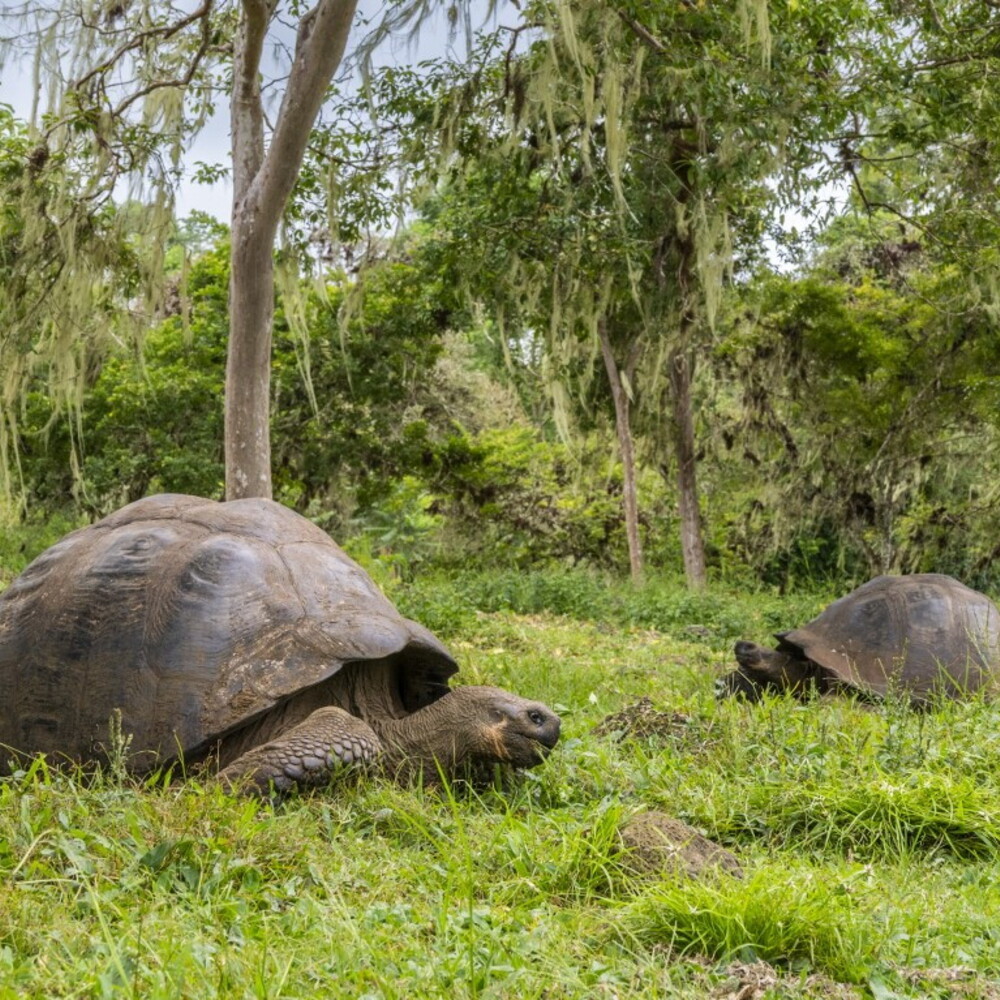
After almost 150 years, giant tortoises return to Floreana, in the archipelago of Galapagos in Ecuador. According to ABC, dozens of young hybrids have been released with the aim of starting to restore the islands’ ecosystem. The new arrivals are 158, aged between 8 and 13. The release was timed with the arrival of the first winter rains of the season. “They are big enough to be released and can defend themselves from animals like rats and cats,” said Fredy Villalba, director of the Galapagos National Park breeding center on Santa Cruz Island.
They had disappeared at the end of the nineteenth century
The best specimens, with the strongest lineage, were selected specifically for Floreana, from which the giant tortoises had disappeared at the end of the 19th century. In total in Floreana approximately 700 specimens will be gradually released. According to Christian Sevilla, director of ecosystems at the Galapagos National Park, turtles have between 40% and 80% of genetic makeup of Chelonoidis niger, the species that became extinct 150 years ago.
These hybrids derive from turtles found in 2020 on the volcano Wolf Volcano, on Isabela Islanda discovery that still leaves some scientists perplexed today. By selecting adults with the strongest genetic makeup, Sevilla said, the breeding program aims to gradually restore the extinct Floreana species to its former purity.
Two centuries ago Floreana was home to around 20,000 giant tortoises
However, whaling, a devastating fire, and relentless human exploitation ultimately led to their complete extinction on the island. “In genetic terms, reintroducing animals to the island with a significant genetic component of the original species is vital,” biologist Washington Tapia told the Associated Press. Tapia, researcher and director of Biodiversa-Consultores, was keen to underline that it is not simply a question of repopulating the island but of restoring a lost lineage. With an area of approximately 173 square kilometers and a volcanic land mass, Floreana is the southernmost point of the Galapagos archipelago. Located in the middle of the Pacific Ocean – approximately 1,000 kilometers from the mainland coast – it remains an ecological site of great importance.
The turtles reintroduced to Floreana will share their territory with flamingos, iguanas, penguins, seagulls and falcons, as well as 200 humans. And adaptation may not be easy: They also have to deal with non-native plant and animal species, such as blackberry and guava, as well as rats, cats, pigs and donkeys.
https://jbcasinobe.com/nl-be/verificatie/
http://community.srhtech.net/user/debtgeese78
https://bbs.pku.edu.cn/v2/jump-to.php?url=https://www.raylyst.eu/it/
https://docs.monadical.com/s/AwXo1EL_e
https://www.divephotoguide.com/user/debtcost96
https://www.ludikarus.com/author/teamsink87/
http://megapari-egypt.org/license/
https://trueluck-global.com/en-ie/about/
https://1win-lucky-jet.in.net/real-or-fake/
https://pinco-canada.net/mobile/
https://partecipo.prato.it/profiles/camiseriasigloxxi/timeline
https://flibustier.top/user/lockcuban32/
https://mycoalitionu.org/forums/users/leveldash7/edit
https://leetcode.com/u/farmaciacercana/
https://doodleordie.com/profile/atomsalad74
https://penalty.in.net/1win/
https://doc.dcrich.net/s/yvmW7he0zr
https://lgbtlook.com/index.php?page=user&action=pub_profile&id=29849
https://mapa.iberculturaviva.org/agente/844545/
https://paripesa-chile.com/cliente-para-pc/
https://pinco-canada.net/pinco-demi-gods-v/
https://www.noteflight.com/profile/ade67b4ab495d60c7864d9d7c006850a643b1160
https://pad.lassul.us/s/VTTTfOLyYP
https://participacion.pajara.es/profiles/dentistaentorredelma/following
https://docs.klg21.de/s/URujCsndJ