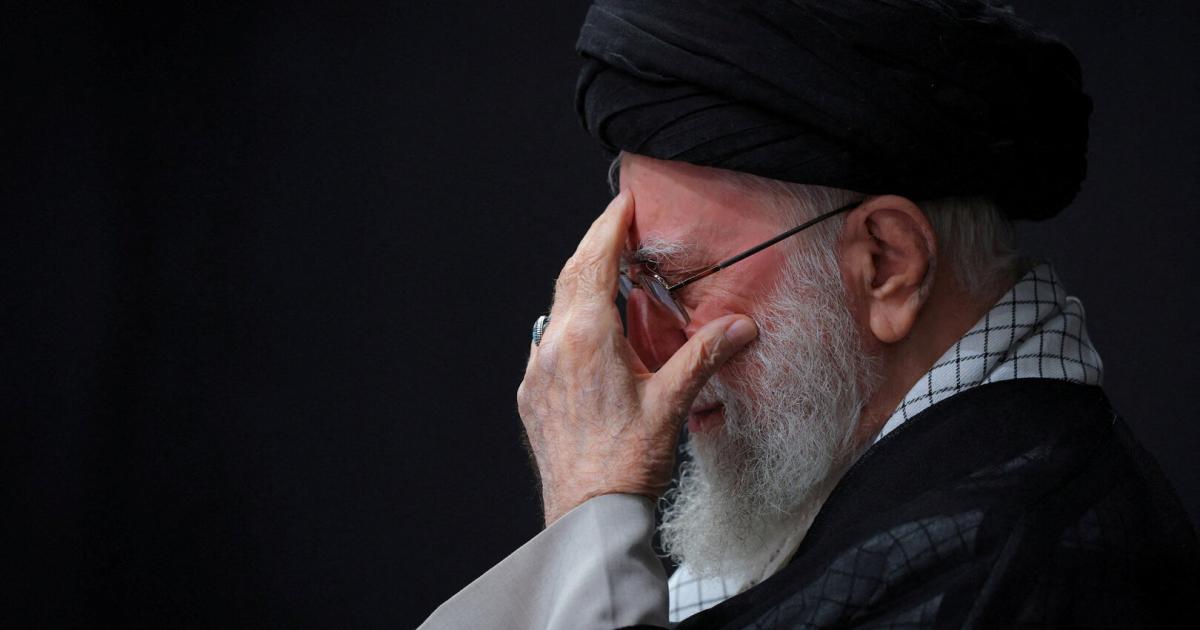
If Iran’s Elite Ali Khamenei in June 1989 Supreme Leader no one was actually convinced that he would ever achieve great things. It was supposed to be a temporary solution because they couldn’t agree on a candidate. Not even he himself exuded much confidence: “Which of you believes in my religious authority?” he said at the time.
In fact, the shoes to fill were big. Just a day earlier was revolutionary leader Ruhollah Khomeini died, founding father and religious icon of the Islamic Republic. Now, 37 years later, Khamenei himself has died, after months of observation in the hail of bombs USA and Israel’stogether with its leadership elite.
The legacy of the Mullah, his black turban and gray beard on almost every house wall Teherans emblazoned, but continues to have an impact: Khamenei was not only a religious leader, he also cemented his power economically and socially. He formed an autocratic system that outlived himself.
Balance of power
From the beginning, the basis of his authoritarian rule was a sophisticated balance between care and the repressive strength of the state. Thanks to bubbling oil revenues, Khamenei was able to put Iran on an economically secure footing for the first time after taking office; Khomeini gave him the state in 1989 after the war Irak almost bankrupt.
The population was able to breathe a sigh of relief after years of deprivation: despite US sanctions, money flowed from Asia and Europe, and the regime invested much of it in the health and education systems. Life expectancy rose sharply and to this day Iran is considered to be regionally superior in these areas.
Open/close copyright notice
© APA/AFP/AHMAD AL-RUBAYE
Supporters of the regime mourned Ali Khamenei on Saturday.
In terms of domestic policy, the Ayatollah give people a little say, even if only apparently. Over the years, moderate forces have always been allowed to run in elections, which gave the regime the appearance of legitimacy. Political restrictions for all dissidents also secured Khamenei’s rule.
They were and are still responsible for this today The Revolutionary Guard. Khomeini had that Guards founded because he did not trust the Shah’s army at the time of the overthrow. To this day, the elite unit, which has around 200,000 men, is more powerful than the regular army.
It has its own army, navy and air force as well as a secret service, and it also controls the fate of a 500,000-strong militia army, the feared Basij units. They recruit their members primarily at schools and universities and are stationed in mosques; they play a key role in suppressing all protests. Just at the beginning of this year, an estimated 30,000 people lost their lives.
The Revolutionary Guards as a state within a state
The Revolutionary Guards, which report directly to Khamenei, not only represent Iran’s security apparatus, they are a state within a state. They also control all relevant economic sectors, have their own holding company that builds motor vehicles, highways, railway lines and even subways. They are also involved in oil, gas and petrochemical projects and have a hand in ports, banks and telecommunications companies.
And with the “The Quds BrigadeThey also have a special unit for foreign operations that was used to train Iran’s allies – Hamas and Hezbollah trained with the Iranian fighters Syria they stood at the side of the Assad-Regimes.
The fact that Khamenei watched Khamenei fall at the end of 2024 and did not intervene was, for many observers, a first visible moment of weakness. Previously had Israel already Hamas and Hezbollah beheaded, Khamenei lost his allies. In addition, Iran has long been plagued by an economic crisis, triggered by the cancellation of the 2015 nuclear agreement Donald Trump. The Nuclear programone of Khamenei’s major projects for decades, was ultimately more important to the Supreme Leader than the economic survival of the state.
Even Khamenei’s sister called him “tyrannical”
The 86-year-old has also recently shown himself to be relentless, both in negotiations with the USA and towards his own people. The Ayatollah had long drawn on his grandfatherly charm in the country; he was undisputed among the clergy until the end; for them he now died as a martyr.
But large parts of the population increasingly hated him because of his rigid interpretation of Sharia law and his uncompromising social policy; No country other than China carries out as many death sentences as Iran. “Today Ayatollah”one heard again and again at the demonstrations. Even two of his siblings turned against him; one sister called Iran “tyrannical.”
The Ayatollah’s legacy is now borne by the men he himself installed. A Triumvirate consisting of president, head of justice and a cleric. How long remains to be seen.