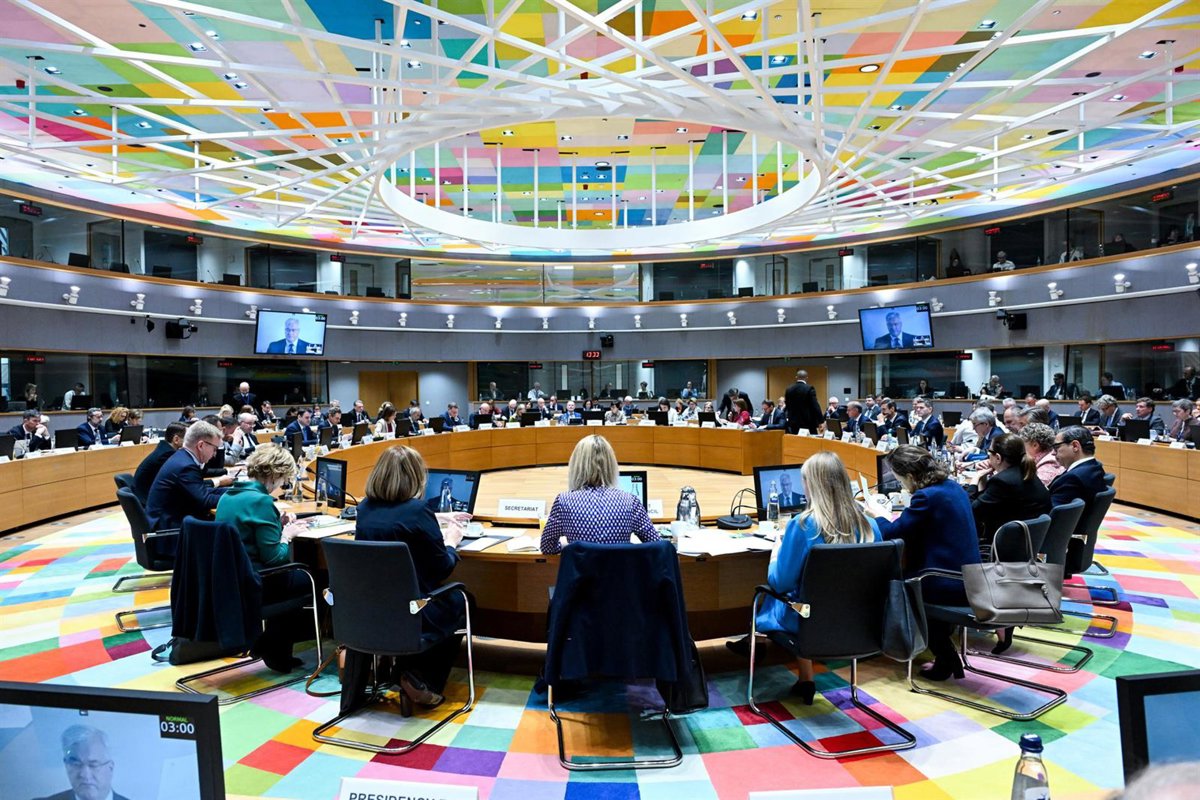
The foreign ministers of the European Union, meeting this Monday in Brussels, have ruled out sending frigates to try to reopen the Strait of Hormuz, although they have highlighted the importance of allowing the transit of ships on the main oil and gas transport route in the world, now blocked by Iran in response to attacks by the United States and Israel.
The diplomatic heads of the Twenty-Seven have expressed before the Foreign Affairs Council (CAE) held in the community capital that they do not see it viable to send European ships to force the reopening of the maritime passage and have opted for prudence and diplomatic means, while at the same time they have shown skepticism regarding the possibility of extending the mandate of the European naval mission ‘Aspides’ to the Strait of Hormuz.
All this after the High Representative of the European Union for Foreign Policy, Kaja Kallas, has proposed to the twenty-seven ministers to modify the EU naval operation ‘Aspides’ – originally designed to prevent Houthi attacks against maritime transport in the Red Sea -, or even establish one organized by the United Nations to keep the Strait of Hormuz open.
According to Kallas, it will not be “easy” to achieve it, but he has advocated in statements to the media before the CAE to find “the quickest way to guarantee” the opening of the Strait of Hormuz, at the same time he is testing other options such as an initiative within the UN framework similar to the one established after the Russian invasion of Ukraine to guarantee the transport of grain in the Black Sea.
Faced with these proposals, the Spanish Foreign Minister, José Manuel Albares, has been forceful against modifying operation ‘Aspides’ so that it operates in the Strait of Hormuz, claiming that it already has “the correct mandate” and that it is “perfectly fulfilling its functions at this time.”
He has also defended that “nothing should be done that adds even more tension” in the region and has indicated that Spain’s position is to advocate “diplomacy.” “The purely military solution never brings democracy, stability, or economic prosperity,” he added.
The Italian Foreign Minister, Antonio Tajani, has expressed himself along a similar line, stating that Operation ‘Aspides’ cannot be expanded to the Strait of Hormuz, among other things because it is an “anti-piracy” mission and what is happening with the blockade of Iran is a “different” reality.
“I think it is right to continue working in the Red Sea to guarantee maritime traffic and free movement. With regard to Hormuz, I believe that diplomatic channels must prevail. An additional diplomatic effort must be made to guarantee freedom of navigation in Hormuz,” he stated.
The head of German diplomacy, Johann Wadephul, has highlighted the “excepticism” of his Government regarding the proposal to modify the mandate of ‘Aspides’, and has advocated first waiting for the United States and Israel to explain “what their military objectives are in Iran.”
SENDING SHIPS WILL NOT SOLVE THE SITUATION
For his part, the Foreign Minister of the Netherlands, Tom Berendsen, has indicated that he does not believe that sending “some ships” will resolve the situation in the Strait of Hormuz, which he has defined as “very sensitive” due to Iran’s ability to deploy naval mines or underwater drones.
“It is not as if we had a button to press to close the strait and we did it. That is not the case. It is a very delicate situation. The chances of escalation are great. “The Netherlands wants to participate in the conversation, but in this case it is very important to act with caution before making decisions,” he added.
His Greek counterpart, Georgios Gerapetritis, has indicated that Greece has no intention of “getting involved in the war” and that Operation ‘Aspides’ “is already operating in the broader region, in which Member States of the European Union participate” in the Red Sea, although he has expressed concern about the situation.
“On freedom of navigation, Greece is in favor of the free movement of all ships in the region and calls on Iran to respect the rules of international law of the sea. It is essential, not only for oil prices but for the entire supply chain, that the seas remain open,” he added.
DEBATE ON NATO’S COMPETENCES
There has also been a disparity of opinions about NATO’s role in the conflict, especially after US President Donald Trump’s warning that the Alliance faces a “very bad future” if they do not help Washington recover traffic in the sea passage blocked by Iran.
In the opinion of the High Representative of the EU, Kaja Kallas, the Strait of Hormuz “is outside the area of action” of the Atlantic Alliance itself, since “there are no NATO countries” in the region.
“That is why we have operation Aspides, and there are Member States that are also willing to contribute,” he added.
The German minister has indicated that he does not see the Alliance making a decision on the Strait of Hormuz, and the spokesman for the German Government, Stefan Kornelius, has stated in statements from Berlin that “this war has nothing to do with NATO.”
On the other hand, the Romanian Foreign Minister, Oana-Silvia Toiu, has stated that “NATO is above all a defensive alliance and that is the most important aspect on which it must focus when it comes to providing support.”
In the case of the Polish minister, Radoslaw Sikorski, he has confirmed that at the moment no procedure has been activated regarding NATO’s role in this conflict, but he has indicated that if there is a formal request from the United States they will examine the proposal “very carefully.”
The Hungarian Foreign Minister, Péter Szijjarto, has expressed himself along the same lines, highlighting that at the moment there is “no proposal on the table”, and that if there were they could address it.