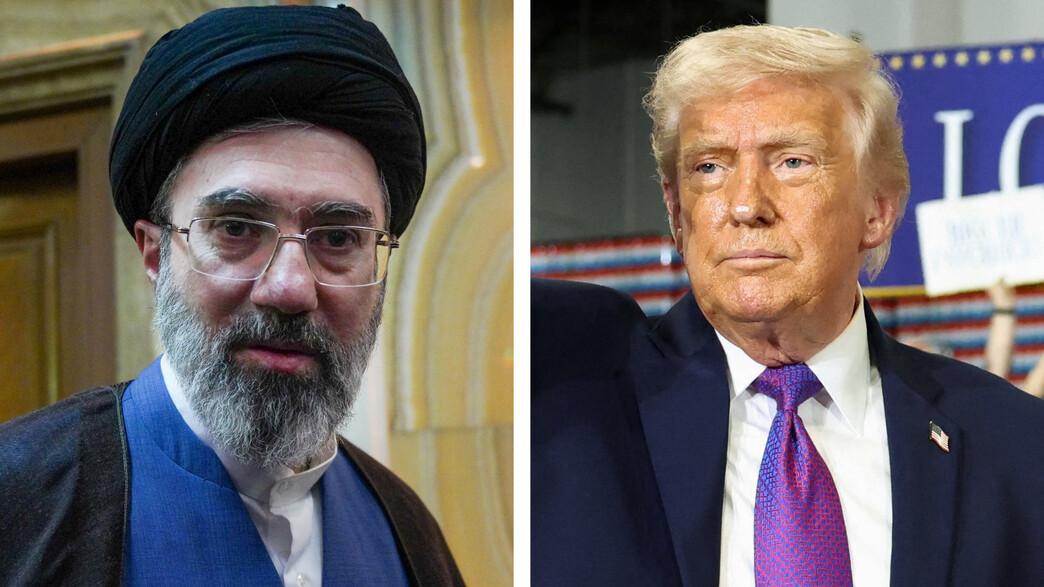
American and Iranian representatives will meet on Saturday in Pakistan with the aim of reaching a long-term agreement • Iran proposed a 10-point plan, while the Americans formulated a counter-proposal of 15 points – and between the two proposals there are large gaps in key issues • On the other hand, a compromise on the Strait of Hormuz issue appears
Iran and the United States announced a cease-fire, and on Saturday senior representatives from both countries are expected to meet in Islamabad, the capital of Pakistan, to start negotiations. Despite the positive rhetoric on the part of President Trump, on paper the gaps between the parties are still very large – and it is not clear how Tehran and Washington intend to bridge the gulf between them on the key issues that led to the war.
Iran’s 10 points and the USA’s 15 points
- The United States last month submitted a 15-point proposal for an agreement with Iran, while Tehran submitted a counter-proposal of 10 points. Although the two proposals are very different from each other, and the countries agreed to work on the basis of both during the negotiations.
- In a statement published by Iranian Foreign Minister Abbas Araqchi and echoed by Trump afterwards, it is written that Iran will agree to the supply of fire while “considering Trump’s request for negotiations on the basis of the 15-point plan, and on the basis of the acceptance of Iran’s 10-point plan as a framework for negotiations by the American president.”
- In the post in which Trump announced the ceasefire, he wrote that the United States “accepted Iran’s 10-point proposal, and we believe it is a viable basis for negotiations.” The president added that “almost all the main points of contention that existed in the past between the United States and Iran have already been agreed upon between the parties.”
- The White House claimed that the 10-point plan that was “published in the media” is very different from the one on the basis of which the regime works. However, the 10-point plan was released by Iranian officials after the ceasefire was announced.
The main points of contention
- Against the positive rhetoric of the president, it seems that Iran’s list of demands is very far from the American proposal on a number of key issues.
- The Iranian plan includes a demand for recognition and acceptance of uranium enrichment by Iran. On the other hand, the American proposal asks for an Iranian commitment to give up enrichment in Iranian territory – and Trump reiterated this demand in a post he published yesterday on the Truth network.
- Another frontal dispute concerns the situation in Lebanon. According to a series of reports, Iran demanded that the ceasefire also include Hezbollah, and in an official statement issued by the Prime Minister of Pakistan, one of the main mediators, he announced that the ceasefire does include Lebanon. But shortly after, Prime Minister Netanyahu’s office announced that Israel would continue fighting beyond the northern border, and yesterday Trump confirmed to the PBS network that the current agreement with Iran does not include a ceasefire in Lebanon. In the field, the Israeli attacks continue in the north.
- The main demands of the United States even before the war, which are actually also to a large extent the war goals of Israel and the United States – did not receive any consideration in the Iranian 10-point plan. These demands include restrictions on the ballistic missile array, the end of support for the proxy array, and the delivery of 450 kilos of highly enriched uranium.
A surprising point of agreement?
- The Strait of Hormuz has become one of the main focuses of the war, and its opening is critical for President Trump and the American and global economy.
- Iran’s 10-point plan includes Iran’s control of the Strait of Hormuz, in the form of collecting fees from ships passing through the Strait. On the other hand, Trump has repeatedly emphasized in recent weeks that he demands free passage through the Strait.
- But it seems that on the issue of Hormuz, the parties are on the way to agreements – Iran announced that it will collect fees from ships that want to pass through the Strait, and Trump told the NBC network that he is considering cooperation with Iran and collecting joint fees in the Strait. “We are thinking about a joint initiative. This will be a way to secure the Strait – it will be wonderful,” said the president.
Representatives from Washington and Tehran are expected to arrive in Pakistan on Saturday and start the negotiation talks. Both sides hope to reach a long-term agreement, but at the current stage it seems that there are still large gaps.
https://magiuscasino-uk.eu.com/
https://magiuscasino-uk.org/
https://magiuscasino.com.es/
https://magiuscasino.com.nl/
https://magiuscasino.eu.com/
https://magiuscasino.mobi/
https://magiuscasino.net.nl/
https://magiuscasino.org.es/
https://magiuscasino.org.gr/
https://magiuscasino3.com/
https://magiuscasinonl.net/
https://magiuscasinonl.org/
https://magiuscasinouk.com/
https://magnum-bet.org/
https://magnumbet-ro.com/
https://magnumbet.eu/
https://malina-casino.ch/
https://manhattan-casino.net/
https://manhattan-casino.org.ro/
https://manhattancasino.eu/
https://manhattancasino.eu.com/
https://manhattancasino.org.ro/
https://marathonbet.co.it/accesso/
https://marathonbet.co.it/app/
https://marathonbet.co.it/bonus/