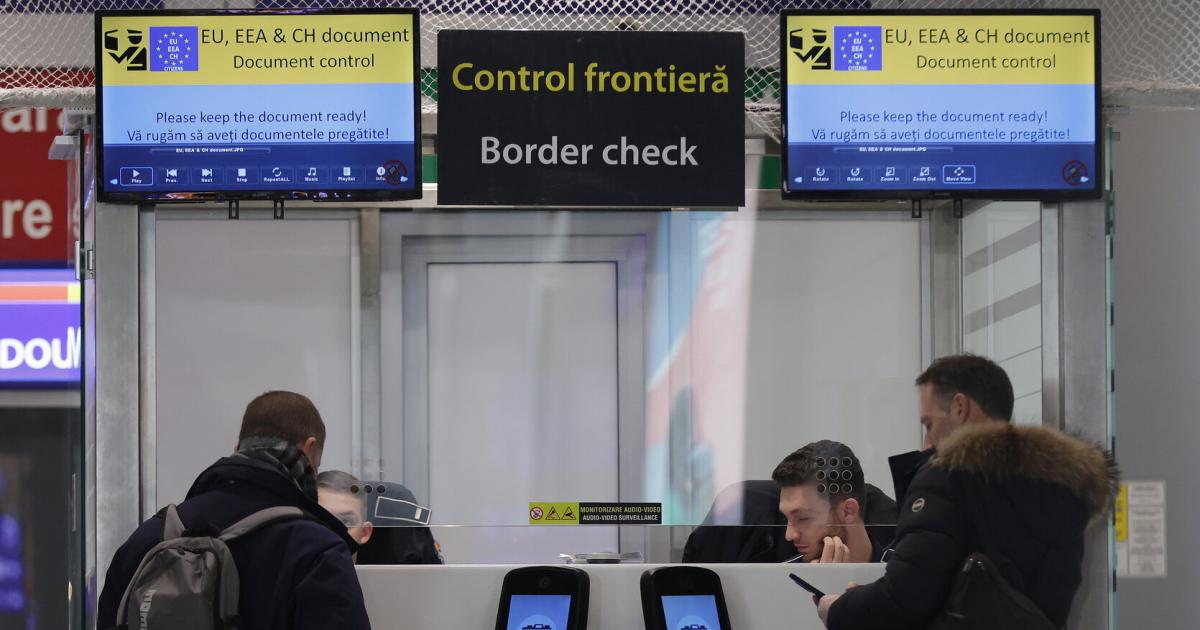
Whether at Vienna’s Schwechat Airport or at the military-secured Terespol border crossing between Poland and Belarus: today the EU’s new EES system comes into force for 29 European states – i.e. the entire Schengen area. Of the EU states, only Ireland and Cyprus are missing.
The system records all non-EU citizens entering and leaving the country, including their biometric data, and makes this data immediately available to the authorities throughout the entire Schengen area. The world’s most modern border control system, as the team of the responsible EU Commissioner for Home Affairs, Magnus Brunner, proudly emphasizes, has been being tested at many external borders for months. It shows considerable success, For example, when registering people entering the country with criminal or terrorist contacts: In the previous trial operation, around 26,000 people were refused entry. For the most part, there were minor problems behind it, such as expired visas. However, 700 people were actually classified as a danger to the EU, meaning they had contact with criminal or terrorist groups.
Model student Austria
The system is already running largely without any problems in Austria. Of course, this is also because the only EU external borders we have are airports, especially the one in Vienna-Schwechat. Over the past few months, more than a million checks on non-EU citizens have been carried out via the “kiosks” there, as the checkpoints with all the technical equipment are called. The system sounded the alarm around 300 times and there was no entry permit.
At the same time, however, EES continues to suffer from numerous childhood illnesses elsewhere in Europe. It is still the gigantic amounts of data that the system produces, especially at the really large international airports, that still leads to difficulties – and therefore delays.
So it shouldn’t be a warning letter, but rather a kind of reminder that arrived from Brussels to the border authorities of all EU states a few days ago, a last reminder before today’s start. The EES system is, after all, a key pillar of the EU’s Asylum and Migration Pact, and it officially comes into force on June 12th. From then on, the system must also prove itself politically.
External borders work
The Brussels authorities say that the system is already working well at the EU’s external borders, which are so important for controlling migration, for example in Poland or the Baltics. Problems, however, were recently reported during trial operations at Lisbon Airport, for example. The Border controls caused delays of up to seven hours, and many passengers missed connecting flights. However, the EES system is often blamed for all problems that actually have nothing to do with it, as Brussels does not ignore every complaint.
What is clear, however, is that the system will definitely not work smoothly everywhere right from the start.
Above all, the summer holiday season with millions of non-EU citizens who wanted to spend their vacation in Europe is giving those responsible in Brussels a headache. In order to prevent a collapse at a border crossing, EU countries are being offered an emergency solution. The EES system can also be temporarily suspended during such peak times. There should also be the possibility of suspending the system locally until September, i.e. after the end of the main season.
70 seconds for check
But none of this can be an excuse not to work hard towards a trouble-free start, if possible now, but in any case in June, when the migration pact comes into force. And to achieve this, some EU states – we don’t want to mention any names – would still have to do their homework. If everything ultimately goes smoothly, an initial check for an entrant should be completed in around 70 seconds. That, people in Brussels emphasize, doesn’t do much for security at the EU borders.
https://penaltygame.com.br/pt-br/sobre-nos/
https://penaltygame.com.br/jb-casino/app-jb-casino/
https://royalbi.pl/konserwacja-roweru-wiosna-checklist-na-sezon-2026/
https://handymaninstall.com/taylor/flooring-installation/
https://ok.ru/profile/910121498371/statuses/156629575796739
https://penaltygame.com.br/winwin/
https://twoja-pozycja.eu/sport,i,turystyka/polski,producent,rowerow,royalbi,s,936/
https://penaltygame.com.br/pt-br/888starz/
https://pinco-canada.net/en-ca/bonuses/
https://royalbi.pl/rower-damski-empowerment-manifest-niezaleznosci-na-kolach/
https://twoja-pozycja.eu/produkcja,przemyslowa/meblopol,hurtownia,materialow,i,narzedzi,do,produkcji,mebli,s,937/
https://bit.ly/49OPeqG
https://handymaninstall.com/contact-us/
https://seo-gold.pl/produkcja,przemyslowa/obrobka,metali,i,tworzyw,sztucznych,kelmet,lodz,s,4074/
https://penaltygame.com.br/pt-br/mostbet/aplicativo-mostbet/
https://pinco-canada.net/en-ca/pinco-coin-up-lightning/
https://penaltygame.com.br/jogos-mc/
https://www.flux.ai/jupiter-global-referral-code
https://pinco-canada.net/en-ca/how-to-bet/
https://royalbi.pl/randka-na-rowerze-5-romantycznych-tras-na-cruiserze/
https://essaypaperonline.com/kingessays-review/
https://j4u.com.pl/sport,i,turystyka/sportowy,sklep,internetowy,sklep,olimpiasport,pl,s,1948/
https://pinco-canada.net/en-ca/esports/cs2/
https://patent.org.pl/biznes,i,ekonomia/biuro,rachunkowe,lublin,ksiegowosc,everte,s,2117/
https://pinco-canada.net/en-ca/withdrawal/