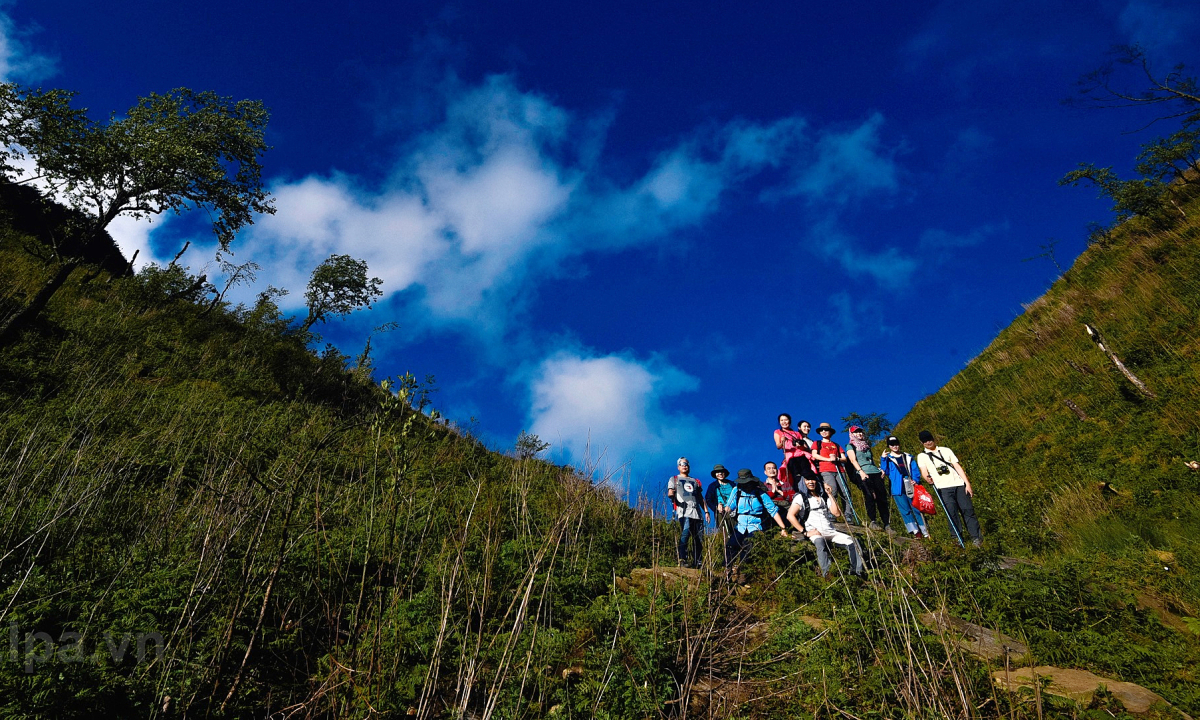
When climbing mountains, visitors must prepare mentally and physically, choose the appropriate climbing form and have basic knowledge to avoid risks.
The northern mountain peaks enter their peak season when the weather is favorable at the end of the year, attracting dozens of tourist groups every week. The number of people flocking to popular destinations increases dramatically, especially on weekends, causing trail congestion and overcrowding of rest camps. This situation not only affects the tourist experience but also poses many potential safety risks.
To make the journey smooth, Mr. Manh Chien, representative of YOLO Trekking and also the admin of the Mountaineering Enthusiast Association with more than 160,000 members, and Mr. Thanh Tung, who has experience conquering many mountain peaks in Vietnam, share some experiences.
A group of tourists from Hanoi conquered Lao Than peak. Image: Hung Lekima
Famous mountain peaks
Climbing routes are often classified based on difficulty, altitude and terrain. Tourists can refer to this information on forums and travel agencies. In the North, the mountain peaks that attract many conquerors are divided into the following areas:
Son La – Yen Bai area: Ta Xua, Ta Chi Nhu, Lung Cung, Sa Mu.
Lao Cai area: Ngu Chi Son, Lao Than, Nhiu Co San, Fansipan, Bach Moc Luong Tu.
Area within Lai Chau province and surrounding areas: Po Ma Lung, Chung Nhia Vu, Pusilung, Khang Su Van, Putaleng, Ta Lien Son, Nam Kang Ho Tao, Chuva, Can Chua, Rang Ngam, Mieu Thach Son.
Forms of climbing
Climbing trips in Vietnam in general and the Northern region in particular take place on a self-sufficient basis, hiring a porter or purchasing a package tour. Each form has its own advantages and disadvantages. Costs include transportation (usually from Hanoi to climbing points), accommodation (at shacks, motels), porters and other expenses (medals, border guards, photography).
– Self-sufficient: The group is self-sufficient in everything. The rental fee for a porter will be from 500,000 to 700,000 VND per day. This is the most cost-effective model but also the most difficult and risky. The cost per person will be from 1.5 million VND, depending on needs.
– Tour porter: Some porters, after leading experienced tours, often organize their own tours with package prices. At that time, guests will book their own car from the starting point (for example from Hanoi to Sa Pa, Lai Chau, Yen Bai, Son La…), the porters will pick up and drop off the group at the meeting point. Cost ranges from 1.5 million VND to 2 million VND depending on experience and organization.
“This is the model I often choose. The cost is higher than self-financing, but cheaper than a tour, you don’t have to worry about much work, and let the local porters do business. However, you need to choose a reputable porter for each palace,” Tung said.
– Package tour: is a long-standing model, but has flourished in recent years. With this model, climbers will be taken care of from A to Z. They only need to pay enough money to go and be picked up and picked up from Hanoi. Depending on how each company builds the tour, whether the profit is more or less, what options are added will determine the high or low price. This tour costs 3 million per person or more.
“This is the most leisurely model for climbers, but you need to carefully check the reputation. High prices are often better quality, but there can still be risks,” Tung added. Package tours may be 1-2 million more expensive, but the experiences received can be much better.
If you prioritize cost, try traveling on your own. If you are new or do not care about money, you should choose a reputable tour organizer.
“Once you’ve gone on a few initial tours, you can choose option 2 to support local people. However, this method still requires a person to lead the group back to the car, a porter, and negotiate the price,” Tung said.
Climbing groups are usually 5-6 or 10-12 people. If there are too many people, separate groups because there are many risks. Even when buying a tour, you should only go with 6 to 12 people to ensure service quality.
Nice weather will be convenient for climbing. Image: Lekima Hung
Weather
From November to February is the best time to climb mountains, especially for those who like to hunt clouds or ice. The climbing season can last until April. Those who do not have experience should consider climbing when there is an announcement of the monsoon or after the Lunar New Year because the North at this time has drizzle, strong winds, and strong cold. Note that the temperature on the mountain is about 10 degrees colder than the foot of the mountain, depending on the time.
For first-time climbers
For first-time climbers, mental and physical preparation are two prerequisites. Tourists need to determine that the journey will be tiring whether the route is easy or difficult to avoid frustration. Physical exercise does not need to be too heavy but must be regular, especially for women. About 10-15 days before the trip, participants should practice climbing 20 flights of stairs, then spend the last 2-3 days completely resting to recover muscles.
Regarding luggage, the most important item is shoes with good grip and anti-slip from reputable brands. Clothing can take advantage of existing items but needs to ensure comfort. The innermost layer should be a breathable shirt, on the outside a light shirt, combined with quick-drying pants. Accessories such as hats, glasses, gloves, knee and ankle protectors help minimize injuries.
In winter, luggage should be supplemented with thermal jackets, sweatshirts or wool, warm hats and thermal patches. Guests should bring at least two pairs of socks and a personal medicine bag including pain relievers, digestive medicine and medical bandages. Investing in expensive specialized clothing can be considered after accumulating enough experience.
Notes for female guests
Visitors should equip themselves with knowledge before climbing. Image: Lekima Hung
Female tourists need to minimize the use of alcoholic beverages at the accommodation to avoid losing control of their behavior. Due to the nature of mountain camps being cramped, with shared activities between groups and mixed sleeping arrangements, safety risks can easily occur when tourists are no longer alert.
In addition, drinking a lot of alcohol directly affects physical fitness, leading to the risk of exhaustion or stroke when exercising vigorously the next day.
“Mountain climbing is a journey of experience, limits and emotions, not a place to compromise your own safety,” a person with climbing experience shared.
http://everest.ooo/user/legaljudge1/
https://masajeseroticostarragona.com/author/toothcase1/
https://gratisafhalen.be/author/workparty5/
https://ecuadorenventa.net/author/gasrouter2/
https://www.ludikarus.com/author/geesenest5/
https://code.antopie.org/lacetray6
https://sketchfab.com/toothbreak4
https://www.multichain.com/qa/user/blacktuba3
https://someplacenice.com/author/partrouter9/
https://www.repecho.com/author/laceshop6/
http://csmouse.com/user/corkaugust5/
https://www.fanficoverflow.com/profile/view/79406
https://www.akaqa.com/account/profile/19191828658
https://groovestats.com/index.php?page=profile&id=193639
https://www.kildarestreet.com/user/?u=61193
https://www.rvparking.com/user/504521
http://buyandsellhair.com/author/LyladfWiggins/
https://www.furvilla.com/profile/233646
https://hasitleaked.com/forum/members/DixiedfBryant/profile/
https://www.audiodraft.com/user/profile/GiadadfChapman
http://www.talkmarkets.com/member/HelendfVargas
https://www.temptalia.com/members/aedandfspears
https://devpost.com/users/RaymonddfAlexander
https://diego-maradona.com.az/user/beachhair28/
https://faq.sectionsanywhere.com/user/copperscale48