From fairytale-like Alpine villages to remote fishing villages beyond the Arctic Circle, small communities across Europe are paying a heavy price for their viral fame. Places that used to revolve around community life, history or nature, have in recent years become the backdrop for Instagram photos, a pilgrimage for movie fans and quick visits by tourists.
For the residents themselves, the price is getting worse: congested roads, crumbling infrastructure, invasion of privacy and gradual loss of local culture. Problems that in the past were mainly identified with touristic cities such as Venice, Barcelona or Dubrovnik, today permeate even the smallest villages, sometimes those where only hundreds of inhabitants live.
Whether it’s a village made famous by a movie location, a UNESCO World Heritage Site, or one iconic lookout, many of these places attract tourists who come for one picture, one attraction, and not much more than that. In response, residents across the continent are beginning to revolt, organizing protests and demanding stricter restrictions on the flow of visitors. These are some of the European villages that are dealing most acutely with tourism that has turned them into scenery.
Hallstatt, Austria: a fairytale village suffocated by its own beauty
Nestled on the shores of a mountain lake and included in the cultural landscape of Hallstatt-Dachstein/Salzkammergut, a UNESCO World Heritage Site, the alpine village of Hallstatt is known for its extraordinary scenery and ancient history of salt mining. Many believe it inspired the kingdom of Arendelle from the animated film Break the Ice, making it a pilgrimage destination. For Disney fans and social media tourists.
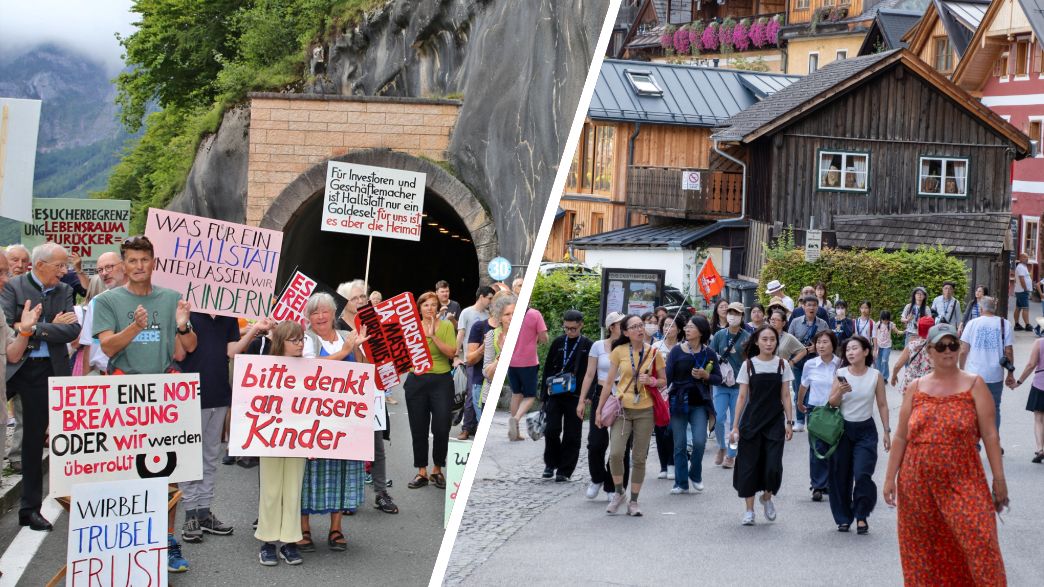
Only about 700 to 800 residents live in the village permanently, but the number of visitors may reach up to 10,000 tourists a day. Most of them come for a short visit, take pictures against the background of the lake view and leave without staying overnight or leaving a significant financial contribution. The congestion is felt at every corner: hundreds of buses and cars overload the narrow roads and force intensive traffic management. The walking paths are blocked, the noise is incessant, and residents report intrusion into private areas for photography purposes, sometimes ignoring signs calling for silence and respect.
In response, residents began protests, including roadblocks, and the village chief set up barricades at key vantage points to control the crowd. Quotas were also imposed on the number of cars and tourist buses, but in practice they often reach the maximum ceiling.
Mont-Saint-Michel, France: The ancient island turned theme park
The island of Mont-Saint-Michel (Mont-Saint-Michel), rising from the tides of the Normandy coast in northern France, is one of the country’s famous heritage sites. The island, known for its medieval architecture and the highest tides in Europe, has historically attracted pilgrims, but in the current era has become a busy tourist destination.
Exposure on social networks and appearance in popular series such as Lufen have resulted in the fact that he is now visited by about three million visitors a year. The narrow streets are flooded, the shuttle services are overloaded and the infrastructure is struggling to cope with the load. The experience of the visit itself has also been affected: endless souvenir shops, long queues and crowds of people create the feeling of an amusement park, while accelerating the wear and tear on the delicate historical buildings.
In response, the French authorities are considering a system of advance entry reservations, limiting the number of visitors and placing gates at the entrance. Tourists are requested to arrive at less busy times, before 10:00 or after 16:00, and even outside the peak season, with incentives such as discounted parking during low hours.
Kinderdijk, Netherlands: Windmills flooded with visitors
The village of Kinderdijk, also a UNESCO World Heritage Site, is famous for its 18 windmills from the 18th century, but its number of permanent residents is only about 60. Despite this, about 600,000 tourists visit it every year, many of them cruise ship passengers.
The residents complain about disrespectful conduct: requests to move out of the frame in a photograph, entering private gardens and treating houses as a set for photographs. Beyond harming the quality of life, the infrastructure is stretched to the limit and the local authenticity is eroded. The situation is expected to worsen with plans to expand the cruise lines and increase the number of visitors. A move by the Kinderdike Heritage Foundation that provoked strong opposition among the residents.
In response, the locals organized protests and even initiated softer campaigns, such as “polite postcards” and posts on social networks calling for awareness of the harms of over-tourism. The authorities banned buses and trailers from entering the center of the village, raised fines and began demanding permits for photography using drones to protect the residents’ privacy. However, the village depends on tourism revenue to preserve the historic windmills, creating a constant tension between preservation and load management.
Pienza, Italy: A Renaissance village that surrendered to cheese
Pienza, a picturesque Tuscan village and UNESCO World Heritage Site, is known for its innovative Renaissance urban planning. Today, however, visitors come less for the squares and buildings and more for the local pecorino cheese.
The village, which is especially popular among day-trippers, is having trouble coping with the growing numbers. Cheese and souvenir shops crowd out essential services such as pharmacies, and restaurants that change menus according to local produce to suit visitors’ tastes at the expense of traditional regional cuisine.
One of the most prominent symbols of the loss of tradition is the silencing of the historic bell tower between 10:00 PM and 7:00 AM, following noise complaints, mostly from tourists. While major Italian cities such as Venice and Rome have begun to implement measures against over-tourism, similar restrictions have not yet been imposed in Pienza.
Gothland, England: A rural railway station turned pilgrimage site
The village of Goathland (Goathland) in North Yorkshire gained worldwide fame thanks to appearances in series and films such as Heartbeat and Harry Potter. The local train station served as Hogsmeade Station in the first film, and the current continues years later. The anticipation of a new Harry Potter HBO series scheduled for 2027 only increases demand.
The result is busy streets, infrastructure under pressure and illegal parking due to lack of space. Community spaces are being taken over by visitors, shops are being repurposed, litter is increasing in nature, and queues for photographs at key sites such as the Aidensfield Arms pub have become routine.
North Yorkshire Council has yet to implement dedicated measures for Goathland, but is operating under regional tourism management plans aimed at more responsible tourism and dealing with visitor congestion.
Heithorn, Netherlands: no roads – but with boat traffic jams
The village of Giethoorn, sometimes called the “Venice of the North”, is famous for its canals, wooden bridges and thatched farmhouses. In the old center there are no roads at all, only footpaths and waterways where silent electric boats cruise. But what used to be a source of peace has become a challenge: Kfar Haim has less than 3,000 residents, but over a million visitors come every year, many of them day tourists from China and the region.
The canals suffer from boat traffic jams, and the bridges are blocked by tourists stopping for selfies. Residents report tourists entering private gardens and even peeking through windows, under the misconception that the entire village is an open museum.
In response to this, the authorities tightened the mooring regulations and are testing digital systems to monitor the load, but even here the tension continues between economic dependence on tourism and the desire to maintain a rural and quiet character.
Lauterbrunnen, Switzerland: the valley of the waterfalls that lost its silence
The village of Lauterbrunnen lies in a dramatic valley between rock cliffs and alpine peaks, and is famous for its 72 waterfalls, including the Staubach waterfall. The landscape is rumored to have inspired Rivendell from the Lord of the Rings book series.
But compared to the books and movies, for its 2,400 residents the reality is far from romantic: thousands of visitors flood the only main road, and illegal drones fill the air with a constant buzzing noise. The photo spots are busy from early morning until evening, with garbage problems and damage to the silence that characterizes the Alps.
The local authorities have been discussing for years the imposition of an entrance fee similar to the model of Venice, the reinforcement of “village ambassadors” to guide visitors, and they are working for stricter enforcement of the ban on drones.
Reina, Norway: Viral beauty beyond the Arctic Circle
The village of Reine, on the island of Moskenesøya in the Lofoten archipelago, is considered one of the most beautiful in Norway. The red and white fisherman’s huts (rorbuer), turquoise waters and granite peaks have made it a paradise for photographers and travel bloggers.
Despite its remote location, tourism to it has surged in recent years, but the infrastructure, designed to serve a small fishing community, is having trouble keeping up with the load. The narrow E10 road, which is the only land connection between the islands, is often blocked by tourists who stop to take pictures, creating safety risks and even harming the accessibility of emergency services.
The residents also complain about “wild camping”: tents in private fields and even in cemeteries, waste and damage to the tundra (a geographical and climatic area characterized by extreme cold and very poor vegetation) the delicate Arctic. In response, higher parking fees were imposed, regulated camping areas were defined, and discussions are held on limiting the number of cruise ships, since the arrival of thousands of passengers at once completely floods the center of the village.