At world-famous destinations, applying multiple price levels to foreign visitors is becoming a strategy to resolve budget pressures, regulate overcrowding and preserve heritage.
On January 14, the Louvre Museum in Paris officially applied a new price frame for visitors outside Europe with an increase of nearly 50%. This move attracted attention in the tourism community and sparked debates about the fairness of access to global cultural values.
The most common reason given by governments is fairness to taxpayers. In countries like France or Italy, heritage buildings are maintained largely thanks to the national budget, money contributed annually by citizens.
The Louvre management board said that the standard ticket price has increased by 45%, from 22 euros to 32 euros (about 976,000 VND). The move is aimed at consolidating the budget after many incidents, long employee strikes, frequent overcrowding and the theft of French royal jewelry that has shaken the authorities recently.
Visitors visit the Louvre museum, France. Image: AP
This price is part of the “differentiated pricing” strategy announced by the French Government from the beginning of 2025. Not only the Louvre Museum, other iconic landmarks such as the Palace of Versailles, the Paris Opera House and the Sainte-Chapelle chapel also applied the new fee schedule this month.
In the US, entrance fees to national parks for foreign visitors will also increase by 100 USD from the beginning of 2026. This policy reflects priority given to domestic citizens, allowing them to access national natural resources at low cost, while international visitors serve as a source of revenue for reinvestment.
In overtouristed destinations, high prices act as a natural filter. In Japan, from March 2026, Himeji Castle plans to increase the fee for international visitors by three times (about 30 USD) to reduce pressure on the ancient structure of the building.
The city of Venice, Italy also applies an entry fee of up to 10 euros during peak periods. Mr. Michele Zuin, City Councilor, affirmed that this is a tool to balance the lives of local residents before the influx of tourists. As costs rise, “conscious and planned” tourists will be retained, instead of the flash flood of visitors that puts pressure on infrastructure but contributes little to the local economy.
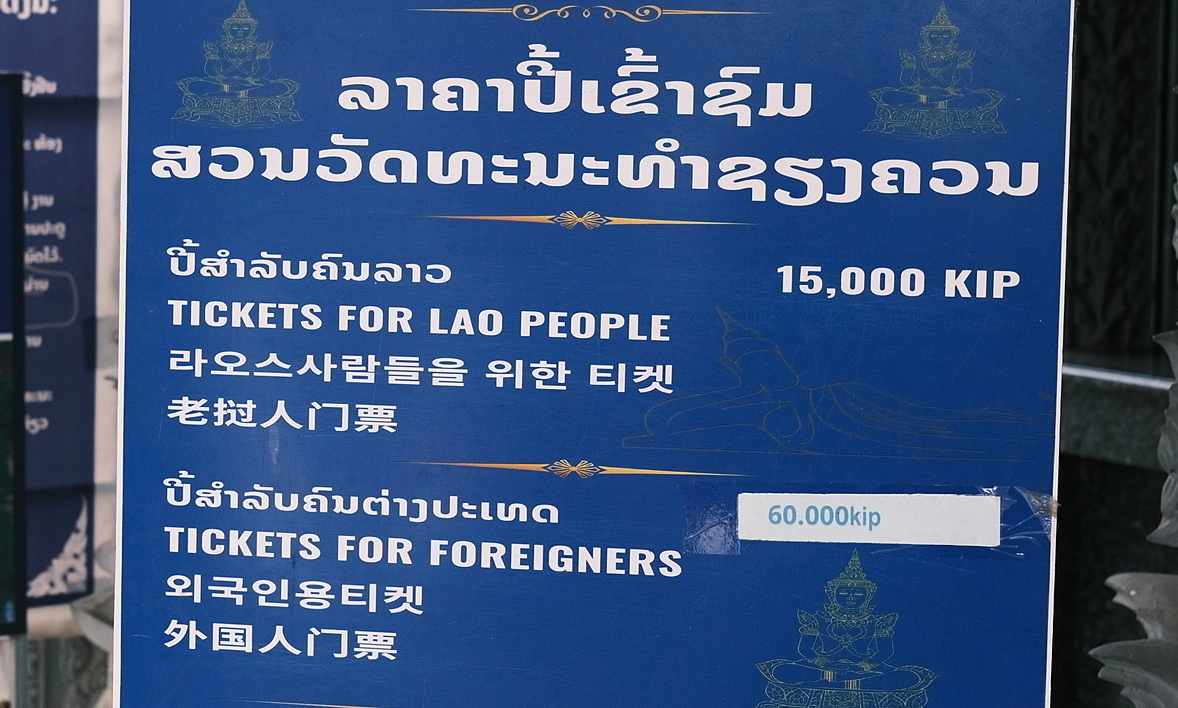
The entrance ticket price to Xieng Khuan Buddha Garden for foreigners is 4 times higher than for local visitors. Image: Bich Phuong
In environmentally sensitive areas, separate prices are a “shield” to protect nature. Galapagos Islands, Ecuador, from August 2024, has increased the entrance fee for international visitors to 200 USD (nearly 7 times higher than for indigenous people). This difference is used directly for preventing invasive species and treating waste on the island.
Jordan uses ticket prices in the ancient city of Petra as an economic strategy. International visitors visiting during the day have to pay up to 127 USD, but if they stay at least one night in Jordan, the ticket price will drop to 70 USD. By imposing “huge” prices for visitors on short-term tours, Jordan forces tourists to stay longer, using hotel and dining services from local people.
In the Himalayan region, Bhutan implements the strategy of “High-value, low-volume tourism”. International visitors (except Indians) must pay a “Sustainable Development Fee” (SDF) of up to 100 USD for each night of stay in the kingdom. Local residents and guests from neighboring countries enjoy nominal fees. This policy helps Bhutan maintain its title as a carbon-negative country and protect its indigenous culture from the encroachment of mass tourism.
In Nepal, the difference in ticket prices at world heritage sites in the Kathmandu valley also makes many first-time visitors confused. At Patan Durbar Square, international visitors have to pay about 1,000 rupees (nearly 200,000 VND), while citizens of countries belonging to the South Asian Association (SAARC) only pay 250 rupees, Nepalis are free or pay a very low fee. The Nepalese government affirms that this source of revenue is their only livelihood to restore temples destroyed after historic earthquakes.
Not only attractions, the service industry also separates customers. In Japan, a buffet restaurant in Shibuya, Tokyo, caused controversy when it charged international customers nearly 1 USD more than locals. The store owner explained that serving foreign customers costs more in labor costs due to the language barrier and complicated menu explanation process.
Unlike the public price increases in other countries, Thailand applies a “two price level” policy under the “hidden price” mechanism. This method causes many foreign tourists to spend money without knowing they are paying prices many times higher than locals.
At some national parks or temples, English signs often clearly state “Foreigners: 200 baht” (Foreign visitors: 200 baht). Next to it is Thai text stating the price is only 40 baht. The key point is that the prices applied to local guests are written in Thai numbers. To tourists who don’t know the language, this text looks like a decorative character or place name, causing them to default to accepting the high price without question.
Thai authorities explain that local people have low incomes and pay annual taxes to maintain these monuments, so they deserve more preferential prices than visitors.
Entrance fees to Khao Sok National Park are in English and Thai. Image: ASEANNOW
Many groups of tourists and foreigners living in Thailand have created websites such as 2PriceThailand to list and “expose” locations that apply this policy. They believe this is discrimination and makes them feel unwelcome.
Tourism economic experts believe that ticket price differentiation is a necessary financial tool for heritage sites that are under pressure of overcrowding. This source of revenue not only helps maintain the project but also supports the local community, who cannot afford to pay high prices like international visitors.
Many experts also warn that if not communicated transparently, this policy can easily be considered “discriminatory”. Tourists are often willing to pay more if they know that money is used directly to protect the environment or upgrade services, instead of feeling like they are the victim of “hidden prices” or unclear surcharges.