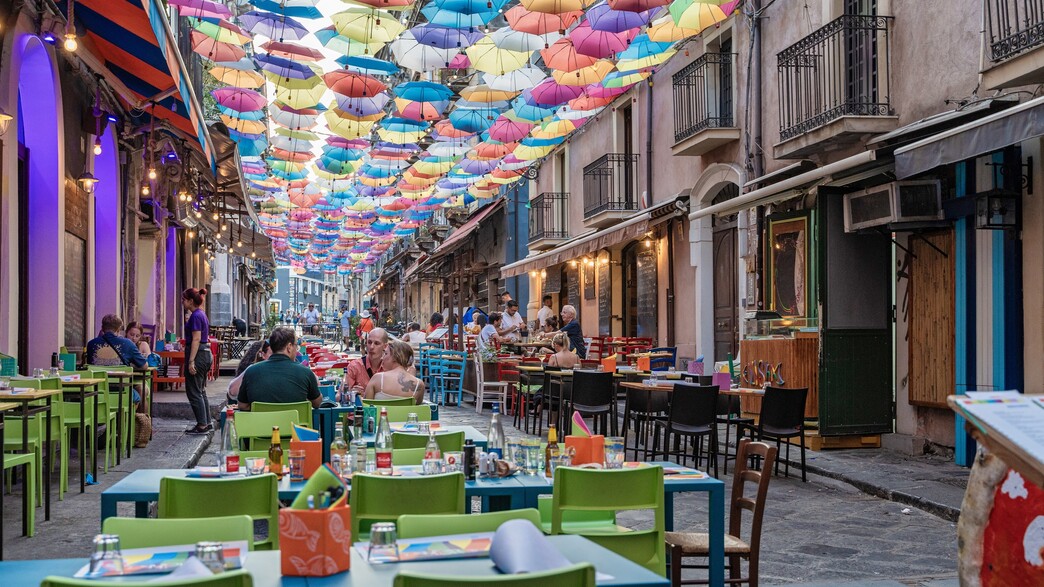
Last week, the airlines Wizz Air and El Al announced the opening of direct routes to Palermo in the northwest of Sicily and Catania in the east of the island. This is good news for the Israeli tourist who now, more than ever, receives an invitation to meet an island and people who live at a completely different pace than he is used to.
Sicilians do have a strong local identity similar to the Israeli one, but with a different attitude to time and an approach to life that is in no rush to impress anyone, not even the many tourists who visit the island. Those looking for the classic Italy of pasta and scenery will actually discover a rough and unexpected destination, but precisely because of this it is one of the most fascinating and profound places in Europe.
“In recent years, we recognize the desire of Israelis to discover more and more interesting destinations that break the routine,” says Revital Ben Natan, CEO of Ofkim Tourism. “Sicily meets exactly this need, and the recent expansion of flight offerings by the various airlines indicates the growing demand for the island, which is becoming a hot destination for summer vacations and holidays. In Sicily you will discover history and culture alongside human warmth, authentic Italian cuisine and spectacular turquoise beaches. You can travel the length and breadth of it, with the help of star tours, travel between destinations or experience one destination. It is suitable for both couples and families with children.
Between myth and soul
Sicily has existed for thousands of years as a crossroads of trade, immigration and government, as throughout history the island has passed from hand to hand – from the Greeks and Romans, through the Byzantines and Muslim rulers from North Africa to the Normans and the Spanish. Each of these cultures left its own layer in it. Not a deletion of the previous one but a unique mosaic of architecture, religion and culture.
Despite the various occupations throughout history, the local identity of the islanders is much stronger than the national identity. Many Sicilians will tell you that they are Sicilian first and then Italian. This is evident in the language, in the mentality, in relation to time and especially in the unique approach to life.
The cinematic image most associated with Sicily is deeply rooted in the global consciousness through the movie “The Godfather”. Even if large parts of the film were shot in the United States, the Sicilian scenes created a whole mythology: quiet villages, men who say few words, women who are strong in silence and social codes that pass from generation to generation. It is an image of power, of hierarchy and of a world closed to outsiders.
In front of this myth stands “Cinema Paradiso” which tells a completely different story. This is a love letter not only to cinema, but to Sicily itself. To the small villages, the squares, the smell of dust in the summer and the feeling of time passing slowly and then running away at once. Sicilia of Cinema Paradiso is not violent or dramatic but is gentle, humane, painful. She talks about collective memory, about community, about a childhood that never comes back. The film made the island a universal symbol of longing not for a place, but for a period in life. These two films place Sicily between two cultural poles, and teach about its power: an island capable of simultaneously containing a myth of power and a soul of emotion.
In Sicily he was bornItalian proverb: Dolce Far Niente – “The sweetness of inaction”. This is not a cliché, but an existential perception of the locals. It is a conscious choice not to rush and not to measure an experience in quantity. Time for the Sicilians is not a resource to be managed but a space to be occupied. Those who come with a tight schedule to get everything done are bound to be disappointed. Places will close early, people will be late, plans will change, but that’s the magic, and those who allow themselves to let go, discover that the island opens up precisely between things: in a chance conversation, in a meal that goes on, in a side street that he wasn’t looking for.
Palermo: get lost in it
Palermo is not a city of strained first impressions but of a depth that is revealed gradually. It combines a glorious past, rich street life and a lively and kicking Mediterranean rhythm and offers an urban experience that feels real and not staged. This is a city where the tourist is not just an observer, but a participant.
Palermo Cathedral, the Norman Palace and the ancient churches are not isolated tourist sites, but part of the living city. Around them a full daily life takes place: balconies with laundry, children in small squares and neighborhood bars that fill up towards evening which are a reminder that in Palermo history is not placed behind glass in a museum, but happens anew every day.
The Ballarò, Vucciria and Capo street markets are a touristic experience but one that doesn’t feel too touristy. They offer Sicilian street food at its best, colors, sounds and direct interaction with the locals. This is the place to taste, chat, stop for a moment and feel part of the city, even without knowing the language.
Alongside the familiar sites, Palermo also offers softer experiences, suitable for those looking for depth and not just photographs. The Kalsa neighborhood combines contemporary art, small galleries and intimate bars, steps away from the sea. Foro Italico is the urban beach strip, it is a perfect place for sunset, a leisurely walk or a spontaneous picnic – just like the residents do.
And those who are also looking for a moment of classic vacation, will find it a short distance away: Mondello Beach, rich in light sand and clear water, provides a perfect respite between a city day and an evening of food and culture. On the other hand, a short drive to the hills above the city leads to the Monreale Cathedral (Cattedrale di Santa Maria Nuova) – one of the most impressive masterpieces of Byzantine mosaics in Europe, a definite tourist site that still manages to excite.
Spending time in Palermo is not based on one well-known and prominent attraction, but on a sequence of moments just like an Italian meal that moves over a long time: from a simple aperitif in the square, to dessert in the form of a night trip to “get lost” among the illuminated streets. It has movement, noise and life but all these are part of the charm, not the burden.
Catania: living on shifting ground
If Palermo carries the memory, Catania lives the moment. Located on the east coast of the island, at the foot of Mount Athena – the active and highest volcano in Europe. The land is literally volcanic and the architecture responds to it: black lava stone as the dominant building material, wide streets and bright light that give Catania the nickname “the black city” (The Black City). Mount Athena is always present in the background – sometimes snowy, sometimes smoking – and it reminds locals and visitors alike that everything in life is temporary. Maybe that’s why life here is experienced with greater intensity.
After the earthquake of 1693, Catania was rebuilt in Sicilian Baroque style, with a sharp contrast between black basalt and white limestone. Via Athena, the Cathedral of Santa Agata and the Castle of Orsino wrapped in lava illustrate a city that lives inside a volcano. The lava stone, also chosen for its durability, culminates in the Fontana dell’Elefante In the Duomo square – an elephant statue made of black lava stone that became the symbol of the city.
Catania is suitable for those looking for an urban vacation with a twist: a lively city, excellent food and immediate access to the most dramatic nature in Europe. It’s a student city, young and vibrant, with an active nightlife and an unapologetic food scene. The fish market La Pescheria is a cultural experience as much as a culinary one.
Beyond the prominent sites, Catania also offers quieter moments for those willing to deviate from the main axis. Monastero dei Benedettini, one of the largest monasteries in Europe and a UNESCO World Heritage Site, is an impressive space where architecture, history and daily life intertwine. The Roman theater Teatro Romano di Catania and the adjacent amphitheater are assimilated right into the urban fabric, evidence that the past here is not confined to a museum but present among the streets. Along the coastline, the area of San Giovanni Li Cuti offers a black lava beach and unusual urban swimming, and in the evening the squares and bars around the Duomo are filled with a local crowd, one that emphasizes that Catania does not play for tourists, it is simply alive.
Food, culture and off-piste attractions
In Sicily, food is no longer an element of vacation, but a part of life itself. It is a local, simple, direct and popular cuisine that is often eaten on the street, standing and with hands, without ceremonies and without apology. Along with street food and authentic restaurants, there is also a quieter and deeper layer that is revealed through wine and agriculture. The wine region of Athenafor example, offers family wineries and wine that expresses volcanic soil, while private farms like the Agriturismo Connecting local food, an open landscape and a slow pace of life. Around Catania you will also find natural pools and fishing villages for example Aci Trezza ו-Aci Castello offering an exciting and dramatic encounter with the sea.
The power of Sicily is not only found in the big cities. The baroque cities (a European architectural style that developed in the 17th centuries) of the southeast of the island: Noto, Modica and Ragusa offering a dramatic aesthetic designed out of earthquakes and restoration.
in the east of the island, Syracusethe home of Archimedes, offers a relaxed and comfortable urban experience to combine with a trip. Ortigia, the nearby historic island, is suitable for walking through alleyways, small beaches and waterfront cafes. It is an ideal destination for half a day or a relaxed day, which balances antiquity, the sea and a relaxed pace without the need for complex planning.
Zingaro Reserve The northwest of the island offers wild beaches without hotels and without roads. The Valley of the Temples in Agrigento is especially impressive in the evening, when the crowd disappears and the light changes. In the interior of the island, mountain villages offer an encounter with an untouristed Sicily, places where time has truly stood still.
Beyond the island itself, Sicily also acts as an ideal base for going to small islands, for example Stromboli, Lipari and Vulcano that offer a different experience: dramatic, quiet volcanic nature, and a pace of life that moves away from the mainland.
Stromboli, for example, makes it possible to watch nightly eruptions not as a scheduled attraction, but as part of the local routine. To the west, the island of Fabignana, accessible from Palermo, offers turquoise water, getting around by bike instead of by car and a lifestyle that best illustrates the Dolce Far Niente culture in practice. This connection between a central island and small islands places Sicily as a gateway to many possibilities.
https://buncomberecords.us/
https://buncomberecords.us/criminal-records
https://buncomberecords.us/court-records
https://buncomberecords.us/inmate-search
https://buncomberecords.us/arrest-records
https://buncomberecords.us/warrant-search
https://buncomberecords.us/property-records
https://buncomberecords.us/divorce-records
https://atlanticrecords.org/
https://atlanticrecords.org/criminal-records
https://atlanticrecords.org/court-records
https://atlanticrecords.org/inmate-search
https://atlanticrecords.org/arrest-records
https://atlanticrecords.org/warrant-search
https://atlanticrecords.org/property-records
https://atlanticrecords.org/divorce-records
https://sttammanyparishrecords.us/
https://sttammanyparishrecords.us/criminal-records
https://sttammanyparishrecords.us/court-records
https://sttammanyparishrecords.us/inmate-search
https://sttammanyparishrecords.us/arrest-records
https://sttammanyparishrecords.us/warrant-search
https://sttammanyparishrecords.us/property-records
https://sttammanyparishrecords.us/divorce-records
https://weberrecords.us/
https://weberrecords.us/criminal-records
https://weberrecords.us/court-records
https://weberrecords.us/inmate-search
https://weberrecords.us/arrest-records
https://weberrecords.us/warrant-search