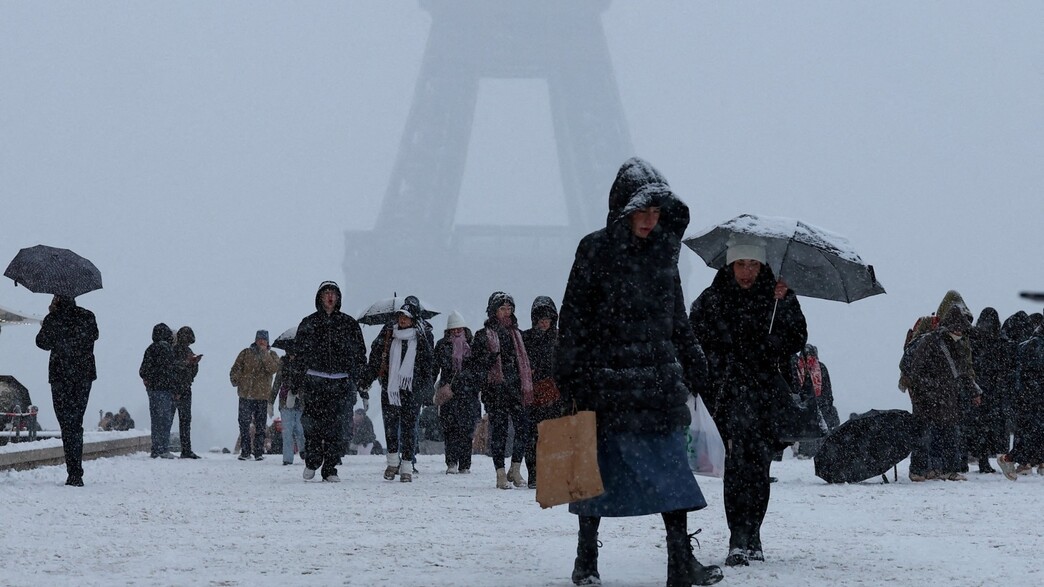
Hundreds of passengers were left stranded following a widespread wave of flight cancellations related to Air France and a fierce snowstorm that affected aircraft traffic across Europe yesterday (Sunday). The disruptions affected main lines from Paris and to cities including Toulouse, Amsterdam, Rome, London, Barcelona and Newcastle, creating a domino effect across the continent and beyond. Major airports such as Charles de Gaulle and Orly were forced to reduce activity following the storm.
The Civil Aviation Authority in France ordered the airlines to reduce the schedules by about 30 percent at Charles de Gaulle and by about 20 percent at Orly during peak hours, in order to prevent congestion on the frozen runways and to allow de-icing procedures for each plane before takeoff. The Ile-de-France region in France has been set on orange alert, the second most severe, with preparations for the accumulation of up to five centimeters of snow in the areas surrounding the capital Paris.
Among the first canceled flights were lines connecting Paris with Toulouse, Nice and Lyon, as well as flights to Amsterdam. Also international lines, including flights from Toulouse to Amsterdam and Manant to Amsterdam, which burdened both tourist traffic and business travel in the middle of the busy winter season.
The influence spreads to Amsterdam and London
The disruptions did not stop in France, and at Schiphol Airport in Amsterdam it was reported that about half of the flights scheduled for that day were delayed or canceled, after the snow moved east towards the Netherlands. KLM, the main partner of Air France and the dominant company at the airport, was significantly affected, which made it even more difficult for passengers who needed connecting flights.
In Britain, significant delays and cancellations were also recorded at London Heathrow and Gatwick airports, when planes and crews that failed to arrive from Europe disrupted the planned chain of flights. Passengers bound for Barcelona, Rome and other destinations in southern Europe had to deal with missing onward flights and long waits, while airlines tried to reorganize planes and crews.
Germany adds burden to the European system
The aviation system in Germany, which has also been dealing with high demand since the Corona period and with a shortage of personnel, has also experienced disruptions. Major airports including Frankfurt and Munich reported delays and cancellations, further complicating the itineraries of passengers passing through central Europe.
Added to this is the Lufthansa strike today, which leads to the cancellation of hundreds of flights and affects tens of thousands of passengers. The strike creates another domino effect throughout the European air network, which operates as a highly interconnected and dense system. Sources in the industry point out that Germany’s central position in the European aviation infrastructure means that any significant disruption in its territory quickly affects neighboring countries and onward flights throughout the continent.
Damage to tourism and business travel
The wave of cancellations affected both tourism and business travel. The month of February is considered a relatively active period in winter traffic, and in some countries there are even school holidays. Passengers who planned city breaks in Paris or Amsterdam, or connecting flights to long-term destinations such as New York, are forced to change plans at the last minute and face additional costs.
The airlines are working to reassign the passengers on alternative flights, but high occupancy rates on many of the flights make it difficult to find free seats in the immediate time frame. In accordance with the European regulation EU 261/2004, passengers whose flight was canceled are entitled to a refund or an alternative flight as soon as possible, but in cases of “extraordinary circumstances” such as extreme weather, entitlement to financial compensation does not necessarily apply.
According to the forecasts, a rise in temperatures later in the day is expected to melt the snow and allow a gradual return to normal. However, residual delays are expected to continue in the coming days as well, until the redeployment of the planes and crews is completed and the schedules are stabilized. In the meantime, passengers are asked to regularly monitor the flight status, show flexibility in planning and prepare for possible changes.
https://gastonrecords.us/arrest-records
https://gastonrecords.us/warrant-search
https://gastonrecords.us/property-records
https://gastonrecords.us/divorce-records
https://tuscaloosarecords.us/
https://tuscaloosarecords.us/criminal-records
https://tuscaloosarecords.us/court-records
https://tuscaloosarecords.us/inmate-search
https://tuscaloosarecords.us/arrest-records
https://tuscaloosarecords.us/warrant-search
https://tuscaloosarecords.us/property-records
https://tuscaloosarecords.us/divorce-records
https://saratogarecords.us/
https://saratogarecords.us/criminal-records
https://saratogarecords.us/court-records
https://saratogarecords.us/inmate-search
https://saratogarecords.us/arrest-records
https://saratogarecords.us/warrant-search
https://saratogarecords.us/property-records
https://saratogarecords.us/divorce-records
https://arlingtonrecords.us/
https://arlingtonrecords.us/criminal-records
https://arlingtonrecords.us/court-records
https://arlingtonrecords.us/inmate-search
https://arlingtonrecords.us/arrest-records
https://arlingtonrecords.us/warrant-search
https://arlingtonrecords.us/property-records
https://arlingtonrecords.us/divorce-records
https://whatcomrecords.us/
https://whatcomrecords.us/criminal-records