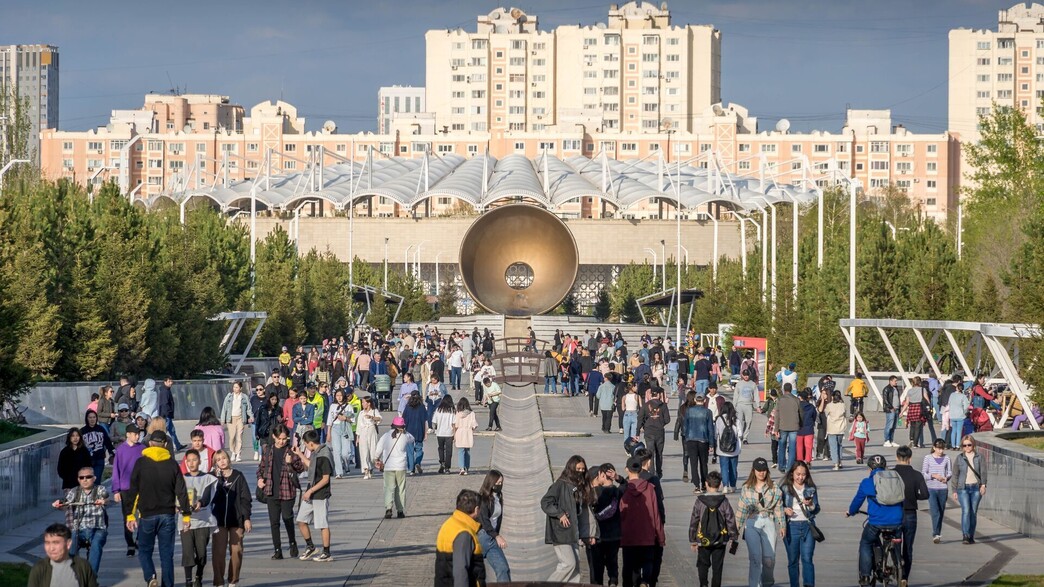
As the smoke from the Roar of Harry billows over the Persian Gulf, the quietest observers of the flames are thousands of miles to the north, in the heart of Astana, the capital of Kazakhstan. For the Central Asian country, the escalation between the United States and Israel and Iran is not just a distant televised crisis, but a structural threat to the “multi-vector policy” that it has painstakingly built over three decades.
Unlike the Gulf states or Azerbaijan, which found themselves in the direct line of fire of Iranian attacks, Kazakhstan occupies a unique intermediate position in the regional hierarchy. She is the affluent neighbor in this Eurasian complex, the one who spent years soundproofing while maintaining polite, if strained, relations with the frenzied tenants on the floors below her. The current silence of the Kazakh Foreign Ministry is a calculated diplomatic survival mechanism; Recognizing that in a burning building, the safest course of action is often to maintain the integrity of your home while quietly preparing for the inevitable smoke damage.
But this strategic panic of Kazakhstan was born out of necessity, not necessarily a deep political game. Kazakhstan shares much more with Iran than the Caspian Sea; It shares a history of pragmatic cooperation that has survived decades of Western sanctions. Tehran helped end Tajikistan’s civil war in the 1990s and played a constructive role in determining the legal status of the Caspian Sea, establishing it as a “friendly partner” for Central Asian countries. While other countries have the privilege of ideological alignment, Astana’s geography dictates its morality. The Kazakh leadership understands that a complete collapse of the Islamic Republic would not only be a victory for its new allies in the West, but could also lead to a potential catastrophe for Central Asian security in the form of waves of refugees, arms smuggling and disruption of critical energy infrastructure.
The Abrahamic axis and the Israeli front
The current tension is intensified by the historic strategic turn that Kazakhstan made on November 12, 2025, when it officially joined the “Abraham Accords”. The move, formulated during a three-way phone call between Kazakh President Tokayev and Netanyahu Trump, turned a long-standing pragmatic relationship into a visible mediator of security aligned with the West. For decades, Israel and Kazakhstan shared a quiet but effective relationship focused on “irrigation and security technologies,” but the agreements elevated relations to the level of “political oxygen.” This connection has already yielded tangible infrastructure achievements, chief among them the partnership valued at millions of dollars with the Mekorot water company, which is beginning to modernize the Kazakh water network.
This developing alliance also fostered a human bridge, and until the recent attacks, Kazakhstan became the “new front” for Israeli tourists seeking the views of Charin Canyon and the prestigious ski slopes of Shymbulak. The sudden grounding of “Air Astana” flights to Tel Aviv and the uncertainty of over 4,000 Kazakh citizens in the Gulf region turned a strategic partnership into a logistical emergency.
The presence of the Bukhari Jewish community, whose roots in Central Asia stretch back 1,500 years, further tightens these ties. It is true that the historical centers and the ancient Jewish quarters (the ‘Mahaleh-e Yehudian’) are in neighboring Uzbekistan and especially in Samarkand, but it is Kazakhstan that has become the most modern and accessible anchor in the region. For tourists on a root trip and Israeli businessmen, Astana and Almaty are the new and convenient gateway to the entire area of Central Asia. This cultural economy, which connects Jerusalem to the heart of the Arabah, is a strategic asset for Astana, and it now faces the daunting task of maintaining this connection without becoming a target for Iran’s proxies, who see any bridge to Israel as a direct threat.
The Iranian umbilical cord and the trade trap
Despite the new romance with the West, Kazakhstan remains physically and economically tied to Iran through an “umbilical cord” of transit and energy. Although Turkmenistan physically separates them on the map, the direct maritime connection through the Caspian Sea and the joint railway make Tehran the most critical neighbor to Kazakhstan, and its main gateway to the open sea and the entire world. Before the current war, Astana and Tehran were in the final stages of plans to double cargo volumes on the Kazakhstan-Turkmenistan-Iran railway. For a landlocked giant like Kazakhstan, Iran is the shortest route to global markets, a route that became even more valuable when the war in Ukraine choked the northern corridors through Russia.
“Harry’s Roar” effectively severed this artery, and while the surge in Brent oil prices, which today crossed the $100 mark and is trading around $106 per barrel, provided unexpected profits for the state-owned company “Kazmiunai-Gas” (KMG), the broader economic picture is one of anxiety. The Iranian ban on food exports that went into effect on March 3 has sparked immediate waves of inflation in the Kazakh steppe, which produces grain, a large part of which is sent to Iran, while the blockade of the Straits of Hormuz, through which a fifth of the world’s oil and natural gas consumption passes, threatens to turn the ambitious “North-South Transportation Corridor” (INSTC) into a ghost road.
Kazakhstan now finds itself as the central axis of the “Middle Corridor”, the only remaining trade lane between China and Europe. This route, which runs through the Caspian Sea, Azerbaijan and Georgia, is challenging and vulnerable, but it is the only exit left in this burning building. Analysts at Kazakh investment bank Teniz Capital warn that while companies such as KMG and KazTransOil may see short-term gains from rising prices and shifting Russian goods to them, structural risks to supply chains are becoming permanent.
Humanitarian mediation in a crumbling world order
In the face of this “catastrophic peace”, President Tokayev has adopted the role of humanitarian mediator, a position connected to Kazakhstan’s long history as a host of nuclear non-proliferation talks. By maintaining open lines of communication with the emir of Qatar and the president of the United Arab Emirates, both of whom have faced Iranian drone attacks, Tokayev is trying to preserve the framework of the “Board of Peace” even as the foundations of international law begin to crumble. The Kazakh leadership’s announcement on March 2 was a model of diplomatic prudence: it offered condolences for “the loss of Iranian civilian lives, including children”, while at the same time condemning the attacks on “friendly and sisterly” Arab countries.
Kazakhstan’s strategy reflects a complex duality: it cannot afford to see the Iranian regime completely undermined, as an immediate collapse would bring regional chaos with waves of refugees and weapons spilling directly to its borders. Astana’s commitment to nuclear stability is reflected in the establishment of the “Enriched Uranium Bank” on its territory, in collaboration with the IAEA, a project designed to offer countries like Iran a safe alternative. Kazakhstan is basically telling the Iranians “Don’t make uranium yourself (a process that can lead to a bomb). If you need fuel for civilian power plants, we will give it to you from our bank.” This makes Kazakhstan a key player in preventing nuclear weapons in the region.
But here is also the current problem of Kazakhstan: while it is trying to promote diplomatic solutions (like the uranium bank), Israel and the US are acting with military force. The use of bombs that penetrate bunkers and damage to nuclear infrastructure means that the West has decided that diplomacy is no longer enough, and this creates pressure on Kazakhstan because the military action makes all its diplomatic efforts irrelevant, and brings closer the possibility of an environmental disaster or spill of hazardous materials as a result of the bombings of nuclear facilities.
Bottom line, Kazakhstan has long been not just a remote stop on the Silk Road, but one of the most interesting apartments in the Eurasian building. She manages to do the unbelievable: drink espresso with the Israelis in the lobby, sign water deals with “sources”, and at the same time leave the door open to the problematic neighbor from below, Iran. But as the fire from the south intensifies and the bunker-penetrating missiles become the soundtrack of the region, President Tokayev’s room for maneuver is shrinking.