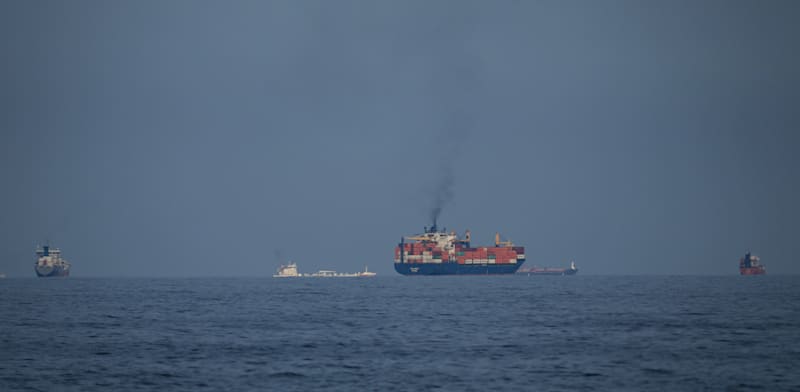
While the Strait of Hormuz is blocked and the price of oil hovers above $100 a barrel Brent, Iran allows certain ships to pass through its “payment station” and reportedly earns $2 million on each. 26 ships passed through this method, some paid and others passed due to diplomatic intervention from countries friendly to Iran, such as China, Russia, India, Pakistan and Iraq.
According to a report by the maritime news and intelligence agency Lloyd’s List, since March 13, at least 26 ships have passed through the Strait of Hormuz in Iranian territorial waters. Some of them had to pay “transition fees” in the amount of 2 million dollars, in the Chinese currency Yuan. Others crossed thanks to diplomatic intervention: for example, India insists that none of its ships were required to pay the Iranian transit fees. India is unique in that it maintains close relations with both Israel and Iran.
Yesterday (Wednesday), Iranian Foreign Minister Abbas Araqchi announced that “non-hostile ships” will be able to cross the Strait of Hormuz under Iranian conditions, and he is in talks with several countries such as Korea, Malaysia and Egypt about this. This morning (Thursday), the Iranian ambassador in Seoul announced that South Korean ships will be able to cross the Strait of Hormuz. In addition, he explicitly mentioned China, Russia, India, Pakistan and Iraq as countries friendly to Iran that there is no reason to block them – but Iran takes payment from them, at least in part. At this point, it is difficult to estimate how many of the ships paid the transit fee and how many won it for free thanks to the intervention of their governments that have good relations with Iran. But even given that a significant part of the 26 ships located by Lloyd’s List paid the Iranian tariff – this is a gain of tens of millions of dollars in cash, which Iran will probably use for its war effort against the US, Israel and the Gulf states.
The ships that “sneak” into the Strait of Hormuz
At the same time, a bill is expected to be submitted to the Majles, the Iranian parliament, to collect payment for the use of Hormuz, reports the opposition-affiliated Iran International news agency. This is expected to set the rules for the transition, whether paid or free. But until then, it seems that the Revolutionary Guards are managing the transition policy on their own, even without a settled law.
Prof. Yehoshua Krasna, a former senior official in one of the intelligence organizations and today the director of the Forum for Regional Cooperation at the Dayan Center at Tel Aviv University, testifies that “Iran is now demanding something that they never had, and that is unacceptable,” and that is the collection of payment for crossing the Strait of Hormuz, which is shared with Oman and should be open for free according to the accepted international conventions. Now, he says, “Trump and Israeli officials are delaying the opening of the Strait of Hormuz As a war target, only he was of course open to it. This is, perhaps, a way in which Iran is trying to get out of the war with an achievement.”
In addition to the 26 ships that definitely passed through Hormuz through Iran, Lloyd’s List reports that 21 ships chose to turn off their transmitters when they passed through the critical strait. Either to “sneak in” while taking the risk of an Iranian attack, as a Greek shipping company did in at least one case, or to deny cooperation with the Iranian regime, which is subject to American sanctions. However, it is important to note – the traffic in Hormuz is still very low compared to the old days, when about 130 ships crossed Egypt every day, transporting 20% of the world’s oil and gas output.
But even more ships are those associated with Iran, and usually part of the “shadow fleet” it operates to export Iranian oil further. According to a report by the TankerTrackers website, Iranian oil exports even managed to increase by 4% since the beginning of the war, compared to a decline of tens of percent in the exports of Gulf countries such as Saudi Arabia and Oman.
For your attention: The Globes system strives for a diverse, relevant and respectful discourse in accordance with the code of ethics that appears in the trust report according to which we operate. Expressions of violence, racism, incitement or any other inappropriate discourse are filtered out automatically and will not be published on the site.
https://doahomework.com
https://decidimos.monterrey.gob.mx/profiles/toldos_automaticos_i/following
https://www.pearltrees.com/findas_tokenomics
https://notionpress.com/author/1485011
https://stackshare.io/wealthplanning.us/wealth-planning-by-bob-chitrathorn
https://docs.localcharts.org/s/RIZjH-qOR
https://codimd.carpentries.org/s/OMSZ3Msjk
https://www.coursera.org/user/58d5c43a1f6d9375f7158fce058def70
https://www.reddit.com/r/design_critiques/comments/1h663x9/feedback_on_startup_website_design_ocemida/?utm_source=share&utm_medium=web3x&utm_name=web3xcss&utm_term=1&utm_content=share_button
https://findas-tokenomics.medium.com/about
https://data.boyolali.go.id/en/user/localesdeensayoporhorasmadrid
https://data.loda.gov.ua/user/camiseta-nike-vintage
https://codimd.communecter.org/s/tFA_ERD0Y
https://md.ha.si/s/piP2_VDyQ
https://wallhaven.cc/user/seoballaratau
https://md.roflcopter.fr/s/5vLRoihI9
https://md.emile.space/s/9CwHmXPGTV
https://docs.localcharts.org/s/qJZb0CzHk
https://hashnode.com/@ocemida
https://500px.com/p/pilaraguilarstudio
https://hedgedoc.logilab.fr/s/Gh7yAP1Mk
https://hedge.dotfionn.de/s/IIgcQodZo
https://controlc.com/f45b731e
https://justpaste.it/m4gum
https://drwriting.com