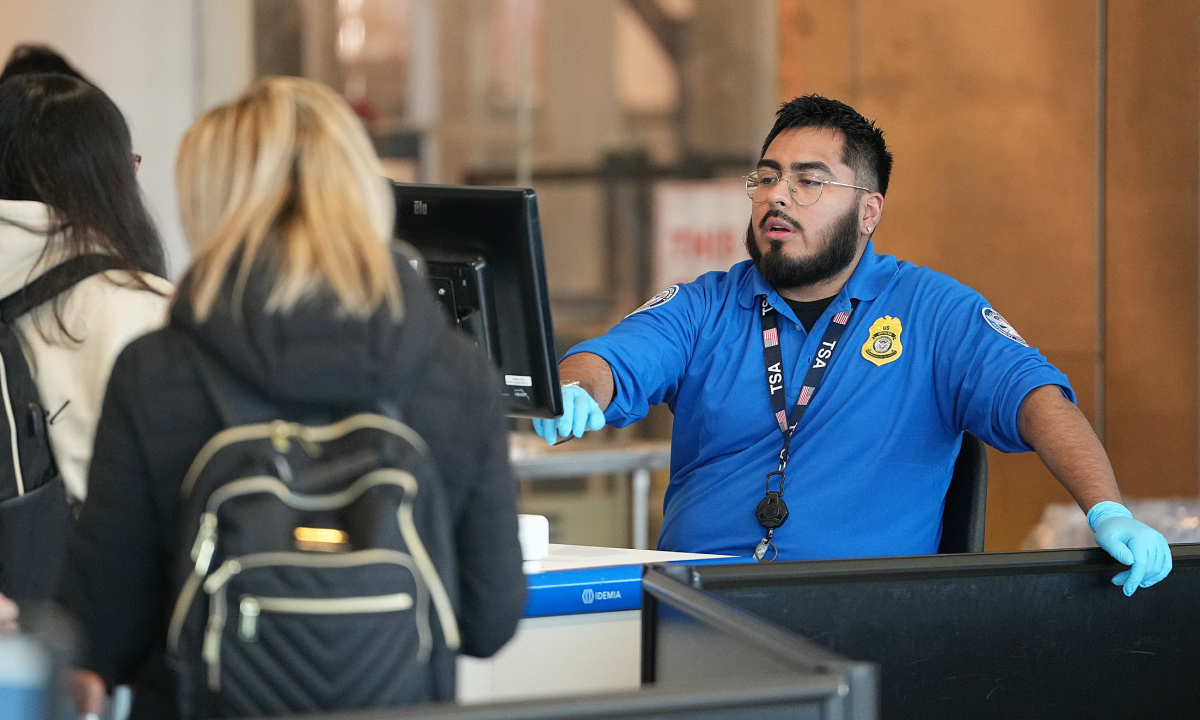
Finlay, a security officer at Orlando airport, had to borrow money from his daughter to buy gas and save money on each meal, as his salary was delayed for more than a month.
“I had to skip meals because I wanted to make sure my children still had food,” Tatiana Finlay, a US Transportation Security Administration (TSA) employee working at Orlando International Airport, told CNN in an interview on March 28.
Due to fasting, she often goes to the airport to work hungry. According to her, some of her colleagues have received notices of being evicted from their homes, having their cars repossessed, or not having enough money to buy daily medicine.
Finlay also couldn’t ask his family for support. Her husband and both of her parents-in-law work for TSA.
Finlay’s family is among about 61,000 TSA employees working without pay as the Department of Homeland Security (DHS) partially shuts down due to congressional failure to agree on a budget for the agency.
According to regulations, TSA employees can backpay when the budget is reauthorized, but this cannot solve the immediate financial difficulties. TSA said many employees went bankrupt, some even had to sell their blood to make ends meet.
President Donald Trump last weekend signed an order requiring DHS to pay TSA employees. DHS said TSA employees can begin receiving salaries today, with the expectation of being able to relieve some of their financial pressure after being delayed for two consecutive pay periods.
A TSA agent leaves a food bank in Indiana after receiving food, March 23. Image: AP
Finlay and many other TSA employees said that having to work without pay for 44 days left them in dire straits, with a series of unpaid bills, mounting debt and additional fees.
“It’s not enough to say despair. It’s more like suffocation,” said Johnny Jones, representing TSA Council 100, the national union for TSA employees under the American Federation of Government Employees (AFGE).
When funding for DHS expires on February 14, some TSA employees understand that they are almost at the end of their rope. Many people depleted their savings and borrowed to spend late last year, during the longest US government shutdown in history.
“Last year, we had no choice but to survive on borrowed money. This year, this method no longer works,” Finlay said, saying the couple still had to repay that loan, so they were not eligible to borrow more in such a short time.
They also had their mortgage payments postponed by the bank during last year’s government shutdown, so this time they are no longer eligible to apply again. “Even if you have savings, it will eventually run out.”
Nearly 500 TSA employees have resigned over the past month. Every day, thousands more people call in sick, causing airports across the country to seriously lack security staff, and security checkpoints are always overloaded.
Passengers waiting in line for security checks at LaGuardia Airport, New York, March 26. Image: AP
Last week, Devin Rayford brought a letter of temporary resignation to the headquarters of the Memphis electric, water and gas company, hoping to request a postponement of bill payments.
After his shift at Memphis International Airport, Rayford also drives a technology vehicle to try to cover living expenses. Therefore, he has almost no time left for his daughter.
“It was really mentally devastating,” he said. “Everything is so bad and heavy, especially when having to explain it to children, family or partners.”
Rayford, president of the local TSA union, had to use both union funds and his own money to support his colleagues. He estimates that nearly 50% of his colleagues have recently stopped going to the airport to work. During the recent spring break rush, there was a time when he had to take on three positions at the security screening gate by himself at the same time.
Finlay said that even when they reach their limit, many people still feel embarrassed when they have to go to food shelters or rely on family.
“The feeling of shame weighs heavily on me, because I have a job but no salary. As an adult, how can I ask someone for money, let alone admit that I lost my house, lost electricity, didn’t have money to buy medicine, pay my car loan, while still going to work,” Finlay said.
Even if they are paid soon, some employees say the consequences of being evicted, accumulating debt, and bad credit scores are very serious and cannot be overcome overnight.
TSA officers work at the security checkpoint at Philadelphia International Airport, March 27. Image: AP
Johnny Jones said a co-worker at the Dallas airport had to pay a $75-a-day fine to his landlord to avoid being evicted. “This is a huge amount of money.”
“We don’t have time to recover. Our credit cards are maxed out. Our credit scores have dropped. This time we can’t borrow any more,” said Rachel, a female TSA agent.
Rachel said there was a time when she left work to pick up her children, then went straight to the WIC office, the federal food assistance program for women with children, to apply for assistance for her family. “That means I have to receive support from the government, while I’m working for that government.”
A female TSA agent in Chicago said she initially chose this job because of the stability and health insurance. But two consecutive lockdowns left her unable to pay medical bills and not enough money to buy prescription drugs.
“It makes me no longer want to stick with this job. I applied to all kinds of places. I even asked my old job if they would accept me back,” the 25-year-old female employee said.
Every day, she submits 5 to 8 job applications but there are no results. A Bath and Body Works store responded to her application, but said she was too highly qualified for the retail position.
Aaron Barker, leader of AFGE in Georgia, warned that more TSA employees will leave in the near future. According to him, the negative image caused by the shutdown will make it very difficult for TSA to recruit replacements for retired personnel.
“No one wants to continue living in this level of uncertainty and unreasonable stress, when they have no fault of their own,” Barker said.
https://extra.cw/extra-journaal-17-03-2026/#comment-362903
https://www.manilashopper.com/2025/05/good-brews-great-bites-even-better.html?sc=1774177182766#c9131288527736461588
https://www.uscgq.com/forum/posts.php?forum=general&page=1&id=677164
https://www.atii.com.au/group/general-discussions/discussion/19d7d258-0a55-4d94-ba43-4c1be002dd9d?commentId=54df24d0-a1a2-4a13-9968-e21d64b5381a
https://www.imagineeducation.com.au/post/my-experience-hsp-cooking-lessons?commentId=6c608b2f-6ffe-414f-92b0-6c4aad28a696
https://velog.io/@vladislavko/Gaming-tou2gsbz
https://www.atheistrepublic.com/forums/site-support/thread-printing#comment-185195
https://pbase.com/oztoq/games_canada
https://www.yapstate.gov.fm/group/yap-state-government-group/discussion/01f856b2-f6c5-4fa2-83f2-ecf5927c974b?commentId=838edc28-d9b6-4f36-bf51-b44f000ee855
https://www.prodetailingsupplies.ca/post/how-to-perform-a-complete-vehicle-interior-detail?commentId=255bc5d5-1a91-4643-bbb0-d47c59cea997
https://bbs.t-firefly.com/forum.php?mod=viewthread&tid=61633&extra=page%3D1
https://forums.hostsearch.com/group.php?gmid=113409&do=discuss#gmessage113409