Abu Dhabi Ports Group has continued to successfully employ its diverse logistics capabilities to support the local and regional supply chain in the Arabian Gulf region and enhance its flexibility.
Since the beginning of regional developments, in late February, the group has been able to continue its operations as usual with the aim of serving the needs of its global customers, by launching alternative routes and redirecting the movement of goods through land, rail, sea and air corridors to mitigate the consequences of the disturbances that affected the supply chain in the ports of the Arabian Gulf in light of the conditions witnessed in the Strait of Hormuz.
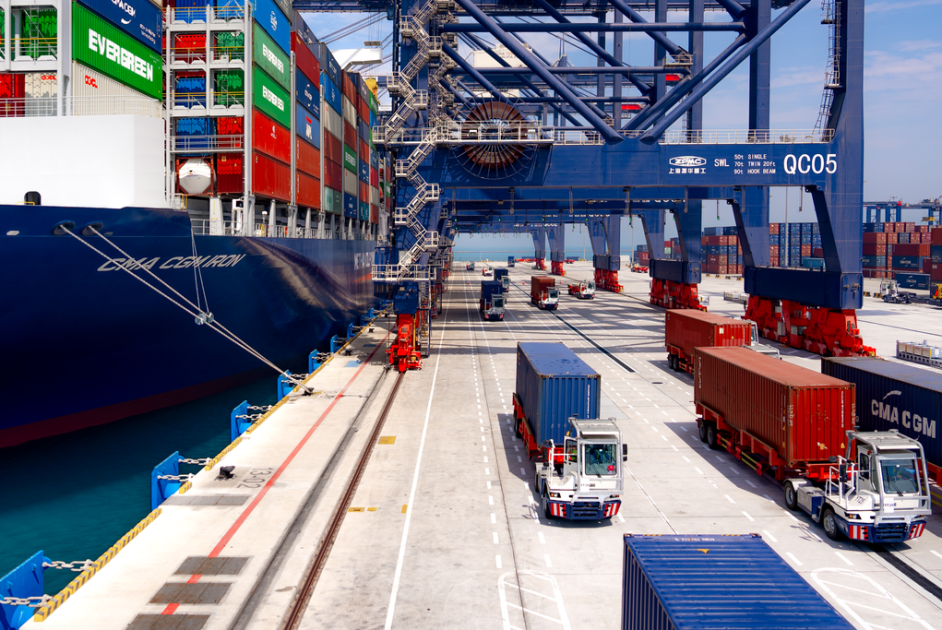
To date, the group has succeeded in handling more than 54,000 TEUs through the ports of Fujairah and Khor Fakkan Port, in addition to transporting more than 22,000 TEUs through its land network, and 18,000 TEUs through its sea network supported by a dedicated fleet, which includes 24 cargo ships providing 8 regional shipping services. More than 8,000 tons of cargo were also transported through its air logistics services through more than 100 charter flights.
Captain Mohammed Juma Al Shamsi, Managing Director and CEO of Abu Dhabi Ports Group, said: “Long-term investments in our diverse and comprehensive network of logistical and commercial infrastructure have allowed the implementation of one of the largest redistribution and deployment operations of logistics services in the UAE with speed, flexibility and high efficiency. The group will continue, in accordance with the directives of the country’s wise leadership, to ensure the flow of goods through local and regional markets, especially essential food, medicines, strategic reserves and materials needed for key sectors.”
With the aim of ensuring the continuity of regular shipping services to Khalifa Port, and along the three main trade lanes linking the eastern ports of the UAE, the Arabian Sea and the Red Sea, the group launched new regional shipping services for containers to enhance the supply chain, which contributed to redeploying and expanding the scope of its dedicated fleet, to reach 24 ships for containers and bulk cargo, with plans to expand the fleet’s capacity.
The group’s regional shipping services, provided by Seven Feeders and Global Feeder Shipping, were redirected through the ports of Fujairah and the port of Khor Fakkan on the Gulf of Oman, providing an alternative gateway to the United Arab Emirates and the GCC region.
New regional container shipping services were also launched linking ports in India, Pakistan and Oman, in addition to the Red Sea and upper Arabian Gulf ports.
By utilizing its logistical assets and its network of strategic and commercial relationships, the group was able to launch an air bridge that includes three aircraft leased by it, with the aim of transporting vital goods, with plans to increase the capacity.
The group opened a land bridge to transport goods from Fujairah and Khor Fakkan, through customs corridors in the UAE, to Khalifa Port, Jebel Ali Port and the Emirate of Sharjah, through 800 trucks belonging to the group, and four daily trips by Etihad trains. These efforts were supplemented by the group’s storage and warehouse capabilities dedicated to basic goods, which currently extend over an area of more than 76 thousand square meters, with plans to increase the storage area to 188 thousand square meters.
The Group also launched new freight management platforms thanks to its award-winning digital infrastructure, which helped enhance flexibility, visibility into different aspects of operations, and efficient management of trade flows. By unifying and processing data throughout the group’s global operations, these platforms allowed the use of real-time information on trade lines to ensure the integrity of the supply chain, while at the same time using empty import containers in export operations through alternative, densely-traffic corridors, which helped improve flexibility and reduce time and costs for customers.
One thought on “Abu Dhabi Ports ensures trade flexibility by utilizing its logistics network”
Leave a Reply
You must be logged in to post a comment.
https://luckystarindia.it.com/en-in/aviator/
https://luckystarindia.it.com/en-in/slots/
https://luckystarindia.it.com/en-in/how-to-bet/
https://luckystarindia.it.com/en-in/alternative-brands/
https://clickedin.co.in/en-in/
https://clickedin.co.in/en-in/app/
https://clickedin.co.in/en-in/android/
https://clickedin.co.in/en-in/ios/
https://clickedin.co.in/en-in/mobile/
https://clickedin.co.in/en-in/pc-client/
https://clickedin.co.in/en-in/registration/
https://clickedin.co.in/en-in/sign-up/
https://clickedin.co.in/en-in/login/
https://clickedin.co.in/en-in/verification/
https://clickedin.co.in/en-in/payments/
https://clickedin.co.in/en-in/deposit/
https://clickedin.co.in/en-in/withdrawal/
https://clickedin.co.in/en-in/bonuses/
https://clickedin.co.in/en-in/welcome-bonus/
https://clickedin.co.in/en-in/promo-code/
https://clickedin.co.in/en-in/live-casino/
https://clickedin.co.in/en-in/casino/
https://clickedin.co.in/en-in/aviator/
https://clickedin.co.in/en-in/slots/
https://clickedin.co.in/en-in/how-to-bet/