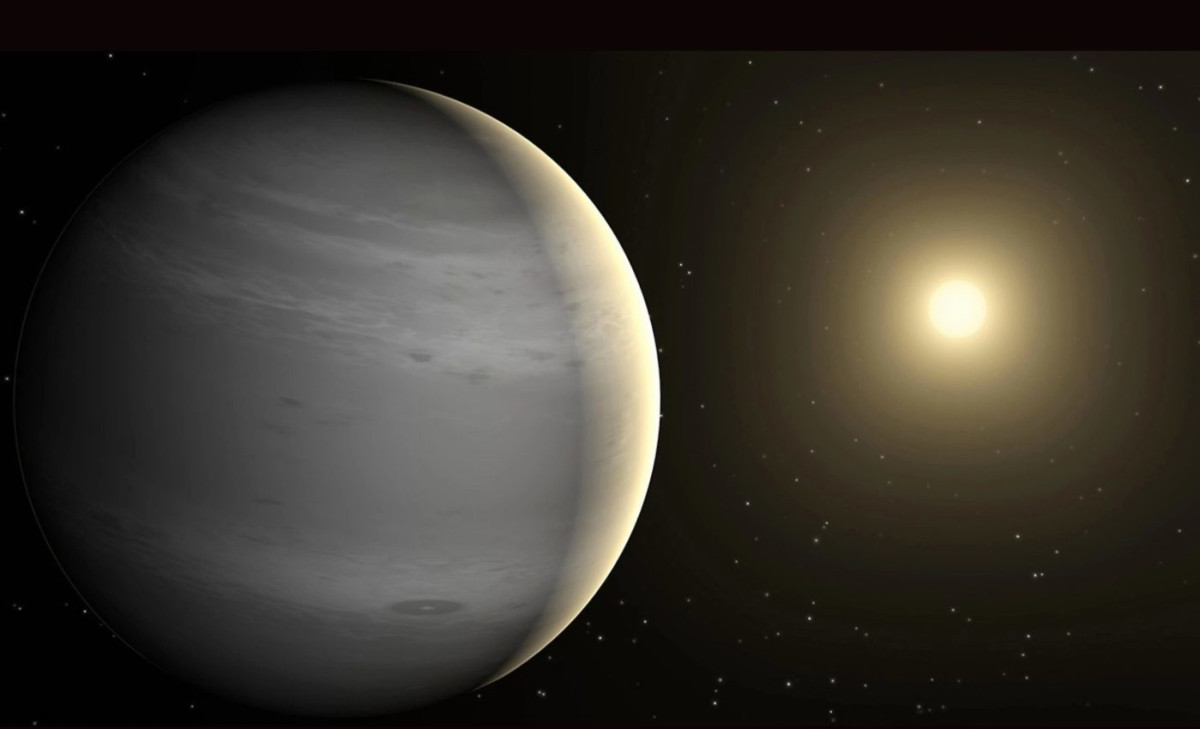
For the purpose of the study, the researchers examined the TOI-201 system, which contains an F-type star, located about 371 light years from Earth, and consists of a giant Earth-like planet, a gas giant (TOI-201 b) and a gas massive (TOI-201 c) with estimated orbital periods of about 5.8 days, 53 days and 2,900 days (7.9 years), respectively.
By comparison, F-type stars are larger and hotter than our Sun. Also, unlike our solar system, where all the planets orbit it in mostly circular orbits, TOI-201 c has a highly elliptical orbit, similar to the orbits of comets in our solar system.
The researchers found that the orbital times for the exoplanets changed, meaning the time when astronomers watched an exoplanet pass in front of its stars changed. The finding confused the research team, and they also discovered that the orbital angles of the outer planets had changed. Finally, the researchers found that the orbital angles changed so quickly that real-time observations could be made, meaning astronomers could watch the evolution of this system on human timescales, as opposed to the routine evolution of star systems, which takes millions or billions of years.
Using a series of computer models, the researchers estimated that all three exoplanets would stop transiting their star, from our point of view, in about 200 years, and would take another 10,000 years to start transiting again. The team concluded that TOI-201 c’s highly elliptical orbit disrupts the orbits of the two inner exoplanets when it is relatively close to its star.
The researchers note that the TOI-201 system has parallels to other exoplanets whose orbits are also pulled by a large, eccentric exoplanet, including Kepler-419b, Kepler-448b and Kepler-693b. The existence of the two outer planets in Kepler-419 and Kepler-448 has been confirmed, but the existence of the second, elliptical, outer planet in Kepler-693 has not yet been confirmed.
https://www.peopleknit.ru/club/user/22651/
https://illustrators.ru/users/vladimir-rogovtsev/about
https://anyflip.com/homepage/lgrwa
https://www.lifeisphoto.ru/page.aspx?id=91270
https://magazin.orgsoft.ru/communication/forum/index.php?PAGE_NAME=profile_view&UID=236550
https://projectnoah.org/users/romanovivan
https://disqus.com/by/mamaevivan/about/
https://pikabu.ru/@JanaSoroka
https://hashnode.com/@tadeiegorov
https://reactos.org/forum/memberlist.php?mode=viewprofile&u=193554
https://www.osd.ru/usrprof.asp?id=40157
https://500px.com/p/yatogi6599
https://bookcrossing.ru/users/61094
https://www.chordie.com/forum/profile.php?id=2506638
https://spinninrecords.com/profile/pavelvolkov
https://wakelet.com/@MalcevBogdan3498
https://spb.spravka.city/company/ooo-berkana
https://ooo-berkana.promportal.su/contacts
https://желтые-страницы.cybo.com/RU-biz/ООО-Беркана
https://www.propartner.ru/companies/berkana-c2795657
https://spravka.ru/vyvoz-i-pererabotka-musora/ooo-berkana
https://www.oborudunion.ru/company/567547475/
https://mestam.info/ru/sankt-peterburg/mesto/6761169-ooo-berkana-pr-kt-industrialnii-4-2
https://www.opt-union.ru/company.php?comp=19605751
https://www.orgpage.ru/sankt-peterburg/berkana-6201587.html