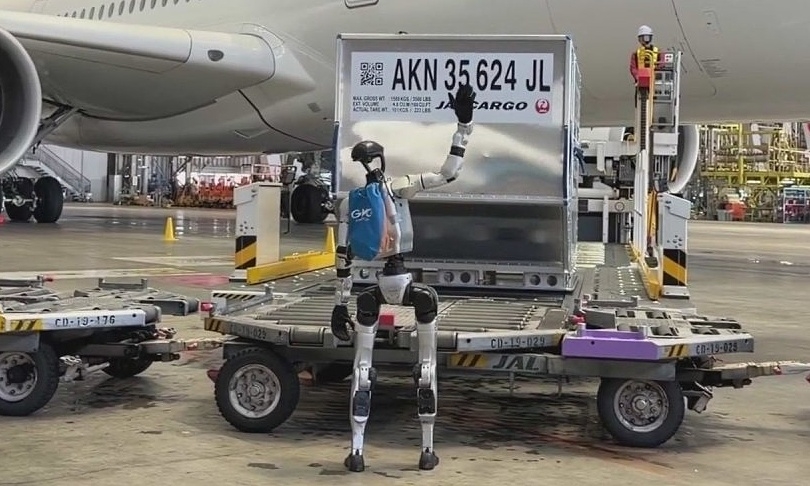
The famous and dedicated baggage handling team at Haneda Airport, Tokyo, will soon have more robot colleagues to share the work.
Japan Airlines (JAL) will deploy anthropomorphic robots from early May as a long-term solution to the country’s chronic labor shortage.
Humanoid robots manufactured by Chinese company Unitree will transport passengers’ luggage and goods on the tarmac at Haneda, which serves more than 60 million passengers a year.
JAL and its partner in the project, Japan Airlines GMO Internet Group, hope the trial – expected to end in 2028 – will ease the burden on staff amid a surge in international travel and forecasts of worsening labor shortages.
In a demonstration for the media this week, a 1.3-meter-tall robot made by Unitree pushed goods onto a conveyor belt next to a JAL airliner and waved to a colleague.
The robot demonstrates the movements of pushing goods and waving its arms. Image: Ktla
Yoshiteru Suzuki, President of JAL Ground Service, said using robots to perform physically heavy work “certainly reduces the burden and brings significant benefits to employees.” However, Mr. Suzuki added that some key tasks, such as safety management, will continue to be performed by humans.
Japan is managing to cope with increased international visitors and an aging population.
According to the Japan National Tourism Organization, more than 7 million people visited the country in the first two months of the year, although the number of tourists from China decreased due to the diplomatic conflict between Tokyo and Beijing.
Japan will need more than 6.5 million foreign workers by 2040 to meet its growth targets as the local workforce continues to shrink. The country’s foreign population has grown sharply in recent years but the government is now under political pressure to curb immigration.
According to Mr. Tomohiro Uchida, President of GMO AI and Robotics, although airports seem to be highly automated and standardized, logistics activities still rely heavily on human labor. In the context of labor shortages, these robots can operate continuously for two to three hours. Companies are planning to use them to perform other tasks such as cleaning airplane cabins.
https://trueluck-global.com/contact/
http://www.dibiz.com/rirolen120
https://dev.to/haronshakava/digital-entertainment-renaissance-in-kenya-broadband-connectivity-across-140m
https://trueluck-global.com/en-ie/esports/lol/
https://trueluck-global.com/es-es/movil/
https://dev.to/amoskiputo/the-digital-revolution-of-interactive-entertainment-21f8
https://pbase.com/oliverkiptanui/image/176252301
https://trueluck-global.com/nl-nl/voetbal/
https://trueluck-global.com/de-de/so-platzieren-sie-wetten/
https://trueluck-global.com/en-ie/esports/
https://edabit.com/user/gqLnkzKArWnH33fhS
https://www.prosebox.net/book/108943/
https://www.dibiz.com/povinil523
https://trueluck-global.com/welkomstbonus/
https://trueluck-global.com/de-de/partnerprogramm/
https://kumu.io/MaratIsaev/maratisaev
https://trueluck-global.com/en-ie/promo-code/
https://hackaday.io/AsbelKiprop?saved=true
https://trueluck-global.com/el-gr/mma/
https://pubhtml5.com/homepage/jiwjv/
https://trueluck-global.com/fr-fr/depot/
https://trueluck-global.com/fr-fr/bonus/
https://www.bandlab.com/post/04f463ed-61bd-4350-a12a-ecbb4830582d
https://tuscl.net/member/887161
https://sciprofiles.com/profile/KiptooAndrew