The Thai government is considering canceling the 60-day visa exemption policy for visitors from 93 countries to tighten screening measures and protect national security.
This visa-free policy was implemented under the previous government, allowing visitors from 93 countries and territories to enter Thailand without a visa for a stay of up to 60 days at a time. This measure takes effect from July 15, 2024 to accelerate the recovery of the tourism industry in the context of fierce global competition. Visitors are also allowed to extend their temporary stay for another 30 days at immigration offices.
However, the current government is reconsidering. Tourism and Sports Minister Surasak Phancharoenworakul said the program will be re-evaluated on a country-by-country basis to ensure suitability after the pilot phase.
He emphasized that any decision to amend or cancel the 60-day visa exemption would be non-discriminatory, focusing solely on improving screening measures. The proposal is expected to be presented to the Cabinet soon.
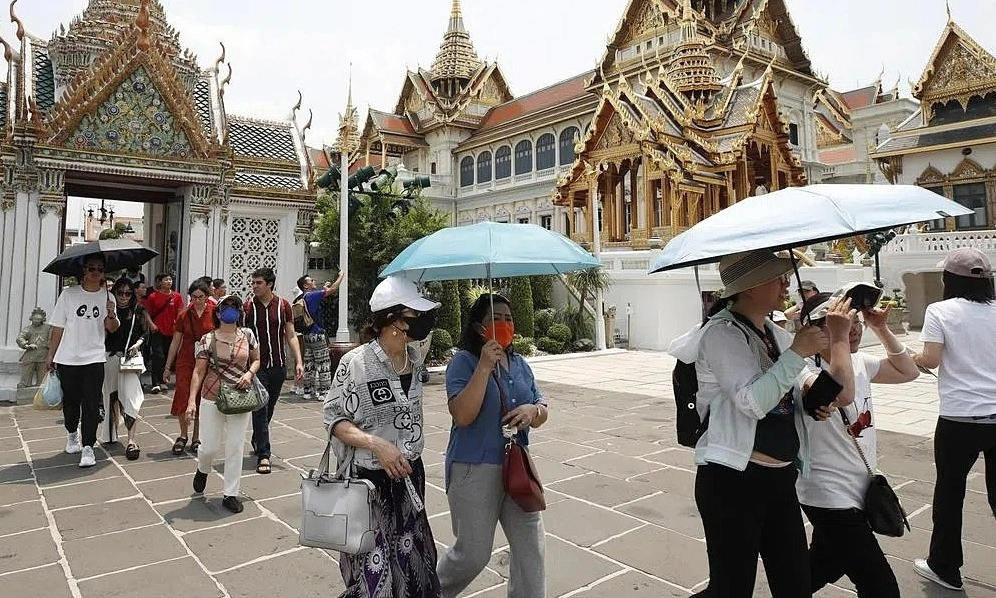
Tourists at the Royal Palace of Thailand. Image: Straits Times
Meanwhile, Mr. Sisdivachr Cheewarattanaporn, Honorary Chairman and Senior Advisor of the Association of Thai Travel Agents (ATTA), said that adjusting the length of stay and reviewing conditions for each country is a positive step.
“At the very least, this helps screen foreign visitors and protect national security,” he said.
He warned that a group of international visitors come to Thailand with the intention of settling down, not simply traveling. In some areas, large expatriate communities have formed with thousands of people living together, raising concerns about land ownership and the use of Thai people to hold real estate in their names.
Therefore, ATTA supports the government’s plan to amend visa exemption regulations, emphasizing that foreigners staying too long does not bring benefits to Thailand. According to the unit’s representative, real tourists usually only stay a few days. Allowing a stay of two to three months is excessive and not beneficial.
Data from the tourism industry also supports this view. Long-haul visitors from Europe tend to stay less than a month per trip, while visitors from nearby markets typically stay in Thailand for 5 to 12 days.
He also expressed concern about the potential for increased criminal activity, including fraud, if entry requirements remain too relaxed.
National security issues became the focus of debate. Mr. Sisdivachr noted that the global landscape has changed and Thailand’s visa policy must adjust accordingly to maintain safety.
ATTA forecasts that Thailand will welcome 30 to 32 million international visitors in 2026. This number is equivalent to the estimate of the Tourism Authority of Thailand (30 to 34 million), down 18% from the original target of 36.7 million, based on the expectation that tensions in the Middle East will ease in the next 1 to 3 months.
According to the Ministry of Tourism and Sports, Thailand recorded about 10.8 million international visitors from January 1 to April 19, 2026, down 3.34% over the same period last year. Tourism revenue from international visitors reached about 530 billion baht (16.34 billion USD).
The top five source markets during this period included China (about 1.7 million visits), Malaysia (about 1.1 million visits), followed by Russia, India and South Korea.