Instead of competing with configurations, Chinese technology companies are turning to “emotional consumption” with robots that can joke or musical instruments that can comfort users.
At the CES 2025 Consumer Electronics Show early last year in Las Vegas (USA), the LiberLive C1 wireless guitar from LiberLive based in Dongguan (China) appeared before the public. The crowd gathered around the booth, their fingers lightly touching the instrument. The event was small but later marked a turning point, when for the first time a Chinese technology product was sold Time honored with “Outstanding Invention of the Year”.
Chinese smart products don’t stop at Las Vegas. It is creeping into every corner of global consumer life, from emotional robot experience stores in Beijing to cosmetics shelves imbued with Chinese cultural identity in Southeast Asia.
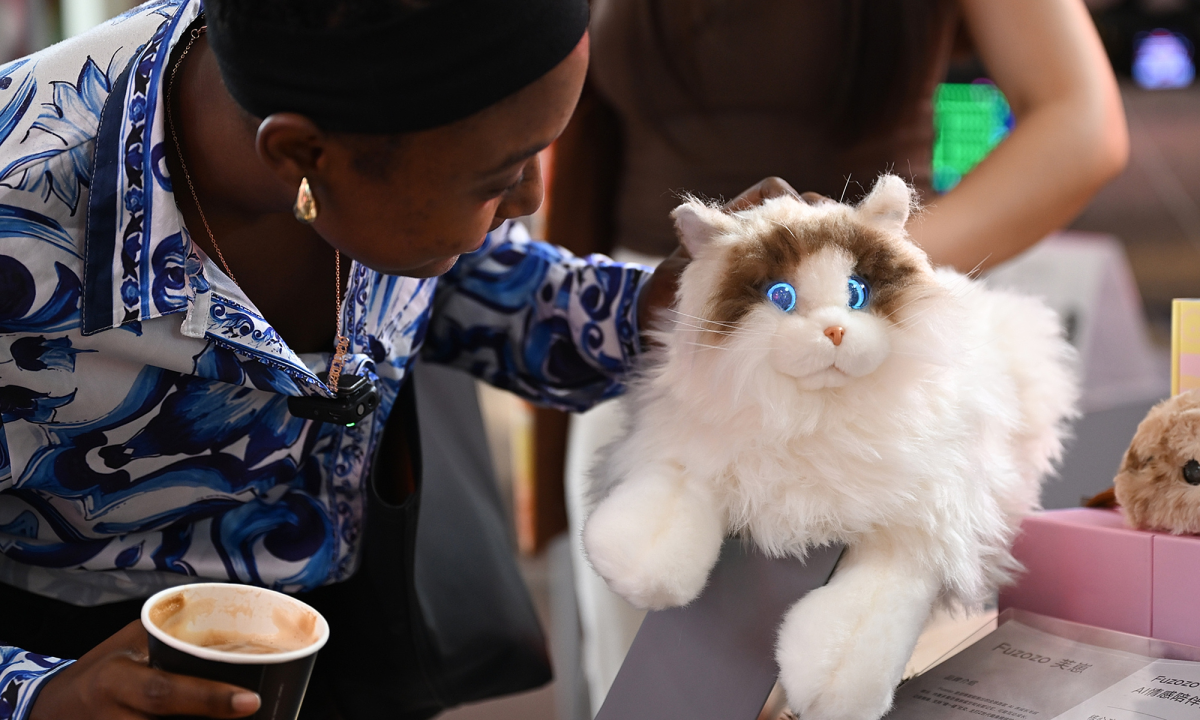
“When I said ‘I love you’, his eyes lit up with a red heart symbol and he responded affectionately in both Chinese and English,” Ram Niranjan Sharma, an Indian business consultant, told Global Time. “It’s not just a technology product that can read emotions. It breaks the stereotype of inanimate machines. I’ve never felt such warmth from technology.”
Sentiments like Sharma’s have become a trend of “emotional consumption” in recent years. Instead of shopping to satisfy material needs, more and more Chinese people spend money on products that bring joy, empathy and a feeling of “healing”. According to Guangming Dailythe key to today’s consumer decisions is not limited to function or price, but also from the meaningful experience, emotional connection and identity created from the product.
A visitor interacts with a cat robot at a technology and fashion exhibition in Hangzhou, Zhejiang province, September 2025. Image: VCG
When machines know “empathy”
At a robot experience store in Beijing, more than 20 types of “companion” robots attract customers’ attention. “For young customers, the purpose is mainly to satisfy emotional needs. Products priced around 500 yuan sell very well,” said Zhang Lulu, store manager.
According to sociological experts, the proportion of people living alone in China is increasing rapidly with the isolation of urban life and increasing psychological pressure, leading to the birth of products that meet the needs of safety, social communication and mental health. The companion robot thus becomes a “digital friend”, non-judgmental and always ready to listen.
In China, the desire to seek warmth and connection has crystallized the trend of consuming emotional value. From mystery toy boxes and anime merchandise to artificial intelligence-powered companionship apps, young people are increasingly spending not for convenience, but to seek psychological comfort, express identity and create moments of joy – prioritizing mental satisfaction over mere functionality.
Not just in China, the global wave of “emotional consumption” is exploding, with the market for mood-enhancing products forecast to grow strongly. According to research company Euromonitor International (UK), the business of products that improve people’s mood will grow at a compound annual growth rate of 12.3% until 2028.
In this context, Chinese products stand out by combining Oriental aesthetics with responsive technology. For example, the LiberLive C1 originally aimed to help users play the piano without learning music theory. “We want to make music casual and joyful,” Tang Wenxuan, LiberLive’s product development team leader, told Time.
A person tries out the LiberLive C1 at an event in Chengdu, Sichuan province, February 14. Image: VCG
LiberLive C1 is designed to remove the barriers of learning guitar: fumbling fingers and complex chords. Instead of traditional strings, it uses two pads and a pressure-sensitive neck pad. Players just need to tap to create chords and swipe to strum. A companion app displays chord suggestions, and the foldable body fits comfortably in a backpack. The product has a 6-hour battery life and a headphone jack for private practice. In Vietnam, the product is also distributed for about 13 million VND.
The LiberLive C1 is not just a guitar, but has become a symbol of a larger strategy: Chinese companies are shifting from hardware outsourcing to selling products that serve people’s emotional needs.
Chen Weijie, representative of a technology company in Dongguan, said that companion robots produced by his company have been sold to 36 countries and territories, such as the US, Germany, and Japan. Smooth, responsive movements help products come alive based on breakthroughs in hardware.
“Previously, we only sold hardware, had low profit margins and often encountered foreign patent barriers,” Weijie told Global Time. “Only technological innovation and creativity will help us stand firm in the global market.”
Culture – the “golden key” of connection
Many people look to products because they love technology, but not all. Some assessments of what makes Chinese products different is the ability to combine technology with culture.
Garima Ghimire, an influencer in Nepal, shared that she is attracted to products based on literary characters or Chinese cultural images. “They evoke emotions of comfort, nostalgia and playfulness,” Ghimire explains.
Talk to Financial Times Earlier this year, Claudia D’Arpizio of consultancy Bain commented that some Chinese brands “interpret local heritage and tastes better”. In the cosmetics sector, Chinese brands are turning their products into storytelling paintings, deeply inspired by Chinese aesthetics and folklore. Instead of following Western standards, they are redefining Chinese elegance.”
Quoting a media expert, WSJ also assessed that many foreigners may still retain an impression of China through martial arts, the Great Wall or pandas. But now, through their collection of technology, they are seeing a China that is innovative and understands the needs of its youth.
People shop for cultural and creative products at a store in Chengdu in 2024. Photo: VCG
According to Wu Qiaomei, brand marketing manager of a toy company in Dongguan, “We don’t just sell products. We create emotional companions rooted in our culture. Consumers crave more than just a decorative item.”
According to Euromonitor International, the “healing” trend will continue to dominate global consumer behavior in the coming years. Citing research data, the company said that with stress at an alarmingly high level, with 58% of consumers experiencing moderate to extreme stress on a daily basis, the demand for products that provide emotional comfort is not going to cool down anytime soon.
“Consumers aren’t just buying products. They’re buying emotions, they’re buying personal identity, and they’re buying a feeling of connection,” Ashley Dudarenok, founder of consulting firm ChoZan, told CNBC. “That’s exactly what Chinese technology products are bringing: a connection, not with cables or digital signals, but with the heart.”
https://betninja.co.com/pl/free-spins/
https://betninja.co.com/pl/login/
https://betninja.co.com/pl/no-deposit-bonus/
https://betninja.co.com/pl/promo-code/
https://betninja.co.com/pl/registration/
https://betninja.co.com/pl/review/
https://betninja.co.com/pl/welcome-bonus/
https://betninja.co.com/registration/
https://betninja.co.com/review/
https://betninja.co.com/ro/
https://betninja.co.com/ro/app/
https://betninja.co.com/ro/bonuses/
https://betninja.co.com/ro/deposit/
https://betninja.co.com/ro/download/
https://betninja.co.com/ro/free-spins/
https://betninja.co.com/ro/login/
https://betninja.co.com/ro/no-deposit-bonus/
https://betninja.co.com/ro/promo-code/
https://betninja.co.com/ro/registration/
https://betninja.co.com/ro/review/
https://betninja.co.com/ro/welcome-bonus/
https://betninja.co.com/sv/
https://betninja.co.com/sv/bonuses/
https://betninja.co.com/sv/deposit/
https://betninja.co.com/sv/download/