US President Donald Trump’s envoys were supposed to fly to Pakistan at the end of last week. According to various reports, real progress was on the table in talks with Iran. Then, at the last minute, Iranian Foreign Minister Abbas Araqchi left Islamabad before the Americans even arrived. Within minutes, Trump canceled everything. “There is a debate and a huge mess within their ‘leadership.’ No one knows who is in power, including themselves,” the president explained his decision, stating that there was no point in more long flights for talks that yield nothing.
● The country that “humiliated” Trump and the revenge that is coming now
● The country that wants to become the strongest army in Europe by 2039
Officially, the heads of the regime in Tehran have changed since the outbreak of the campaign, including Ali Khamenei’s son, Mujtaba, who was appointed supreme leader. But it seems that it is still not clear who is running the event on the Iranian side – the political echelon, the army or the Revolutionary Guards in general – and how involved Khamenei Jr. is in view of the rumors about his health.
A complex situation in leadership: “everyone pushes in a different direction”
Since the Iranian revolution in 1979, the Islamic Republic has built a complex power structure with multi-level institutions, supported by a shared commitment to the survival of the theocratic system rather than relying on a small number of individuals. That is, the system was designed so that there would not be one dictator, but a collective.
“Approximately five senior officials from the military and political ranks determine Iranian policy,” explains Dr. Raz Zimat, director of the Iran program and the Shia axis at the Institute for National Security Studies (INSS). “They listen to each other, discuss and debate various issues, and finally reach a consensus.”
If, however, the parties find it difficult to reach agreements, the supreme leader enters the picture. The leader has the final say in almost everything important: war, peace and the strategic direction of the country. “There have always been disagreements between the parties involved in the management of Iran. In the event that they have difficulty deciding which direction to go, the Supreme Leader is decisive,” says Dr. Zimet. “The apparent leader speaks in the name of God and has the first and last word in everything that happens.”
However, since the death of Khamenei Sr. in the combined attack by Israel and the US, it seems that a governing vacuum has been created in the Iranian regime. Son Mujtaba has not been seen in public, and beyond a handful of written statements, including one insisting that the Strait of Hormuz remain closed, there is very little evidence regarding his current condition, as he was injured in the attack.
According to the New York Times, he may be suffering from several injuries, including to his face, that are making it difficult for him to speak and move. “At the moment, few people can consult him, and we don’t even know if he can even speak,” says Babek Itzhaki, Iran International’s correspondent in Israel. “A country that has been a dictatorship all its life – cannot suddenly live without ‘father’.”
This reality, as Yitzhak describes, created a complex situation in Iran’s leadership – each party in the leadership is trying to pull strings.
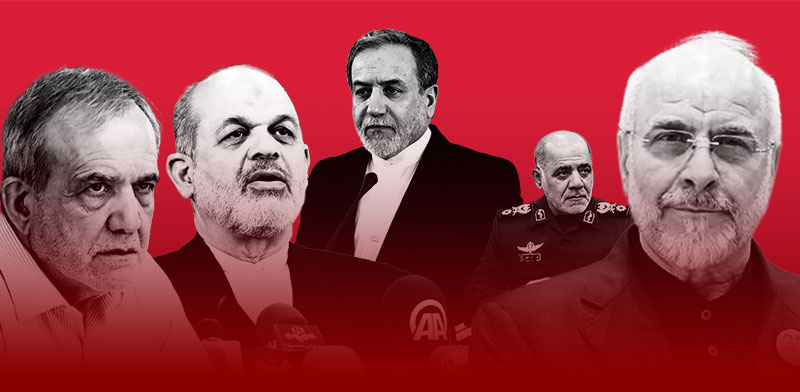
On the one hand, there is the more radical wing, which consists of two central figures: Commander of the Revolutionary Guards Ahmed Vehidi and Commander Khatam al-Anbi (Iranian Army) Ali Abdallahi Ali-Abadi. The two support an extreme conservative line, which was established over years of brutal suppression of internal protests. Among other things, Vahidi headed the special units that suppressed the hijab protest. “Vahidi is a dominant and extreme player, so it is quite clear that he has a significant say in the Iranian set of considerations,” says Sima Shein, a senior researcher and former director of the “Iran and the Shia axis” research program at INSS.
On the other side, there is the more pragmatic wing, which consists of President Massoud Pazkhian and Foreign Minister Abbas Araqchi. On paper, Arakchi, President Pazkhian’s emissary, represents Iran in talks with the US. He met with senior officials in Pakistan, Oman and Russia, and according to reports he even conveyed to Pakistan a possible framework for ending the war.
However, Arakchi and Pazkhian are not free. The head of the Iranian delegation was until recently the Speaker of the Parliament Mohammad Bakr Kalibaf – a former member of the Revolutionary Guards, who supports a more hawkish line against the West in general and the US in particular.
And here, Yitzhaky explains, the problem begins. “Each side is now pushing in a different direction, whether to reach agreements on the US and the West, what to compromise on and to what extent: from the nuclear issue to Hormuz,” he says. “Foreign Minister Arakchi really has no unequivocal authority in negotiations. He returns to Tehran with proposals, and then agreements need to be reached within Iran from a number of different parties.”
But this is not the only complexity. Parliament Speaker Kalibaf does belong to the more conservative side of the regime, but he also has various disagreements with the current commander of the Revolutionary Guards, Vahidi. Among other things, while reports indicate that Kalibaf strives to finally reach a deal with the Americans, and Vahidi pushes more in an uncompromising direction – which deepens the vacuum.
“The validity of the Halacha people in Iran has expired”
Despite the split in the Iranian leadership, Trump speaks of the rise of a “new leadership”, one that “wants to talk” with the US. And the president, it seems, is not wrong. The balance of power in Iran has changed dramatically since February 28, but not exactly as Trump presents. The Revolutionary Guards led by Vahidi, as stated the hawkish wing of the ruling elite, have become a stronger force in Iran and some argue – the de facto agenda setters.
“The validity of the Ithullah regime – that is, the rule of the halachic sages under the leadership of the supreme leader – has expired,” believes Prof. Uzi Rabi, senior researcher and head of the regional cooperation program at the Moshe Dayan Center for Middle East and African Studies at Tel Aviv University. It seems that Iran is moving from a messianic theocratic government of a wise Halachic people to a murderous military dictatorship, where the Revolutionary Guards de facto run the country.”
Therefore, Mujtaba Khamenei, assesses Prof. Rabi, is not really an effective player. “The Revolutionary Guards use him as a governing authority, but in practice he is not as influential or decisive as his father, either because of his health condition or the fact that he is at the beginning of his career. In theological terms, the rule of the religious sages no longer operates in the format we knew under Khamenei the father, that is, the party that gives the last word, and I don’t think he will return anymore.”
The balance of power has changed dramatically. Tehran, this month / photo: ap, Vahid Salemi
Another point that strengthens the status of the Revolutionary Guards led by Vahidi is the legacy left by Khamenei Sr. “On the eve of the war, Ali Khamenei did not want to come to an understanding with the Americans – or rather, did not agree to their terms. This is the legacy he left,” recalls Shane. “Therefore, opposition to concessions vis-à-vis the US after all the damage and a series of assassinations by the Iranian leadership – strengthens the position of the Revolutionary Guards at the top of the ruling elite. Any other position could be perceived as a deviation from the path of Khamenei the father.
“On the nuclear issue, for example, it can be assumed that there is more resistance among the Revolutionary Guards to taking the material out. There is an understanding that this material gives them a future option for weapons, and this is also important for them from an image point of view. The same is true for Hormuz. In the end, they are portrayed as more ideological, as a side that managed to withstand the war against the US and Israel. And for them this is a tremendous achievement internally and externally.”
Sitting on the economic cliff in Iran
The Revolutionary Guards did not take the positions of power by complete surprise. Even before the war, their arms reached all systems of government, partly because the leader strengthened them over the years by appointing radical people to key positions. At the outbreak of the war, when Khamenei Sr. died and his successor proved to be weak, the Revolutionary Guards were the only body that possessed real economic tools. And whoever controls the money, controls the power.
“While Iran itself has weakened, the Revolutionary Guards have only grown stronger in the war against the US and Israel,” says Ella Rosenberg, a researcher specializing in Iran’s economy and terrorist financing at the Jerusalem Center for Foreign and Security Affairs (JCFA) and a member of the Deborah Forum. Precisely during this important period, they manage the entry and exit of money.
“Along with networks of fictitious associations, shadow banking and other indirect channels, the Revolutionary Guards have a card in their hands that is hardly talked about – the Iranian Central Bank. The Central Bank is officially a government body, but in practice it is directly controlled by the Revolutionary Guards. The Central Bank supervises all financial authorities in Iran. Large companies such as the state-owned oil company Newok, are fully controlled by the Revolutionary Guards.”
And if that’s not enough, the same armed force also controls Hormuz – one of the main cards discussed in the talks with the US. The decisions regarding its closure or collection of funds for the passage of ships are in the hands of Vahidi and his partners, and not in the hands of the diplomatic staff. “To a large extent,” says Rosenberg, “this does indicate that the operational autonomy of the Revolutionary Guards has expanded. In the end, those who manage the army, the industries, the nuclear and especially the economy at the most critical moments in the history of the current regime are the Revolutionary Guards, and therefore their status has improved dramatically.”
For your attention: The Globes system strives for a diverse, relevant and respectful discourse in accordance with the code of ethics that appears in the trust report according to which we operate. Expressions of violence, racism, incitement or any other inappropriate discourse are filtered out automatically and will not be published on the website.
https://jeetbuzz-bd.net/how-to-bet/
https://jeetbuzz-bd.net/kyc-aml-policy/
https://jeetbuzz-bd.net/licence/
https://jeetbuzz-bd.net/live-casino/
https://jeetbuzz-bd.net/login/
https://jeetbuzz-bd.net/magic-ace-wild-lock-by-jdb/
https://jeetbuzz-bd.net/mega-fishing-by-jili/
https://jeetbuzz-bd.net/mini-roulette-by-spribe/
https://jeetbuzz-bd.net/mma/
https://jeetbuzz-bd.net/money-coming-by-jili/
https://jeetbuzz-bd.net/money-pot-by-jili/
https://jeetbuzz-bd.net/money-time-by-pragmatic-play/
https://jeetbuzz-bd.net/payment-methods/
https://jeetbuzz-bd.net/piggy-bank-by-jdb/
https://jeetbuzz-bd.net/policy-privacy/
https://jeetbuzz-bd.net/promo-code/
https://jeetbuzz-bd.net/referral-program/
https://jeetbuzz-bd.net/registration/
https://jeetbuzz-bd.net/responsible-gaming/
https://jeetbuzz-bd.net/royal-ace-by-yellow-bat/
https://jeetbuzz-bd.net/royal-fishing-by-jili/
https://jeetbuzz-bd.net/rummy-by-jili/
https://jeetbuzz-bd.net/slots/
https://jeetbuzz-bd.net/sponsor-delhi-bulls/
https://jeetbuzz-bd.net/sponsor-montreal-royal-tigers/