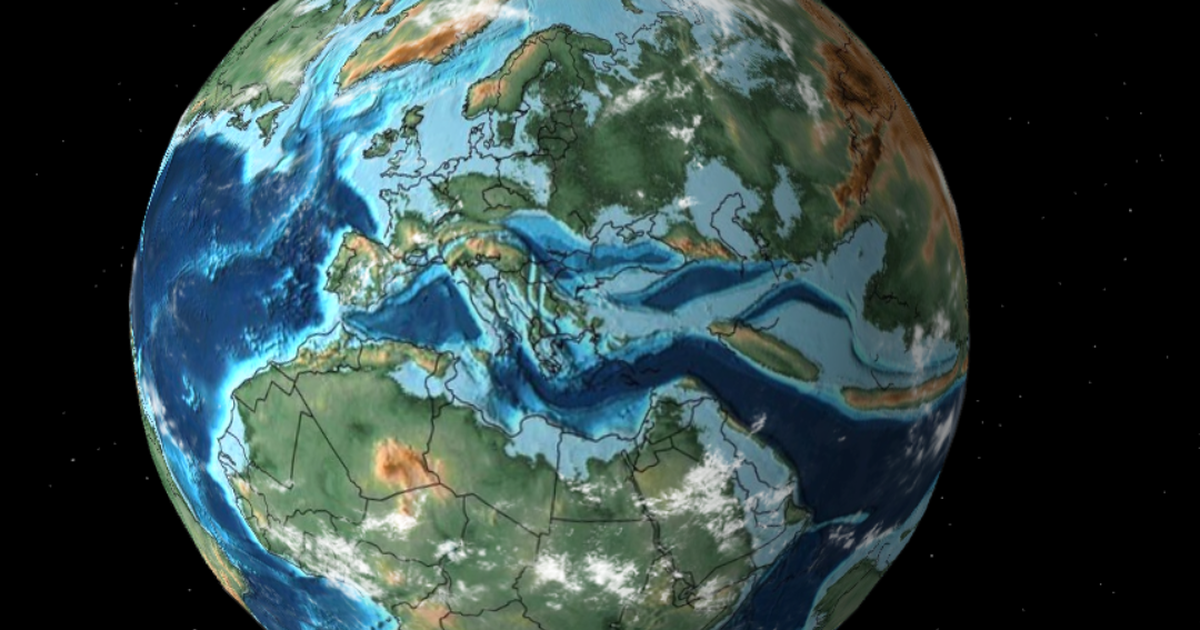
Have you ever wondered where your neighborhood was at the time of the supercontinent Pangea? Was there once a tropical sea, a volcanic wasteland or an ice cap under your house? Thanks to new interactive tools, you can now get the answers to these questions in just a few clicks, traveling hundreds of millions of years into the past without leaving your home. Two new projects allow users to explore the Earth’s tectonic journey and discover the ancient location of any present-day site, Science Alert writes.
Watch the video
Solving a geological puzzle
One of these revolutionary tools is Paleolatitude.org, a platform developed by researchers from Utrecht University in the Netherlands. The project was born from a geographical puzzle. Studying fossils in the Dutch quarry Winterswijk, geoscientists found remains of flora and fauna that looked like they belonged to the area of today’s Persian Gulf.
This opened a key question: was the whole world then a hot sauna or is the explanation elsewhere?
The answer lies in plate tectonics. Latitude determines the angle at which the sun’s rays fall on the surface and thus directly affects the local climate. The new model confirmed that 245 million years ago the Netherlands had a desert climate not only because the planet was warmer, butć because that land mass was physically located at the same tropical latitude as today’s Persian Gulf.
The tool thus helps scientists distinguish whether ancient environmental changes were caused by global climate changes or simply by the movement of continents.
How does a digital time machine work?
To reconstruct the travel of the continents, the scientists used a two-step method. First, figuratively speaking, they “unrolled” the mountain ranges to see how the tectonic plates moved relative to each other. This process has helped to identify traces of long-lost continents, such as the Great Adria, Argoland and the Tethys Himalayas, land masses that were swallowed by the Earth’s mantle long ago, but left their “imprints” in the folded rocks of the Mediterranean and Indonesia.
The second step was to determine the exact latitude of these plates by analyzing magnetic minerals trapped in ancient rocks. Since the angle of the Earth’s magnetic field changes from the poles to the equator, these minerals act as a prehistoric GPS. They enable scientists to determine the original location of the rock on the globe and track its journey over millions of years.
- This means that for the first time a truly global model is available that allows you to connect these rocks with their original plates, which have since disappeared into the Earth’s mantle. Now it is possible to follow the global journey of these rocks – pointed out Professor Douwe van Hinsbergen, head of the study.
A map that goes even further into the past
For those who want to travel even deeper into the past, software engineer Ian Webster has created an interactive map called Ancient Earth. This tool allows users to enter their address and see where it was located up to 750 million years ago.
The results are fascinating: 240 million years ago, the area of present-day Washington was almost adjacent to the coast of Mauritania, before the Atlantic Ocean separated them. 750 million years ago, downtown Manhattan was in the middle of a huge icy land mass.
Webster’s tool is based on data from the PALEOMAP project, led by paleogeographer Christopher Scotese, and offers additional features, such as a list of dinosaurs that ž lived near the entered location.
In addition to satisfying the public’s curiosity, these tools are extremely valuable to paleontologists. By pinpointing the exact historical locations of fossil-rich rocks, researchers can analyze how species responded to ancient mass extinctions and sudden temperature changes. This “three-dimensional” approach reveals which latitudes served as refuges and which became uninhabitable.
- With the new model, we have much greater certainty, and our understanding of biodiversity goes from one-dimensional, i.e. only through time, to three-dimensional, which encompasses space as well – explained study co-author Dr. Emilia Jarochowska.
“It allows us to draw important lessons about biodiversity resilience today.”
*with the use of AI
http://zanib.org/index5593-396.html
https://awma.hotzamon.xyz/u5zx/21
https://domena-wykladziny.pl/jak-przygotowac-podloze-pod-wykladzine-pcv/
https://viralnewsnetwork.net/the-most-effective-way-to-boost-your-social-media-profile-buy-real-instagram-likes/
https://ehdzj.ttgdqp.xyz/ymM918a699975/
https://r84gmwwqh7.jobprobd.xyz/3Hww725d799274/
https://notes.bolha.tools/s/k9y-X43Y4
https://blog.graphask.com/2025/06/26/social-analytics-tools-are-crucial-for-successful-instagram-marketing/
https://ooz.fxccdn.xyz/d52g/45
https://doc.interscalar.eu/s/5t-zHhXxT
https://akmobilesolution.com/the-road-to-stardom-tips-for-becoming-instagram-mega-famous/
https://indydiscoverynetwork.org/tips-on-how-to-buy-instagram-followers/
https://redsnowcollective.ca/wordpress/open-44/
http://www.sportsauthenticjerseyshop.com/index1448.html?page=10
https://graphicsunion.info/reach-more-people-instantly-by-investing-in-instagram-followers/
http://e-zekiel.tv/system/media/play.asp?id=30216&key=00260E4D-6870-45C4-8498-79C4CDD71F55
https://nds.brewology.com/forum/viewtopic.php?f=152&t=37033&p=229065
https://refundfees.com/eldorado-6/comment-page-200/
https://janeredmont.com/2026/01/07/masslinker-com-software-to-publish-your-own-7/
https://secure2.websrvcs.com/system/media/play.asp?id=30216&key=000AB1DC-85F9-426B-98F5-B14B82456856
https://ovdvc.azizulhakiminquiry.xyz/lxj/
http://comidaeseducao.com.br/index.php/2020/02/22/lassu/
https://q7teotbsjs.lakuuu.xyz/WoyS62d399841/
https://urbandigital.id/bagaimana-membuat-bio-instagram/
https://kochamy-dywany.pl/perski-dywan-jako-waluta-dywany-w-handlu-historycznym/