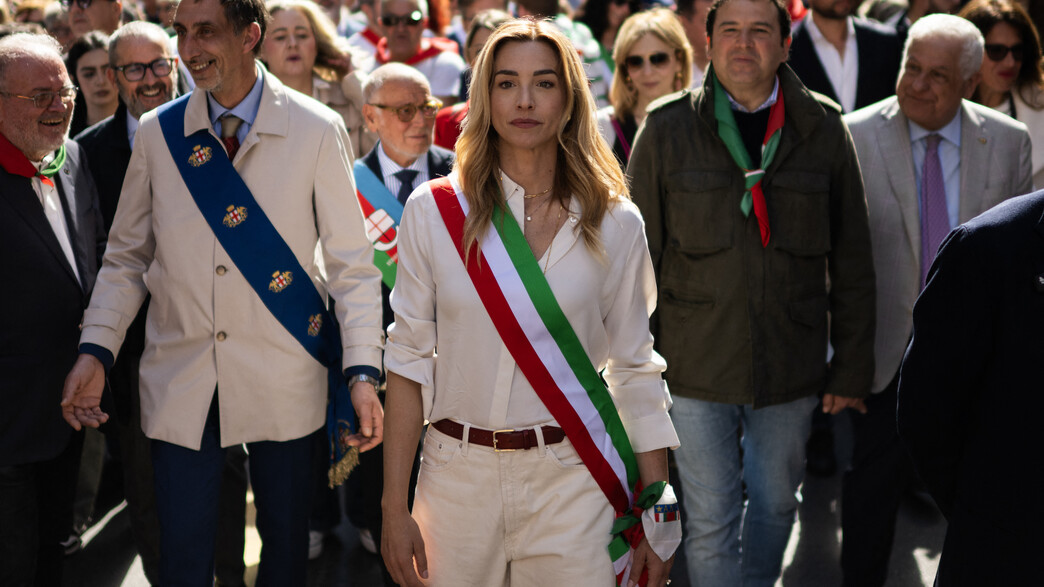
The political left in Italy, considered for years to be divided and lacking clear leadership, has recently found a new figure who is attracting increasing attention in the national arena. Silvia Salis, mayor of Genoa and former Olympic athlete, appears to be one of the prominent candidates who may challenge Prime Minister Giorgio Maloney in the near future.
Salis, 40, burst into the public consciousness earlier this month when she was at the center of an unusual event in Italian politics. She organized a big techno party in a central square in Genoa, and was even recorded celebrating at the DJ stand. The photos from the event were quickly circulated on social media and highlighted the gap between her and Maloney, who at the beginning of her term campaigned against illegal rave parties.
The timing of her entry into the national political scene is particularly interesting. Maloney suffered a severe defeat in a referendum on judicial reforms in March, which strengthened the sense of security among the opposition parties, and made her particularly vulnerable. Suddenly, the left began to believe that they had a real chance of winning the next general election, which is expected to be held by the end of next year. However, to get there, they need a candidate who can unite the camp.
According to a publication on the Politico website, Salis herself has not yet announced clear intentions. At the beginning of March, she admitted in an interview that she would be dishonest if she said she was not interested in national politics in the future, but since then she has been more cautious. According to her, the residents of Genoa elected her to serve as mayor, and she is committed to this position at this time.
Despite the caution, the data indicate a positive trend for her. A recent survey revealed that a list headed by her, although it does not actually exist yet, may receive about 6.5% of the votes at the national level. Such a result would have brought the left bloc to about 45.5%, very close to the right bloc which stands at about 46.8%. At the same time, media outlets affiliated with the right began to attack her almost daily, a sign that she is already causing discomfort among parts of the establishment who see her as a target.
In the internal arena of the left, the main candidates for internal competition are Eli Schlein from the Democratic Party and former Prime Minister Giuseppe Conte from the Five Star Movement. Salis, for her part, clarified that she is not interested in participating in the primaries or even voting in them, which increases the estimates that she may enter the race at a later stage.
According to her, the right way to choose a candidate is through agreement between the parties and not through an internal struggle. She even hinted that the model in which she was elected mayor of Genoa, while uniting forces between the center and left parties, could serve as an example at the national level as well.
Salis emphasizes that unity is the key to political victory. From her experience as an athlete, she claims that success requires sacrifice and the ability to compromise. According to her, the main problem of the left is not the identity of the leader – but the inability to present a unified and convincing front to the public.
Like Meloni, Salis also presents herself as a “normal” character who grew out of everyday life in Italy. She grew up in a modest family and began her journey in the world of athletics, where she won ten Italian championships in the hammer throw and participated twice in the Olympic Games. An injury interrupted her career before the 2016 Rio Olympics, after which she served as vice president of the Italian Olympic Committee, before entering local politics as a compromise candidate.
At the same time as her rise, she also faces criticism, including reference to her appearance and clothing style. Her critics mock her fashion choices, but she replies that this is a phenomenon of misogyny in politics, where women are judged on a personal basis instead of professionally.
In an attempt to bring the discussion back to the essence, Sallis points an accusing finger at the Maloney government on issues such as security, poverty and health, and even criticizes the support Maloney expressed for US President Donald Trump. In addition, she claims that Maloney’s tenure did not lead to a real improvement in the status of women.
In her position as mayor of the municipality, Salis promoted initiatives of a progressive nature, including registering children born to lesbian couples outside of Italy, opening a municipal office for LGBT rights, and introducing a minimum wage in municipal contracts. Alongside this, in the past year she has made a certain shift towards the center, with an emphasis on issues such as health, work, security and immigration, based on the notion that the left should focus on practical issues.
https://openlibrary.org/people/crystaltableware
https://www.myvidster.com/profile/cahepe4142
https://forum.mygolfspy.com/profile/135897-oliver-davies/?tab=field_core_pfield_15
https://www.blackhatworld.com/members/sogan18.2032596/#about
https://www.dualmonitorbackgrounds.com/mikerezz/
https://log.concept2.com/profile/2345081
https://www.playbook.com/s/worldiqtest/K7aLmfmq4KmBqvFnnQR9YC3b
https://worstgen.alwaysdata.net/forum/members/worldiqtest.172836/#about
https://forums.servethehome.com/index.php?members/sogan182.131688/#about
https://www.viewbug.com/member/WorldIQTest
https://www.smartmoneymatch.com/papusa.midler
https://oldminibikes.com/forum/index.php?members/mikonas22.90994/#about
https://solo.to/worldiqtest
https://www.zubersoft.com/mobilesheets/forum/user-135000.html
https://www.findtheneedle.co.uk/companies/worldiqtest
https://www.bizify.co.uk/child-care-services-and-elementary-and-secondary-schools/ullapool/SW1A-1AA/worldiqtest
https://www.giveawayoftheday.com/forums/profile/1809166
https://fyers.in/community/member/lzN6qqE0t2
https://apptuts.bio/worldiqtest-259996
https://spinninrecords.com/profile/WorldIQTest/following/