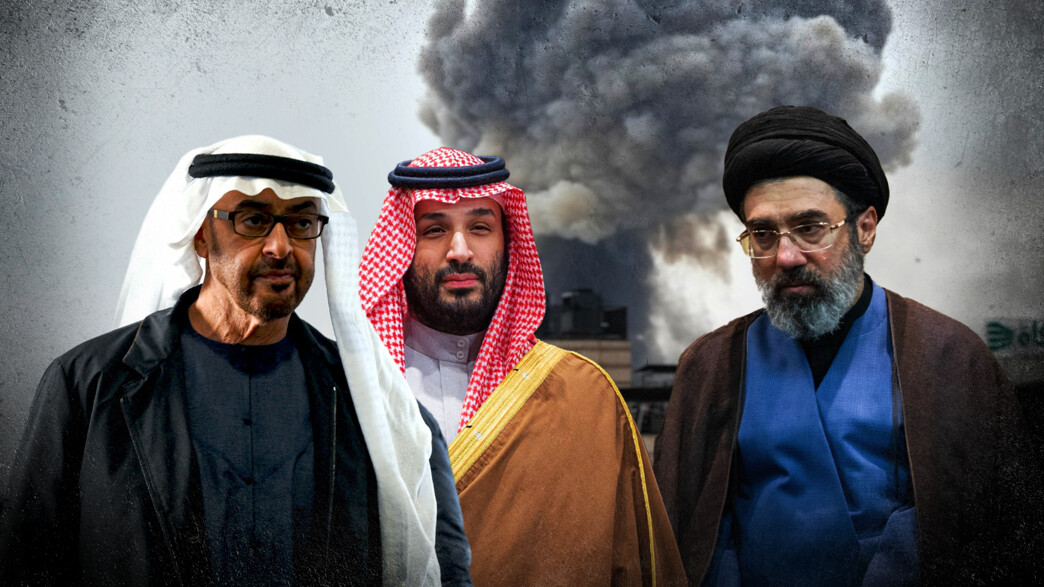
In the last day it was reported that Saudi Arabia and the United Arab Emirates attacked Iranian territory during the war, and at the beginning of the campaign we reported that Qatar also carried out an attack of its own • The attacks reflect a new and unprecedented phase in relations and the balance of power in the region • The US welcomed the attacks • Also: the various interests in the Gulf
From the beginning of the war, the Iranian strategy was to involve the Persian Gulf countries in the campaign. In the face of thousands of missiles and UAVs launched at them, Arab countries in the region made it clear publicly that they were not an active part of the fighting. But reports from the last few days reveal the secret and direct reactions of those countries against Iran – an unprecedented escalation in relations between Iran and its neighbors and an internal campaign in the Persian Gulf.
According to various reports, Saudi Arabia, the United Arab Emirates and Qatar directly attacked Iran during the war. Danny Sitrinowitz, an expert on Iran and a senior researcher at INSS, explains that the purpose of the attacks is to provide an internal signal to the local public, and an external signal to the world and Iran, that those countries will respond militarily to attacks on their territory. However, he emphasizes that they still aim to avoid a broad direct war with Tehran.
The United States has welcomed the attacks by the Gulf states on Iran, the Wall Street Journal reported. It seems that an escalation in relations between the Gulf countries and Iran also serves Israel’s interest, since such an escalation may isolate Tehran and bring Jerusalem and the Gulf capitals closer together.
The subsequent reports on the attacks by Saudi Arabia and the United Arab Emirates
The Wall Street Journal reported yesterday that the United Arab Emirates attacked Iran in early April, shortly before the ceasefire was announced, and that the targets of the attack included a refinery on Lawan Island in the Gulf. The attack caused a major fire that shut down much of the refinery’s production capacity for months. Iran said that the refinery was attacked by an enemy attack, and in response it launched a barrage of missiles and UAVs against the United Arab Emirates and Kuwait. On the same day of the attack, on April 8, after the cease-fire began, the media in Iran reported that the United Arab Emirates was behind the attack.
Iran focused much of its fire on the United Arab Emirates, attacking it with more than 2,800 missiles and UAVs – far more than any other country. The attacks severely damaged the Emirates’ civil aviation, tourism and real estate market, and led to a wave of layoffs.
Yesterday, a day after the publication of the attacks by the United Arab Emirates, it was reported in the Reuters news agency that Saudi Arabia also attacked Iran during the war. Citrinowitz estimated that the proximity of the publications implies a competition between the two countries.
According to the report, the Saudi military action against Iran included a series of attacks carried out by the kingdom’s air force. They took place at the end of March in response to Iran’s large-scale attacks on Saudi Arabia, including on its oil infrastructure.
At the beginning of March, we reported that Qatar also attacked Iran at the beginning of the war. The publication was not approved in the country. It should be emphasized that experts estimate that while the Gulf states have the ability to hit Iran, the additional power they provide to Israel and the United States is not very significant in the campaign.
The interests behind the attacks
Although it was revealed that the three Gulf states attacked Iran during the war, it seems that each of them’s approach to Iran and the war remains different.
The United Arab Emirates has positioned itself as the most hawkish country towards Iran among the Gulf countries. Reuters reported that the purpose of the attack was to exact a price from Iran, and the countries hold diplomatic dialogue only rarely. Abu Dhabi also maintains the closest cooperation with Israel among the Gulf states, which includes official relations and wartime cooperation that included placing Iron Dome batteries on the country’s territory. The UAE’s public statements towards Iran are also the strongest.
On the other hand, Reuters reported that even after the attacks, Saudi Arabia tried to prevent the escalation of the conflict and maintained continuous contact with Iran, including through Tehran’s ambassador in Riyadh. Saudi Arabia notified Iran of the attacks, and an intense diplomatic effort followed, along with Saudi threats of further retaliation. This led to understandings between the two countries on de-escalation – and according to official data from the Saudi Ministry of Defense, the number of Iranian attacks dropped dramatically in the days that followed.
Qatar, for its part, has in the past two weeks become the main mediation channel between the US and Iran in an attempt to reach an agreement to end the war, our correspondent Barak Ravid reported. For a long time, the Qataris did not want to mediate between the countries, but a few weeks ago, under pressure from President Trump on the Emir of Qatar, they returned to mediation efforts. The Qataris are using their connections with senior members of the Revolutionary Guards, generals who are close to making decisions regarding negotiations between the US to Iran, and this is how they try to influence and reach an agreement.
The attempted invasion of Kuwait
Another development in the domestic arena in the Persian Gulf occurred yesterday, when Kuwait accused Iran of trying to invade a strategic island belonging to the country. According to the announcement of the Kuwaiti Ministry of Interior, on May 1, an armed group of Revolutionary Guardsmen arrived at Bubian Island in the Persian Gulf, aboard a rented fishing boat, and exchanged fire with Kuwaiti soldiers. In the exchange of fire, a Kuwaiti soldier was injured, four members of the Revolutionary Guards were arrested and two escaped.
The Iranian Foreign Ministry rejected Kuwait’s claims and claimed that the Iranians arrived in the area “following a malfunction in the navigation system.”
The war is reshaping the relationship between Iran and the Gulf states. The willingness of Saudi Arabia, the United Arab Emirates and Qatar to act militarily against Iran is expected to have long-term consequences for the balance of power in the region, even after the end of the current conflict.
https://iszene.com/user-351054.html
https://github.com/tw1248840-blip
https://www.roton.com/forums/users/poyew77877/
https://apptuts.bio/poyew77877-263701
https://www.diigo.com/profile/yukievans
https://odysee.com/@piwimom130:8?view=discussion
https://www.clashfarmer.com/forum/member.php?action=profile&uid=81381
https://koga.net.pl/30540-voxit54779/profile.html
https://www.liraland.ua/forum/user/162480/
https://lhub.to/voxit54779
https://bandori.party/user/890517/mawes64/
https://www.kniterate.com/community/users/mawes64/
https://wemixplay.com/community/YMIR/12/597
https://swallowingdisorderfoundation.com/forum/users/wiyasi8909/
https://spiderum.com/nguoi-dung/mawes64
https://amazingradio.com/profile/safodij225
https://bots.ondiscord.xyz/lists/kUVAL_Tip
https://frcs.pro/community/members/zejonsnow69.1873/#about
https://drukarnia.com.ua/logob50228
https://app.talkshoe.com/user/logob50228
https://ummalife.com/umma1777964053
https://velog.io/@logob50228/about
https://apptuts.bio/kifise8904-264352
https://www.diigo.com/profile/woffoukigritoi96
https://codoc.jp/sites/Vd1iCy5lNw/