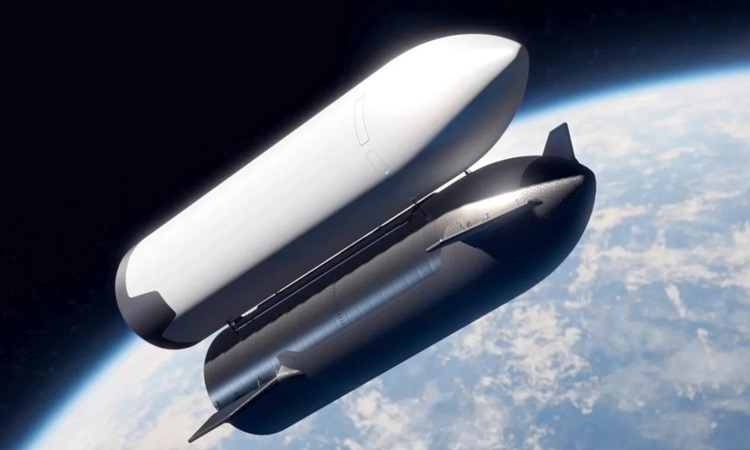
Starship V3, the most powerful rocket in history, is ready for takeoff with many important upgrades that will help the vehicle revolutionize the large payload launch market.
Theo SpaceSpaceX plans to launch the latest version of the Starship V3 super payload rocket on May 19. This is the largest and most powerful launch vehicle ever built, promising a major impact on the commercial aerospace industry if successful. Before the launch, SpaceX revealed some new details about important upgrades on Starship V3, creating a key difference from the two previous versions, V1 and V2.
Increase load
V3’s Super Heavy thruster is equipped with 33 Raptor 3 engines, expected to provide about 8.2 million kg of thrust when taking off, nearly 10% more powerful than previous generations of Super Heavy thrusters. The Ship, the upper stage of V3, uses 6 Raptor 3 engines, generating more than 1.5 million kg of thrust.
Theo Gizmodowith the above design, the payload of Starship V3 is much larger, able to carry 100 tons of cargo into low Earth orbit, far exceeding the 35 tons of Starship V2, helping to reduce the number of launches needed for large missions. With V3, SpaceX and its partners can transport larger satellites, space station modules, lunar landers and many other heavy cargo into orbit. The ability to carry more mass per flight could gradually reduce launch costs, opening up opportunities to conduct missions that are currently too expensive.
SpaceX made several upgrades to the booster stage to support increased thrust and overall performance such as redesigning the Super Heavy V3’s fuel transfer tube for faster simultaneous engine ignition during launch and landing. The company also modified the rocket’s tail (where the engine mounts) to better resist heat and integrate the fuel transfer, electrical and computer systems more tightly.
Optimize rapid reuse
SpaceX expects to launch thousands of Starship rockets each year through a combination of rapid reuse and significantly increased payload, and some of the V3’s design is geared towards that goal.
Super Heavy V3 is equipped with an integrated hot stage separation system to replace the disposable inter-stage protection structure in previous versions. To separate the stage, Starship uses a hot stage separation operation, the upper stage engine fires before the thruster stage engine is completely turned off. Instead of relying on a disposable structure to protect the thrust stage against the explosive force of the upper stage engine, the stage separation system is now mounted directly onto the thrust stage, reducing the number of parts lost after the mission and the need for post-flight repairs.
SpaceX modified the V3 booster’s mesh fin to optimize reusability. According to Orbital Todaythe first tier will have 3 fins instead of 4, each fin is 50% larger and significantly more powerful. This lattice structure contributes to the precise steering of the Super Heavy back to Earth for retrieval using a “chopstick” that allows SpaceX to reuse a booster stage multiple times.
On the upper stage of Starship V3, SpaceX made several design changes that support rapid reuse by simplifying systems, reducing exposed parts, and optimizing how the vehicle handles fuel, heat, and controls in flight. These upgrades reduce the risk of failures, shortening turnaround times between missions.
According to SpaceX, both the Ship and the Super Heavy booster stage feature advanced electronics designed for high flight rates, complete reuse and increased reliability. At the core of these two stages are 60 custom electronics units, integrating batteries, inverters and high-voltage distribution in individual packages, providing a maximum power of 9 megawatts for the entire rocket.
In-orbit refueling capability
Simulate two Starships connecting and transferring fuel in space. Image: SpaceX
SpaceX will use the Starship V3 rocket to test orbital refueling, a crucial maneuver for missions to the Moon and beyond that no other company or space agency has ever performed before. SpaceX needs to demonstrate Starship V3’s orbital refueling capability in the near future because NASA plans to use a modified version of this rocket’s upper stage as a lander for the Artemis program.
Starship V3 features a series of systems that help the two Starship vehicles connect, transfer and manage fuel safely in space. Engineers added four connecting parachutes to the underside of the upper deck along with connectors to transfer propellant between the two ships.
To keep the cryogenic fuel stable during transfer, the rocket has a specialized system to manage fuel interaction with the engine during long space flights. The new radio frequency sensor will also provide accurate fuel level measurements in microgravity to support on-orbit refueling. Achieving the above capability not only paves the way for deep space exploration but also helps reduce launch costs and extend mission duration.
https://leon-portugalonline.com/bonus
https://leon-portugalonline.com/casino
https://leon-portugalonline.com/deposit
https://leon-portugalonline.com/download
https://leon-portugalonline.com/faq
https://leon-portugalonline.com/legal
https://leon-portugalonline.com/login
https://leon-portugalonline.com/mirror
https://leon-portugalonline.com/mobile
https://leon-portugalonline.com/payments
https://leon-portugalonline.com/problems
https://leon-portugalonline.com/promocodes
https://leon-portugalonline.com/reviews
https://leon-portugalonline.com/slots
https://leon-portugalonline.com/support
https://leon-portugalonline.com/withdrawal
https://leon-ptcasino.com
https://leon-ptcasino.com/apk
https://leon-ptcasino.com/app
https://leon-ptcasino.com/bonus
https://leon-ptcasino.com/casino
https://leon-ptcasino.com/deposit
https://leon-ptcasino.com/download
https://leon-ptcasino.com/faq
https://leon-ptcasino.com/legal