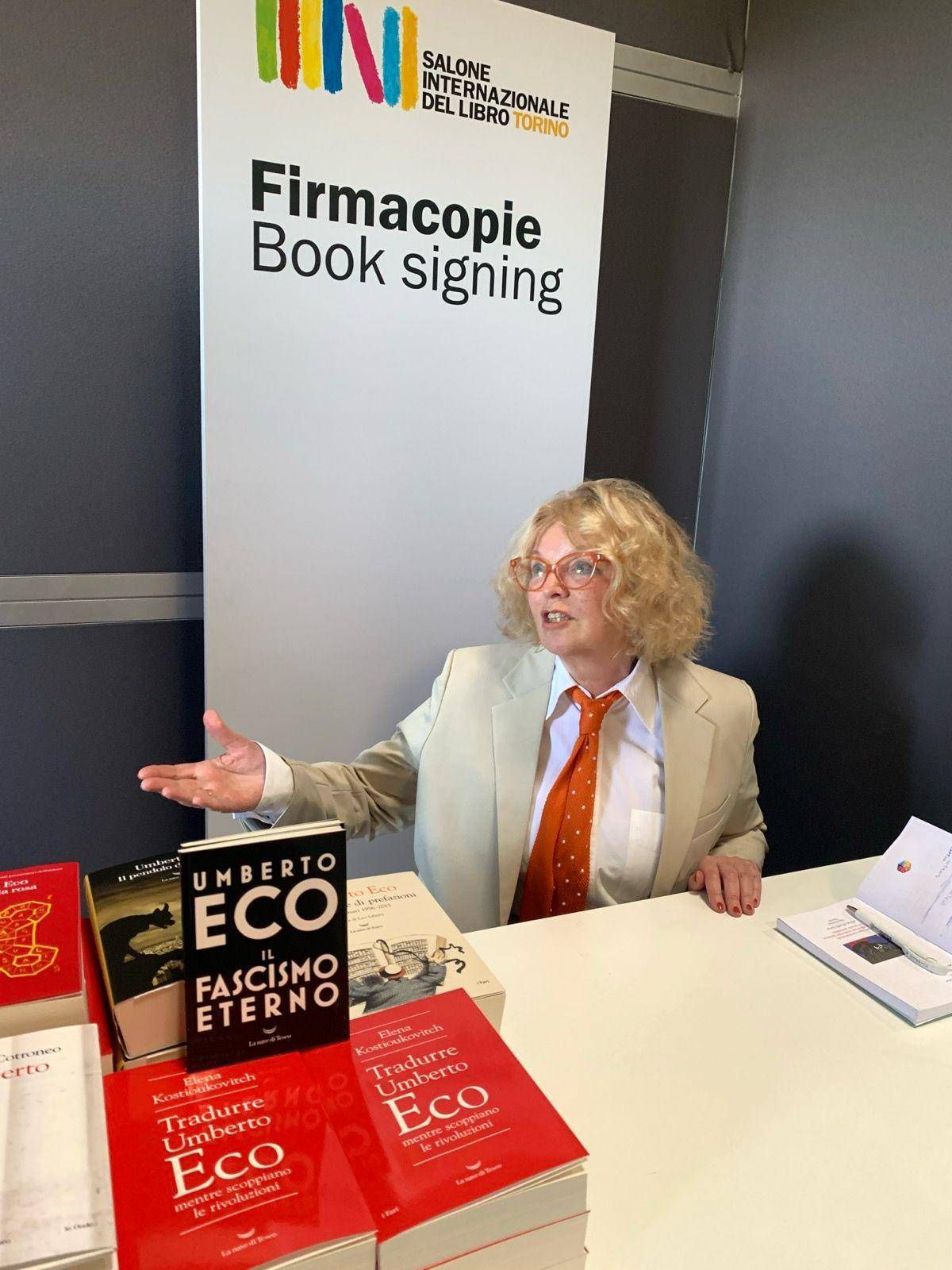
Reading Umberto Eco was banned in the Soviet Union. A sentence pronounced by Mikhail Gorbachev in 1986 opened the door for the publication, two years later, of the Russian translation of the Name of the Rose which had remained in a drawer for a long time “due to a ban on censorship”. The effect was disruptive and amplified, with the “European matter” it dealt with, the yearning for change and the questioning of the system, the first cracks in the regime destined to collapse shortly thereafter. In “Translating Umberto Eco while revolutions break out” published recently by La Nave di Teseo, Elena Kostioukovitch, translator of the works of the ‘Professor’, one of the five translators to have worked on all seven of his novels, reconstructs the editorial history of the Name of the Rose in the USSR, and the resonance between the events of William of Baskerville, ecclesiastical power in the fourteenth century and the readers of a country in which religion was instead banned and there wasn’t even a lexicon into which to translate the references to Catholicism that constitute the backbone of the text.
“When the Russian-language Name of the Rose appeared in print – in August 1988 – the reaction of readers was overwhelming,” recalls Kostioukovitch. Even in the Soviet Union, as in every other country in the world, “amazing sales” were recorded in those years, but for different reasons. Reading the Russian version of the novel had, from the beginning, a political connotation. Immediately after the publication of the text in the magazine Inostrannaya Literatura, many of the participants in the first demonstration – “unauthorised but not even forbidden” – organized to coincide with the anniversary of the events in Prague, held in their hands a copy of the magazine in which the word “aggression” was used for the first time to describe the USSR’s intervention in Czechoslovakia twenty years earlier. The incipit of the novel in fact contained a reference to the intervention of Soviet tanks, a narrative and real event – Umberto Eco was actually in Prague in those days.
It was precisely those sentences that made it impossible to publish in the USSR, where any reference to the repression carried out at the time was prohibited. But once published, it was “Europe and its history, the idea of good government, the parallel game of the three powers (aristocratic, religious and communal), the principle of the intangibility of property, Roman law, judicial procedures, the fascinating and unknown entourage of the Catholic liturgy, which aroused an indescribable wave of attention and the desire to penetrate ever deeper into the substance which through that text poured like a torrent into the language and culture Russian”, claims Kostioukovitch, recalling his effort then to “invent an ad hoc lexicon and recreate in Russian a history of distant Europe, at the same time making intuitive that political message which profoundly underpins the entire novel”.
“On August 16, 1968, a book was put in my hands […] the learned trouvaille cheered me up while I was in Prague […] six days later the Soviet troops invaded the unfortunate city” is the introduction of the Name of the Rose. “For a lucid and attentive European like Eco, that invasion could only have had a very strong, tragic and lasting impact”, sedimented until 1978, when he began to write the novel. Kostioukovitch lived in Kyiv in 1968. She was a child, but she had noticed the silences of the adults, their lowered eyes and gloomy faces. When she read instead the introduction for the first time, in 1981, was in Moscow, in the secret room with the ‘harmful books’ of the State Library of Foreign Literatures, where she worked while completing her doctorate in literature and philosophy with the task of drafting every two months a ‘résumé’ of publishing news abroad reserved for a few. It was she, who knew Eco’s semiological works, who asked for the acquisition of the Name of the Rose, after learning of the victory at the Kostioukovitch Prize he understood “immediately that that novel could never have been published in the USSR”.
In some Warsaw Pact countries, however, those words had been expunged – in Hungary and East Germany. In the Soviet Union it would have been more difficult. “It wouldn’t have been enough for me to falsify the Russian text: the logic of the Soviet censors required absolute ‘purity’, not far from that of the medieval inquisitors described by Eco. They went to directly check the original texts, making the translator’s attempts to hide some ‘challengeable’ fact pathetic.” Furthermore, the principle followed by the translators in the block “was only one: not to touch the true text, and not to allow anyone to distort it, to change even the slightest nuances”. To get around censorship, they instead resorted to a diplomacy that “remained confined to the editorial sheets and accompanying notes, in the prefaces and afterwords, in the careful use of footnotes, in the choice of synonyms ‘with cunning'”.
“I decided to stall, to see how we could avoid suppressing the Prague motif.” In fact, they were words that functioned “like a musical key placed at the beginning of the pentagram that gave meaning to all the notes that followed. The readers would have thought exactly like this: that the Inquisition was the KGB, the monastery with its library an island of culture and freedom in a world saturated with violence, that that freedom was destined to be suffocated and all that remained was to side with the suppressed. Many would have concluded, as the consultant of the Central Committee of the Pcus Henrich Smirnov, that a historical novel written by a modern progressive semiologist and dedicated to the Inquisition could only be a ‘romance a à clef'”.
When in 1986 Kostioukovitch finally proposed his translation of the novel to a publishing house, and the publishing house asked for the go-ahead from the censors, Smirnov, an Italian scholar and a translator with an unclear reputation, did not give his consent. And he accused Eco of “Eurocommunism” and “historical relativism”, the equivalent of an editorial death sentence. “Smirnov was right. The real Jorge of Burgos was not a blind monk of the fourteenth century. He was sitting in an anonymous little office of the labyrinthine central committee of the CPSU. He was the ‘devil’, as William apostrophized him. Anxious to burn every word of free thought or, on the contrary, to extinguish any doubts about his authority.”
On October 20, 1986, Gorbachev received an international delegation of writers in the Kremlin. And it emphasizes “the priority of human development interests over class interests.” “That day I was listening to radio newspapers while I was washing the dishes. I dropped one. The revolution began in that instant. After that day we saw hitherto forbidden texts appear in print”, recalls Kostioukovitch who, within a few months, managed to have an appointment with the Kyrgyz writer who led the delegation received by the General Secretary of the CPSU, Chinghiz Aitmatov, a leading exponent of the bloc’s cultural nomenklatura and director of Inostrannaya Literatura. “We had the clear sensation that it was precisely through the publication of texts coming from Europe and the United States that the most vital flows of meaning for the development of our transforming societies flowed. As if foreign literature brought with it the very oxygen of democracy.” “We immediately understood the measure of the moment. The words spoken by the General Secretary of the Communist Party were enough to turn our entire world upside down. In disbelief, we discovered that a tiny crack was opening in the Soviet monolith.”
The publication of Foucault’s Pendulum in Russia had an opposite resonance to the Name of the Rose, and was even less explored until now, in the second half of the 1990s, where an excessive reading of the text instead resonated with the first seeds of an extremism visible only many years later. “It was Eco’s second novel populated by characters intent on orchestrating a colossal lie. In Foucault’s Pendulum an alternative variant of universal history is presented as a construct”, summarizes Kostioukovitch who then hastened to translate and publish ‘Eternal Fascism’, the short essay “with the typical characteristics of what I would like to call ‘Ur-Fascism’, as the Professor presented it, which had an “explosive effect” in Russia. While the Pendulum was not received by some as a condemnation of the mystical and ignorant approach to universal history, but rather, as evidenced by enthusiastic messages arriving at the editorial office at the time, praising occultism, the Templar lodges and similar sects”.
“We were perfectly aware that it was a duty to support the Pendulum with materials capable of clarifying to readers how the novel was closely linked to the author’s intention to unmask the essence of fascism and to contribute with the strength of literature to eradicating it or at least denouncing it”. Therefore, in the same period in which Inostrannaya Literatura began to publish in installments, as with The Name of the Rose years before, Eco’s new and highly anticipated novel, ‘eternal fascism’ was published in Literaturnaya Gazeta.
At that moment, “Eco’s sentences (in ‘Eternal fascism’, ed.) were perceived as a reference to the USSR, to the past which was now believed to be definitively overcome”. “They were very wrong. As the years passed, an ever-increasing number of observers began to look with growing skepticism at the statement according to which that chapter of history for Russia is now closed”, recalls the author, citing two different articles from Novaya Gazeta, in 2009 and then in 2013, which recalled the principles listed by the Professor as a key to understanding the increasingly frequent ideological interventions in political discourse in Russia. “The difference between what the author represents with disgust and what, instead, is proposed by him as a model was not understood. The consequences of what Umbero Eco had warned us against can be seen today, dazzlingly, on the political scene”. Between Eco’s two first novels and their Russian history, the hope of an opening of Russia.
https://wefunder.com/feed/321958-body-resuscitation-after-cosmetic-repairs-where-to-look-for-the-truth
https://forums.delphiforums.com/vpshostinguae/messages/12457/1
https://steemit.com/autobodylab/@southcide/removing-rust-on-arches-yourself-mission-accomplished
https://pub44.bravenet.com/forum/static/show.php?usernum=3768885695&frmid=684&msgid=1384691&cmd=show
https://www.fitday.com/fitness/forums/weight-loss-tips/52995-paintless-dent-removal-pdr-worth-buying-chinese-kit.html#post201440
https://fpgeeks.com/forum/showthread.php/54135-The-plastic-bumper-cracked-in-the-cold-should-I-solder-it-with-a-mesh-or-buy-a-donor?p=467739#post467739
https://www.hostboard.com/forums/showthread.php?t=1231342
https://www.keepandshare.com/discuss2/47227/a-dent-from-someone-else-s-door-in-the-silpo-parking-lot-how-to-restore-beauty-without-repainting
https://latinverge.com/forums/topic/52970/bad-u-turn-in-the-yard-bumper-rubbed-against-a-post-will-pdr-sav/view/post_id/326447
https://hackmd.io/@-qUwyx1mQ7mSjT6zaIyO0Q/ryBijlckGe
https://monochrome-mint-10hfsl6.mystrikingly.com
https://pub5.bravenet.com/forum/static/show.php?usernum=370159560&frmid=1037&msgid=1024727&cmd=show
https://organiqo.com/index.php/forum/thread/26011/masking-chips-on-the-hood-before-the-summer-season-paint-completely-or-loca/
https://allaboutschool.activeboard.com/t72846782/matte-car-paint-a-stylish-trend-or-a-constant-headache-for-t/?page=1#lastPostAnchor
https://culture-informatique.net/forum/quelquun-peut-mexpliquer/restoration-of-thresholds-and-arches-after-welding-work-how-to-paint-forever/#p20442
https://bandori.party/user/961495/eryck45/
https://yipyipyo.com/forum/main-forum/110259-i-tore-off-the-bumper-mount-on-a-winter-road-how-to-restore-the-ears
https://pets4friends.com/blog/1234/cobwebs-and-deep-scratches-on-the-corners-of-the-bumper-local-painting-or-r/
https://w.bibliotece.pl/blog/entry/33516
https://stepwork.activeboard.com/t72846798/replacing-the-textured-plastic-on-the-bumper-of-a-crossover-/
https://convivea.com/forums/index.php/topic,15860.0.html
https://members2.boardhost.com/businessbooks6/msg/1778974935.html
https://www.swiatobrazu.pl/forumgaleria/thread/view/id/3573
https://muhammadali456.stck.me/post/1906979/Caught-a-body-kit-in-an-underground-parking-lot-with-a-mirror-masking-a-long-strip
https://plaza.rakuten.co.jp/terion44/diary/202605170001/