Japanese scientists successfully created a non-volatile magnetic memory, with a state switching speed of only 40 picoseconds (trillionths of a second) without generating heat or consuming much electricity.
Theo Tom’s Hardwareresearch from the University of Tokyo can overcome AI’s current technological weakness, which is the need for huge energy consumption and cooling when transmitting and storing data.
In essence, modern computers operate based on converting physical states such as on – off, charge – discharge to represent the binary system. This process takes a lot of energy and most of it is converted into heat. As AI GPU clusters scale to hundreds of thousands, power and cooling become the industry’s bottleneck.
Currently, each memory technology has disadvantages. DRAM – system memory on PCs, servers, GPUs – is used to store data as an electrical charge in small capacitors. Because the capacitors are constantly leaking electricity, the system continuously recharges the memory cells thousands of times per second, consuming energy and radiating heat even when the computer is in standby mode. Flash memory on SSD hard drives retains data when the power is turned off thanks to electronic traps, but the state transition speed is slow and also consumes a lot of energy, making it unsuitable for high-speed random access memory. SRAM, CPU cache memory, has a very fast conversion speed, takes up a lot of chip area and is expensive, making it difficult to expand to a large capacity.
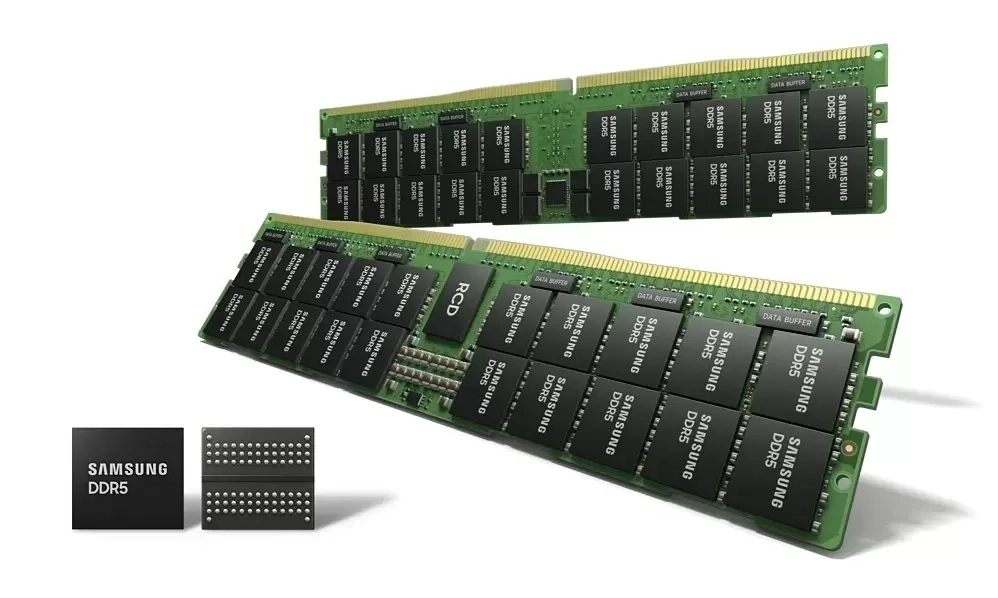
Samsung DDR5 RAM. Image:Samsung
For decades, the technology industry has been searching for a universal memory that combines the speed of SRAM, the density of DRAM and the persistent storage capacity of Flash. However, previous experimental technologies that pushed the speed to the picosecond (ps) level often had to use large amounts of heat to destabilize the state, causing the device temperature to increase by hundreds of degrees K during operation.
To solve that problem, researchers at the University of Tokyo went in a completely different direction through spintronics. Instead of storing information using an electrical charge, spintronic devices store it using a magnetic state. Instead of using conventional ferromagnetic materials such as iron and nickel, the research team used an antiferromagnetic material called Mn₃Sn. This material has adjacent magnetic moments that cancel each other out, allowing the device to switch faster, resist magnetic interference better, and shrink in size more easily.
Scientists fabricated the Mn₃Sn layer structure on a silicon substrate, then used short electrode pulses to stably switch the magnetic configuration. The key point is that this conversion mechanism does not rely on heating the material. Instead, the electrical pulses create an orbital torque effect that transfers angular momentum directly into the magnetic structure to switch states without a sudden increase in temperature.
The research team’s device achieves a state transition speed of just 40 picoseconds, 1,000 times faster than the nanosecond (ns) speed of today’s conventional memory. In the simulation, the device temperature only increased by about 8 K during operation, proving that this mechanism almost does not encounter the overheating problem like previous studies.
In particular, the research also demonstrates the ability to convert using light. The authors used a telecommunications band laser and a photodiode to generate a 60 ps photocurrent pulse, thereby changing the magnetic state of the device. This test opens up great potential for silicon photonics and optical interconnect technology, a trend that large data center operators are moving towards to move information using light instead of traditional electrical signals.
If successfully commercialized, this technology will completely eliminate the energy costs of recharging memory, reduce cooling requirements and cut power consumption when the device is at rest. On personal computers, it helps the system retain all working data without the need for sustained power, allowing for instant restarts and less heat generation. For AI infrastructure, the biggest benefit is optimizing energy efficiency and reducing cooling costs for massive GPU clusters.
However, this technology is still at the laboratory testing level in the form of a microscopic structure, not a memory chip that can be mass produced. The study also notes that the current version still requires an externally directed magnetic field to trigger the transition – a major practical limitation for commercial hardware.
The ability to scale production, durability of components, price competitiveness and integration into the CMOS chip manufacturing process have also not been addressed. Still, the research confirms the fact that future performance advances in computing will no longer depend on transistor miniaturization, but on reducing the energy needed to convert, transmit and store information.
https://www.markerzone.com/hockey/mbr/tools/pool/forum_read.php?nyx=55924&leid=76117
https://letterboxd.com/amylia654/film/cars/
https://www.marqueur.com/hockey/mbr/tools/pool/forum_read.php?nyx=55924&leid=76138
https://pub8.bravenet.com/forum/static/show.php?usernum=668694916&frmid=820&msgid=1027903&cmd=show
https://international.projectwet.org/discussion/trunk-and-spare-tire-compartment-flooded-after-dry-cleaning-and-heavy-downpour-how-save
https://matters.town/a/82nmc7lximej
https://gcmediaarts.com/sportsrap/index.php?topic=52202.0
https://www.4m.net/forum/press-releases/race-events/1696770-insurance-claim-after-a-natural-disaster
https://fendies.com/forums/topic/traces-of-large-hail-on-the-panoramic-roof-and-pillars-how-to-save-the-power-fr/
https://pub29.bravenet.com/forum/static/show.php?usernum=2449088381&frmid=70&msgid=1265523&cmd=show
https://members3.boardhost.com/gatchat/msg/1778892590.html
https://pub16.bravenet.com/forum/static/show.php?usernum=1314092243&frmid=2162&msgid=1287268
https://www.markerzone.com/hockey/mbr/tools/pool/forum_read.php?nyx=55924&leid=76080
https://slubowisko.pl/topic/116889/
https://wineintro.com/forum/ubbthreads.php/topics/439030
https://www.abitur-und-studium.de/Forum/Studieren-in-Trier/Choosing-Workshop-Lighting
https://groups.google.com/g/chilloutcalmdown/c/MBnZ8CyaWEE
https://medium.com/@tendarjony/modern-lighting-for-metal-workshops-4108afcf2985
https://tablo.com/genres/scifi/discussions/17029
https://www.hostboard.com/forums/showthread.php?t=1231357&p=2962872
https://forum.maistrafego.pt/index.php?topic=528364
https://www.ezega.com/Communities/Forums/ShowThread/54869/Barndominium-Costs-and-Benefits
https://mb.boardhost.com/minecraft/msg/1779009339.html
https://mforum.cari.com.my/home.php?mod=space&uid=3324732&do=blog&quickforward=1&id=611038
https://pub45.bravenet.com/forum/static/show.php?usernum=3788637698&frmid=11205&msgid=1077245
https://www.4m.net/uncategorized/amsoil-products/1696702-steel-building-durability
https://www.gabitos.com/DESENMASCARANDO_LAS_FALSAS_DOCTRINAS/template.php?nm=1778943778
https://convivea.com/forums/index.php/topic,15857.0.html
https://culture-informatique.net/forum/quelquun-peut-mexpliquer/workshop-building-advice/