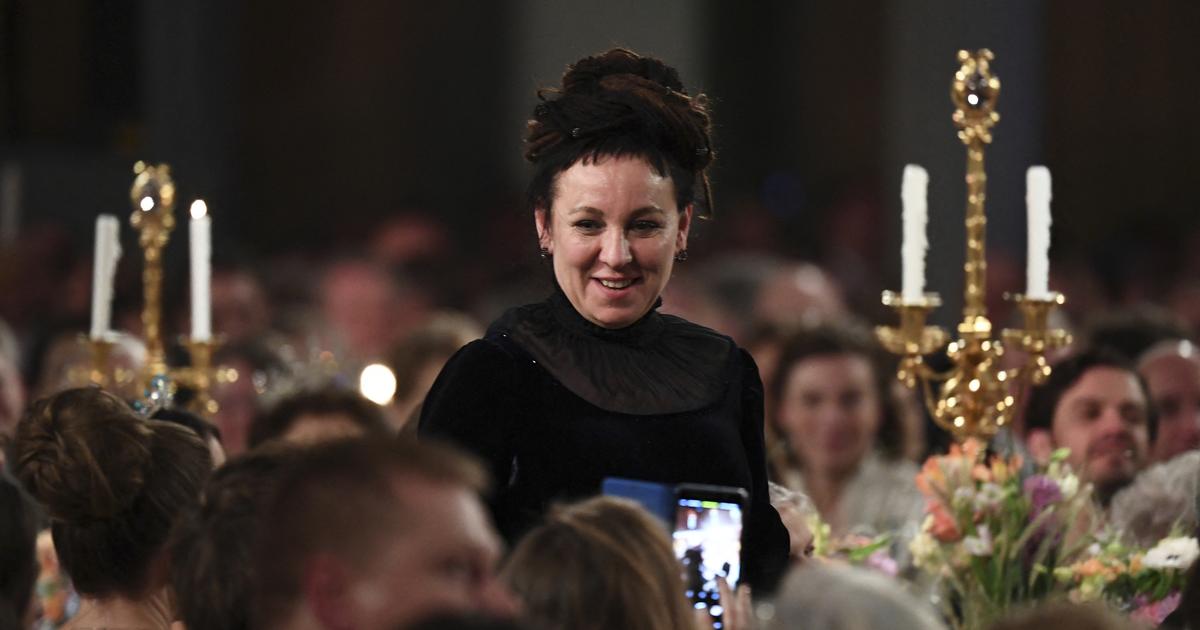
During the Poznan Forum in Poland, on May 13 and 14, the novelist explained how she uses artificial intelligence. Then she published a correction to clarify her comments and say that her next novel which will be published in the fall is not written by AI.
Winner of the Nobel Prize for Literature in 2018, the Polish Olga Tokarczuk created a certain stir during the Impact Forum in Poznan, a show which brings together actors from the economic world, artists, writers, directors to share their thoughts on the world. In this context, during a meeting, the novelist affirmed that she used artificial intelligence.
Faced with the controversy that ensued, she clarified her comments on Facebook, with perceptible annoyance. It begins solemnly and dryly with these words: “I declare briefly and firmly”. Then she develops, in three points. First, she says: “I use artificial intelligence according to the same principles as most people in the world – I see it as a tool for faster documentation and verification of facts. Every time I use this tool, I also verify the information. Just like I have done for decades reading books and exploring libraries and archives.”
Skip the ad
Second, she continues: “None of my texts, including the novel that will appear in Polish this fall, have been written with the help of artificial intelligence – except as a tool for faster preliminary research.”
With scathing irony, she concludes: “I am sometimes inspired by dreams, but before this phrase is distorted by the commentators, I hasten to say that these are my own dreams.
« Collaboration with artificial intelligence can be useful »
Olga Tokarczuk
That said, here is the question of the use that writers can make of AI raised in broad daylight. And by referring to the site My Company Poland which quotes in full the remarks she made in Poznan, we see that the subject is complex: in fact AI can be a sparring-partner extremely effective and attractive for writers. Olga Tokarczuk began by expressing sadness that many contemporary readers are put off by narrative complexity and are no longer capable of reading a long novel. She did not hide a certain discouragement: “I would like us to consider literature from an economic angle. What an effort! Not only intellectual, but above all physical. If we calculated the number of hours I spent writing The Books of Jacob (1000 page novel, editor’s note) and compared it to the salary of a worker, no publisher would buy it. And today, readers discover the end of the story thanks to the summaries ». Implied: they don’t read it to the end…
Faced with the magnitude of the poorly paid literary task, she recognizes that « collaboration with artificial intelligence can be useful » to writers. She elaborates by explaining why AI is relevant to support an author in their creative process: “Despite fears, I believe that we writers, due to the specificity of our profession, are particularly sensitive to tools like AI. Our literary mind, our literary brain, functions in a totally singular way by very extensive peripheral and associative association of facts, which differs radically from the narrow and focused vision of academics. » She then recounts that she has acquired the most advanced version of a language model and declares: “I am often deeply amazed at how this AI broadens my horizons and deepens my creative thinking.”
« In the field of fluid literary fiction, this technology is an invaluable asset”
Olga Tokarczuk
Olga Tokarczuk puts nothing on guard: “On the other hand, you have to be very careful. These exchanges with AI are captivating, and we can lose sight of the initial objective in favor of, for example, the exploration, or even the discovery, of extraordinary theories. You also have to be wary of AI hallucinations. » She gives an example. When she was writing her last novel, she asked her advanced model: “what songs could my characters have danced to at a ball decades ago? » The AI gave it some references… with an error in a title.
Skip the ad
The most thorny passage of his statements is undoubtedly this one: “I’ll often pitch an idea to the AI, asking, ‘Honey, how could we develop this so finely?’” Olga Tokarczuk points out that she knows the many factual errors that algorithms can make, but notes: “I have to admit that, in the realm of fluid literary fiction, this technology is an invaluable asset. »
Its conclusion clearly states that the use of AI by writers, even if it is reasoned and it is in no way a question of asking it to write in place of the author, is a revolution : “At the same time, I feel a deep, very human sadness for an era that is disappearing forever. My heart is heavy at the loss of traditional literature, written over months in solitude, the work of a lifetime, shaped by the mind of a fully conscious individual. »
Novels that span borders and centuries
Born on January 29, 1962 in Sülechow, Olga Tokarczuk spent her childhood in a strange phalanstery. His parents taught at the Klenica Uniwersytet Ludowy, a school in a castle in the countryside where around ten adults and around a hundred children lived who called their teachers “uncle” or “aunt”. This liberal-libertarian enclave, inspired by the principles of a Danish educator, was financed by the communist state… But the government closed the establishment in 1972. Expelled from her paradise, young Olga lived a normal life from then on. Later, she studied psychology in Warsaw. She published a first collection of poems in 1989, then hybrid novels, a patchwork of impressions, reflections, short stories, portraits, anecdotes, bizarre knowledge that the novelist connects, seeking hidden links between the most distant eras, territories and disciplines. Stories that span borders and centuries to recreate a fluid universe where everything is connected, the animal, plant and human kingdoms, the supernatural and the natural, science and mysticism.
Although they are not always very easy to read, his novels are bestsellers in his country. Before obtaining international recognition with the Nobel Prize in 2018, Olga Tokarczuk twice received the Nike Prize, the Polish equivalent of the Goncourt: in 2008, for The Pilgrims (also awarded the Man Booker International Prize), then in 2015 for Jakob’s Booksa 1,000-page novel about a sulphurous Jewish sect from the 18th centurye century.
https://www.bizmaker.org/retail/robert-miller
https://www.squeakafrica.com/christopher-allen
https://www.nethalal.com/christopher-allen/serving-the-halal-industry
https://www.apsense.com/article/881433-how-quran-translation-helps-muslims-understand-islam-better.html
https://medium.com/@goxor43185/islamic-lessons-muslims-can-learn-from-angel-jibreel-fb866ff69006
https://git.rikkei.edu.vn/makayla57o6400/makayla2019/-/issues/61
http://hiphopinferno.com/user/SamuelBrooks/wall
https://www.zonaeconomica.com/respuestas/user/SamuelBrooks/wall
https://www.czporadna.cz/user/SamuelBrooks/wall
https://www.wantoask.com/user/SamuelBrooks/wall
https://schwanger.mamaundbaby.com/user/SamuelBrooks/wall
https://www.searchdirect.ca/internet-tv/al%E2%80%91qur-an
https://www.recreationalvehicles.llc/local/al%E2%80%91qur-an
https://www.bizmaker.org/other/samuel-brooks
https://www.squeakafrica.com/samuel-brooks
https://www.nethalal.com/samuel-brooks/serving-the-halal-industry
https://www.apsense.com/article/881428-how-data-sense-helps-businesses-make-smarter-decisions.html
https://medium.com/p/540e1ee2d283?postPublishedType=initial
https://forum.amzgame.com/thread/detail?id=626671
http://hiphopinferno.com/user/RyanTaylor/wall
https://www.zonaeconomica.com/respuestas/user/RyanTaylor/wall
https://www.czporadna.cz/user/RyanTaylor/wall
https://schwanger.mamaundbaby.com/user/RyanTaylor/wall
https://www.wantoask.com/user/RyanTaylor
https://www.searchdirect.ca/it-services/data-sense